

It surprises many new electric car owners in Singapore: the big battery shows plenty of range, yet the car will not wake up, the doors will not unlock and the screen stays dark. The usual culprit is the EV 12V battery, a small auxiliary battery that sits quietly alongside the main traction pack. Understanding what it does, why it fails and how to replace it can save you a stressful morning in a multi-storey carpark.
This guide focuses only on the low-voltage auxiliary battery. For the high-voltage pack that drives the wheels, see our guide on EV battery health and habits to slow degradation.
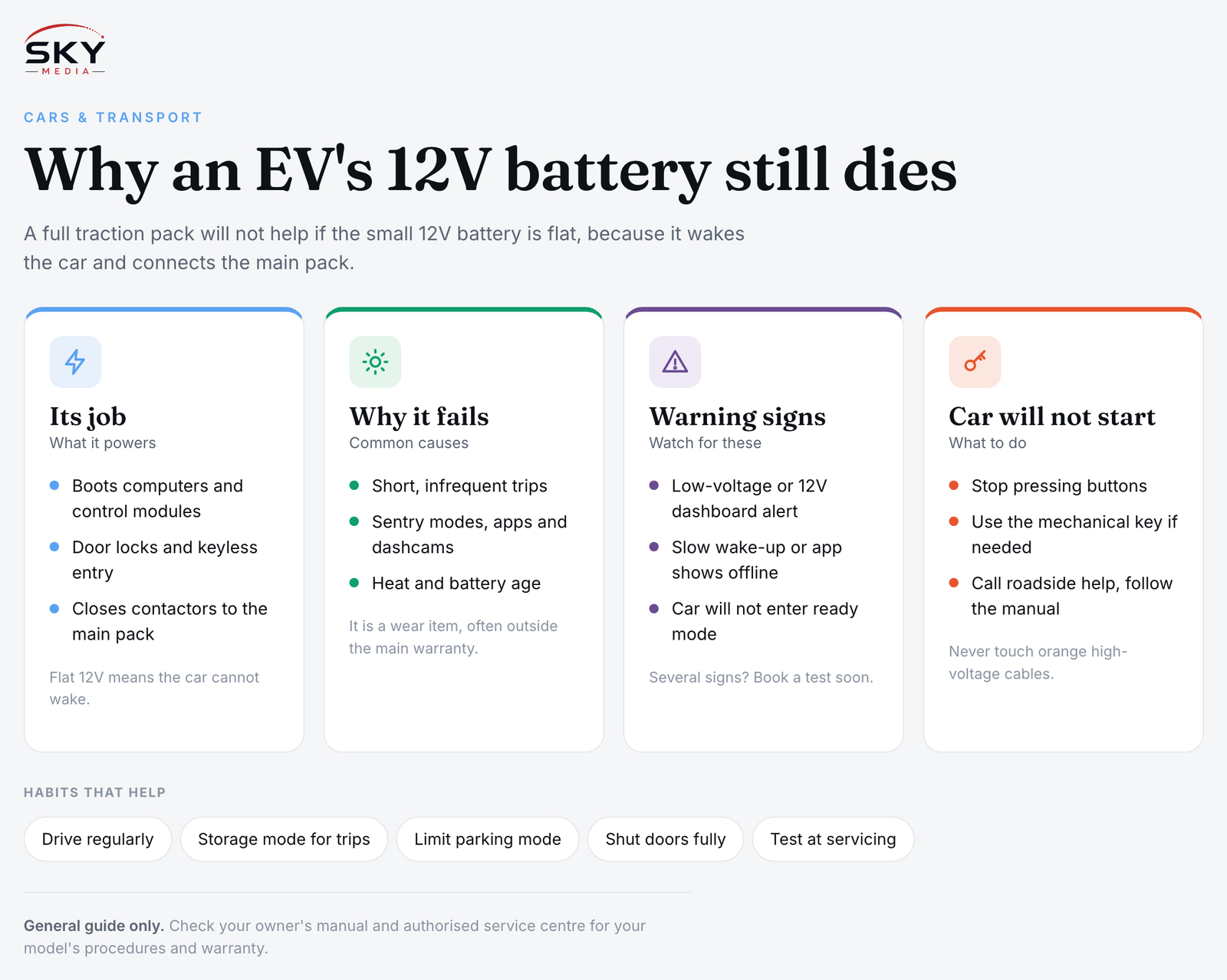
What the EV 12V Battery Actually Does
An electric car has two very different batteries. The traction battery is a large high-voltage pack that powers the motor. The 12V battery is a much smaller unit, similar in role to the battery in a petrol car, that runs the car’s “low-voltage” systems.
Typically, the 12V battery powers:
- The computers and control modules that boot the car up
- Door locks, keyless entry and the alarm
- The relays (contactors) that connect the high-voltage pack when you switch on
- Interior lights, the infotainment screen and some safety electronics
- Connected-car features that keep talking to the app while parked
That third point is the key. In most EVs, the high-voltage pack cannot connect itself. The 12V system has to “wake” the car and close the contactors first. If the 12V battery is flat, the car cannot reach its main battery, so a full traction pack does not help you.
Some newer models use a lithium-ion 12V battery, and a small number of designs have moved away from a conventional 12V unit altogether. Many EVs still use a lead-acid or AGM (absorbent glass mat) type. Your owner’s manual will say which yours has, and that matters when you replace it.
Why the 12V Battery Fails in an Electric Car
In a petrol car, the alternator tops up the 12V battery whenever the engine runs. In an EV, a DC-DC converter takes power from the traction pack and charges the 12V battery, but usually only while the car is switched on, charging, or running certain scheduled top-ups. Several habits common in Singapore can leave the 12V battery under strain.
Short, infrequent trips. Many owners drive short hops around the estate and park for days. The 12V battery may not get a full top-up.
Background power drain. Sentry or camera modes, app check-ins, remote climate control and aftermarket dashcams with parking mode all draw on the 12V system. Each one is small, but together they add up over a long weekend or overseas trip.
Heat. Lead-acid batteries age faster in hot climates. Singapore’s year-round warmth, plus a car parked in an open-air carpark, shortens battery life.
Age. A 12V battery is a wear item. It does not last the life of the car, and it is not usually covered by the long traction-battery warranty. Our explainer on EV battery warranties covers what the high-voltage warranty typically includes, and the 12V unit is normally treated separately, so check your warranty booklet.
Leaving things on. A door not fully shut, a boot left ajar or an interior light on can keep modules awake and drain the battery overnight.
Warning Signs of a Weak 12V Battery
The 12V battery often gives hints before it fails completely. Watch for:
- A dashboard message about the low-voltage or 12V system, or a “service” warning
- The car taking longer than usual to “wake up” when you approach or unlock
- Keyless entry working intermittently, or the app showing the car as offline
- Flickering interior lights or a screen that restarts on its own
- Random electrical glitches, such as windows or mirrors behaving oddly
- The car refusing to enter “ready” mode even though range looks normal
If you see more than one of these, book a check soon. Many workshops and battery service providers can test a 12V battery in a few minutes, and some EV brands schedule a 12V check as part of routine servicing.
What to Do When the Car Will Not Start
If your EV is completely dead, stay calm and work through these steps.
- Do not keep pressing buttons. Repeated attempts can drain what little charge is left.
- Use the mechanical key if needed. Many EVs hide a physical key inside the key fob and a concealed keyhole on the door. Your manual explains where.
- Check your roadside assistance. Most new EVs come with a manufacturer roadside programme for a set period, and many motor insurance policies include breakdown help. Call them first, as EVs have specific jump-start points and procedures.
- Jump start only as the manual describes. Many EVs have dedicated 12V jump terminals under the bonnet or in the front storage area, not at the battery itself. Some manufacturers advise against using an EV to jump start another car. Follow your model’s instructions exactly.
- Drive afterwards. Once the car is “ready”, keep it switched on or drive for a while so the DC-DC converter can recharge the 12V battery, then get it tested.
Never open the orange high-voltage cables or components. These carry dangerous voltages and are for trained technicians only. If there is any smell of burning, smoke or swelling, move away and call for help. Our guide on what to do about EV battery fires explains the safety steps.
Repair, Recharge or Replace: Your Options
The right fix depends on how the battery has failed. This table compares the common routes.
| Option | When it suits | What to check |
|---|---|---|
| Recharge with a smart charger | Battery drained by a one-off event, such as a light left on | Charger must match battery type (lead-acid, AGM or lithium) |
| Jump start and drive | Flat battery while you are out, car otherwise healthy | Use the model’s jump points; get a test soon after |
| Replace at the dealer or authorised centre | Car under warranty, or a lithium 12V or complex setup | Warranty terms, parts availability, any software step needed |
| Replace at an independent workshop | Older car, conventional lead-acid or AGM battery | Correct specification, and whether the car needs a battery registration step |
Some EVs need the new 12V battery to be “registered” or the battery management settings reset with a diagnostic tool, so the car charges it correctly. Ask before you book. Our general guide to car battery care and replacement in Singapore explains how to compare battery types and ask the right questions of a workshop.
Habits That Help the 12V Battery Last
You cannot make a 12V battery last forever, but you can avoid the most common causes of early failure.
- Drive regularly. A proper drive every few days helps keep the auxiliary battery topped up.
- Plan for long trips. Before travelling overseas, check your manual for a storage or deep-sleep mode, switch off camera or sentry modes, and consider leaving the car plugged in if your carpark charger allows it, since some models top up the 12V battery while connected.
- Limit parking-mode accessories. Set a dashcam’s low-voltage cut-off correctly, or use a model designed for EVs.
- Shut everything properly. Make sure doors, boot and frunk are fully closed and lights are off.
- Keep software up to date. Manufacturers sometimes release updates that improve how the car manages the 12V battery.
- Ask about it at servicing. Request a 12V test at each service, especially once the car is a few years old.
When to Seek Professional Help
If the car keeps losing 12V charge after a new battery, there may be a parasitic drain from a faulty module or accessory. This needs proper diagnostics. Go back to the dealer or a workshop experienced with your brand, and mention any accessories you have added. Battery lifespans, warranty terms and replacement procedures vary between models and change over time, so always check your owner’s manual and confirm current details with your manufacturer or authorised service centre.
Further reading: Start-Stop Car Batteries: AGM vs EFB Battery Explained