

Videos of burning electric cars spread fast online, and they leave many drivers wondering whether an EV is safe to own, park or charge in a multi-storey car park. The honest answer is that an EV battery fire is uncommon, but when one happens it behaves differently from a petrol car fire. Knowing the warning signs and the right response matters more than worrying about the odds.
This guide explains the real level of risk, why lithium-ion battery fires are different, which signs to watch for and what to do if your car starts to smoke. It is general safety information. For official guidance, refer to the Singapore Civil Defence Force (SCDF), and for charging rules, the Land Transport Authority (LTA).
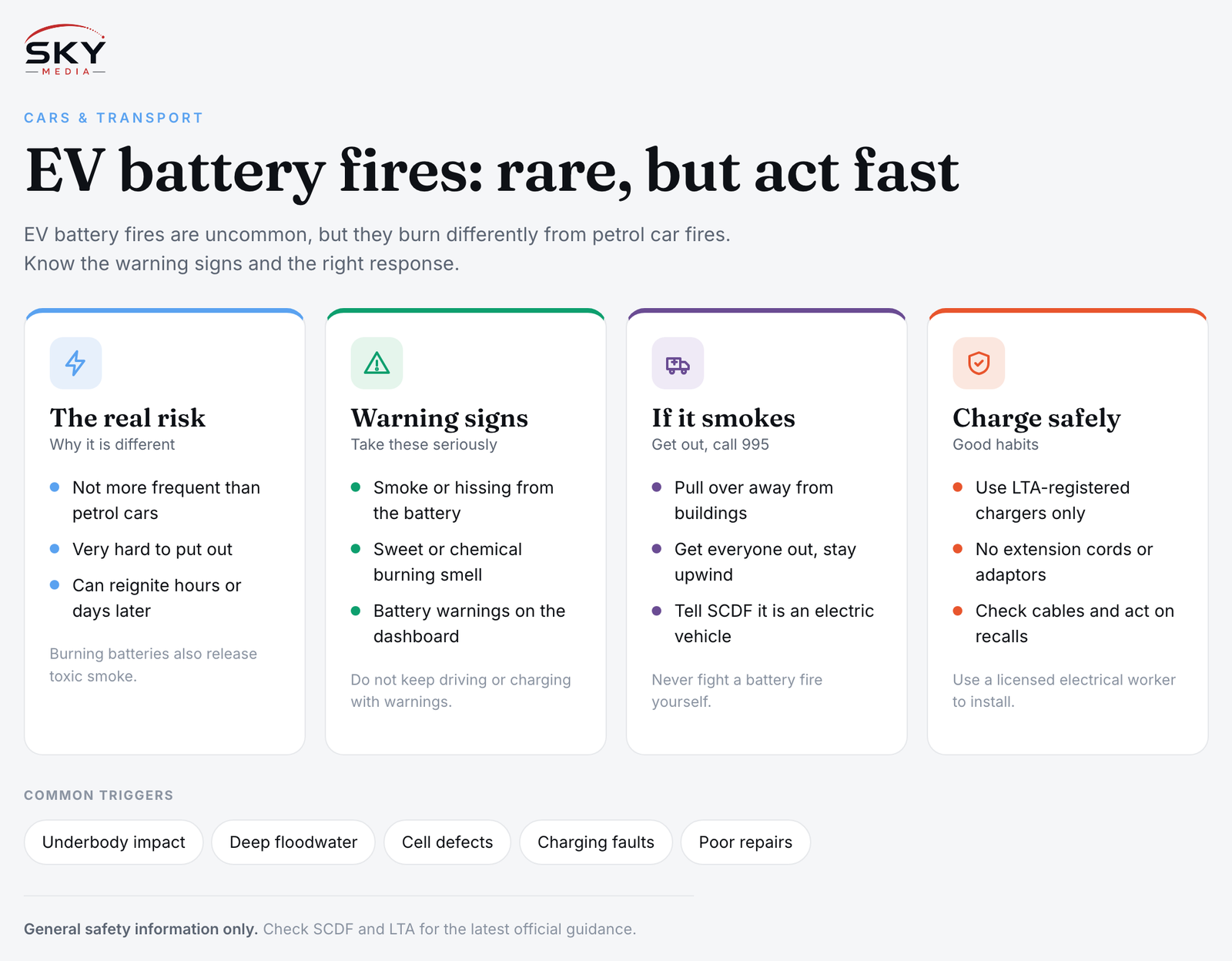
How Common Are EV Battery Fires?
Studies from several countries have generally found that electric cars do not catch fire more often than petrol or diesel cars, and some suggest they catch fire less often. Combustion cars carry flammable fuel and hot exhaust systems, which are well-known fire causes. Data is still building, though, because EVs are newer and the fleet is younger.
What is different is the nature of the fire when it does happen:
- It can be very hard to put out. A lithium-ion battery fire can keep generating its own heat.
- It can reignite. A battery that looks extinguished can flare up hours or even days later.
- It releases toxic smoke. Burning battery materials give off harmful gases.
- It can start while the car is parked, not only after a crash.
So the risk is low, but the consequences call for a careful, professional response.
Why Lithium-Ion Batteries Catch Fire
An EV’s battery pack is made of many individual cells. Fires usually begin when one cell fails and overheats in a chain reaction called thermal runaway: the heat from one cell spreads to its neighbours, which then fail too.
Common triggers include:
- Physical damage, such as a hard impact to the underside of the car, a crash, or debris striking the battery pack.
- Water damage, for example after driving through deep floodwater, especially if the pack’s seals are compromised.
- Manufacturing defects in a batch of cells, which is why recalls happen.
- Charging faults, from damaged cables, non-compliant equipment or unsafe wiring.
- Poor repairs by workshops not trained on high-voltage systems.
Good battery care, covered in our guide to EV battery health and longevity, helps the battery last, but fire prevention is mainly about avoiding damage, using proper chargers and acting on recalls.
Warning Signs to Watch For
Most battery problems give some warning. Take these seriously:
- Smoke or vapour from under the car or around the wheel arches, even a small wisp.
- Hissing, popping or crackling sounds from the battery area.
- An unusual smell, often described as sweet, chemical or like burning plastic.
- Battery or high-voltage warning messages on the dashboard or app.
- Sudden, unexplained loss of range or the car refusing to charge.
- Visible damage to the underside after hitting a kerb, road debris or a pothole.
- Heat from the floor of the cabin that is not explained by the air-conditioning or sun.
If you see a warning message but no smoke, stop safely, follow the instructions in your owner’s manual and contact your manufacturer or authorised service centre. Do not keep driving or charging a car that is showing battery warnings.
What to Do If Your EV Starts to Smoke or Burn
Act quickly and put people first. The same principles apply to any vehicle fire, with a few EV-specific points.
If you are driving:
- Pull over safely as soon as you can, away from buildings, petrol kiosks and other cars if possible.
- Switch off the car and put it in park.
- Get everyone out immediately, including pets. Leave belongings behind.
- Move well away from the car and stay upwind of the smoke.
- Call 995 for SCDF. Tell the operator it is an electric vehicle, so responders can prepare.
- Warn other people to stay back.
If the car is parked or charging:
- Do not go back to the car to unplug it if there is smoke or fire. Get away and call 995.
- In a car park, alert others and use the building’s fire alarm if one is nearby.
What not to do:
- Do not try to fight a battery fire yourself. A handheld extinguisher may tackle a small fire elsewhere in the car, but it is not enough for a burning battery pack.
- Do not open the bonnet or doors to look.
- Do not breathe in the smoke.
After the fire is out, the car should be handled only by trained responders and recovery specialists, because of the risk of reignition. Inform your insurer and the manufacturer.
Charging Safely at Home and in Car Parks
Most charging in Singapore takes place at condo car parks, HDB car parks and public charging points. A few good habits reduce risk:
- Use proper chargers only. LTA regulates EV chargers in Singapore, including registration and safety standards. Check LTA’s website for current requirements.
- Get installation done by qualified professionals. If you are installing a charger at a landed home or in a condo, use a licensed electrical worker and follow your MCST’s (the condo’s management corporation) process.
- Do not use household extension cords or adaptors for charging an EV.
- Inspect the cable and connector. Stop using damaged or overheating equipment.
- Act on recalls. Register with your manufacturer and check for safety recalls from time to time.
The table below compares good and poor practices at a glance.
| Situation | Safer practice | Risky practice |
|---|---|---|
| Charging equipment | Registered charger, installed by a licensed electrical worker | Extension cords, adaptors or DIY wiring |
| After underbody impact or flooding | Get the battery inspected at an authorised centre | Keep driving and charging as normal |
| Dashboard battery warning | Stop, check the manual, contact the service centre | Ignore it until the next service |
| Repairs and servicing | Workshops trained on high-voltage EV systems | General workshops unfamiliar with EVs |
Insurance, Warranties and After an Incident
Check what your motor insurance covers for fire, flooding and charging-related damage, as policies differ. Your battery warranty is also relevant: our guide to understanding EV battery warranties explains what is usually covered and how inspections work.
Keep records of servicing, any underbody impacts and battery checks. If something does go wrong, these records help with claims and investigations.
For fire safety beyond your car, including household batteries and appliances, see our guide to home fire safety in Singapore. SCDF’s website and its public education materials also cover vehicle fire response and are worth a read for every driver.
Official sources: Land Transport Authority (LTA)
Further reading: Preventing Lithium-Ion Battery Fires From Power Banks and Gadgets at Home · How to Handle a Minor Car Fire Safely in Singapore