

You start a run along the park connector feeling fine, and ten minutes later your chest tightens, you start coughing and every breath feels like it is coming through a straw. For many adults, this is exercise induced asthma, a pattern where physical activity triggers narrowing of the airways. Doctors often call it exercise-induced bronchoconstriction, or EIB.
The good news is that most people with this condition can keep training, including running, cycling, swimming and team sports, once they understand their triggers and have a plan agreed with their doctor. This article focuses on the practical side of exercising with asthma in Singapore: warming up, timing your medication with your doctor’s guidance, and handling the haze and heat. For the bigger picture of diagnosis and long-term control, see our guide to managing asthma in Singapore.
This is general information, not medical advice. Always follow the plan from your own doctor or polyclinic.
What Happens in Your Airways During Exercise
When you exercise hard, you breathe faster and more through your mouth. That air is less warmed and humidified than air drawn through your nose, and the drying and cooling effect can irritate sensitive airways. In people prone to asthma, the airways respond by tightening and producing more mucus.
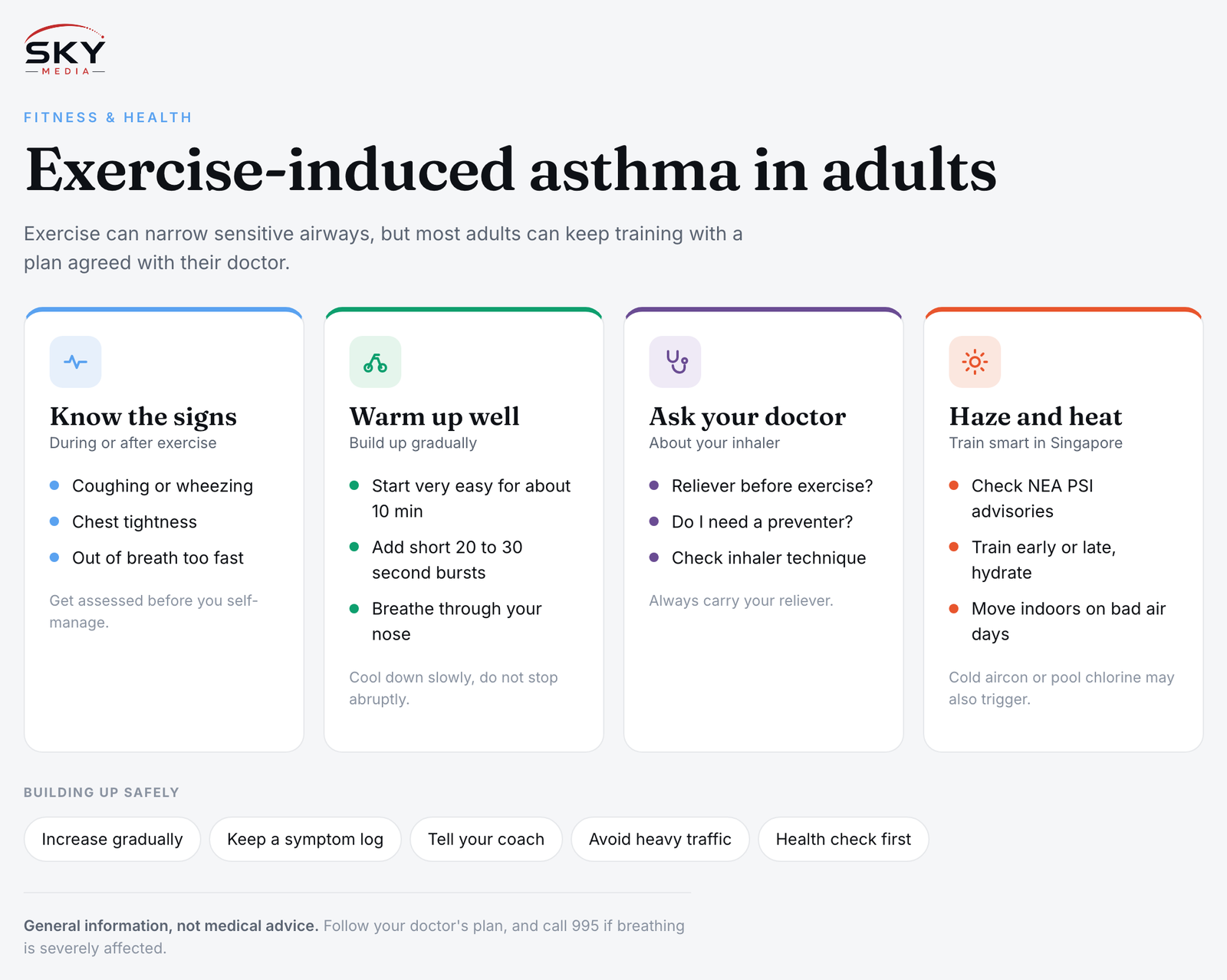
Common signs include:
- Coughing during or shortly after exercise
- Wheezing or a whistling sound when breathing out
- Chest tightness or a feeling you cannot get a full breath
- Getting out of breath much faster than your fitness level suggests
- Symptoms that peak a few minutes after you stop, then ease over time
Some adults only have symptoms with exercise. Others have underlying asthma that is not well controlled, and exercise is simply the trigger that exposes it. That distinction matters, because the fix may be better day-to-day control rather than just a pre-exercise step. Only a doctor can tell which applies to you, usually after breathing tests.
Get Assessed Before You Self-Manage
If you suspect exercise induced asthma but have never been diagnosed, see a GP or polyclinic doctor before assuming that is the cause. Breathlessness during exercise can also come from heart problems, vocal cord issues, being unfit, or other lung conditions. A doctor may arrange lung function tests and, in some cases, a referral to a respiratory specialist.
Bring useful details to the appointment:
- What activities trigger symptoms, and how soon into the session
- Whether symptoms are worse outdoors, in air-conditioned gyms, or in pools
- Whether haze, pollen, dust or a cold has made things worse
- Any family history of asthma, eczema or allergies
- Any medicines you already use
Seek urgent medical help, or call 995 for an ambulance, if someone has severe breathlessness, cannot speak in full sentences, has blue or grey lips, or their reliever inhaler is not helping.
Warm-Ups That Help Your Airways
A proper warm-up is one of the simplest tools for reducing flare-ups. Many people with EIB find that a gradual build-up of intensity makes the hard part of a session easier on their chest. Some even notice a short period afterwards when their airways are less reactive.
A practical warm-up structure:
- Start very easy for around ten minutes, such as brisk walking or light cycling.
- Add short bursts of moderate effort, for example several 20 to 30 second pickups with easy recovery in between.
- Breathe through your nose where you can during the easy part, to warm and moisten the air.
- Check in with your chest before you begin the main session. If you already feel tight, follow your asthma action plan rather than pushing on.
Cool-downs matter too. Stopping abruptly after hard effort can bring on symptoms, so ease down over several minutes rather than collapsing on a bench.
Talking to Your Doctor About Inhaler Timing
Medication is where you must follow your own doctor’s instructions exactly. We will not give doses or recommend specific drugs, but these are the questions worth raising at your appointment.
- Should I use my reliever before exercise? Some doctors advise using a prescribed reliever a short time before training. Ask how long before, and whether this is right for you.
- Do I need a preventer? If you need your reliever often, your doctor may review your daily control, since frequent reliever use can be a sign asthma is not well managed.
- What is my asthma action plan? A written plan sets out what to do when symptoms appear, get worse, or become an emergency.
- Am I using my inhaler correctly? Poor technique is common. Ask the nurse or pharmacist to watch you use it, and ask whether a spacer would help.
Always carry your reliever when you exercise, including to the gym, the pool deck and group runs, and make sure a training partner knows where it is.
Training Smart in Singapore’s Haze and Heat
Singapore’s climate brings two specific challenges for people with asthma: seasonal haze from regional fires, and heat and humidity all year round.
Haze
Fine particles in haze can irritate airways and trigger asthma. The National Environment Agency (NEA) publishes the Pollutant Standards Index (PSI) and health advisories during haze episodes on its website and the myENV app. People with chronic lung conditions are generally advised to reduce or avoid prolonged or strenuous outdoor activity when air quality is poor. Check NEA’s latest advisory for the specific guidance at each PSI band.
Heat and humidity
Heat does not trigger EIB for everyone, but it adds strain to your whole body, and dehydration can make it harder to cope with symptoms. Training early in the morning or in the evening, staying hydrated, and taking shade breaks all help. NEA also provides heat stress information for outdoor activity.
Indoor versus outdoor
Moving a session indoors is a good option on bad air days, though some people find cold, dry air from strong air-conditioning or chlorine in indoor pools also bothers them. Notice your personal pattern.
| Situation | What it can do to your airways | Practical adjustment |
|---|---|---|
| Hazy day with elevated PSI | Fine particles irritate airways | Check NEA advisory, move indoors or swap to a light session |
| Hot, humid afternoon | Raises overall strain and dehydration | Train early or late, hydrate, take shade breaks |
| Cold, heavily air-conditioned gym | Cool, dry air can trigger tightness | Longer warm-up, nasal breathing, layer up |
| Indoor pool | Chlorine fumes bother some people | Try outdoor pools or off-peak times, tell your doctor |
| Recovering from a cold or flu | Airways more sensitive for a while | Ease back in gradually, follow your action plan |
Choosing Sports and Building Up Safely
People with exercise induced asthma compete at high levels in many sports, so there is no need to give up activities you enjoy. That said, sports with short bursts and natural breaks, such as tennis, badminton or interval sessions, are often easier to manage than continuous hard efforts like long-distance running. Swimming suits some people well because the air above the water is warm and humid, while others are bothered by pool chemicals.
Tips for building up:
- Increase training volume gradually, rather than jumping into a race or bootcamp
- Keep a simple log of sessions, conditions and any symptoms to spot patterns to discuss with your doctor
- Tell coaches, instructors or running group leaders that you have asthma
- Avoid exercising near heavy traffic where you can, especially in the evening rush hour
- If you are new to a structured programme, a pre-participation health check with your GP is sensible
Living Well With Exercise-Induced Asthma
With a clear diagnosis, a good warm-up habit, an agreed medication plan and attention to haze and heat, most adults can train confidently. Review your plan with your doctor every so often, especially if your symptoms change, you start a new sport, or you find yourself reaching for your reliever more than before. Parents managing a child’s condition can also read our guide on managing asthma in children.
Official sources: HealthHub