

Being let go from a job is more common than most people admit, and it does not end a career. What matters in your next interview is how you talk about it. Employers are not only listening for what happened; they are judging your honesty, self-awareness and whether the issue is likely to repeat. This guide shows you how to explain being fired interview questions in a way that is truthful, brief and forward-looking, how to handle references, and the mistakes that cost candidates offers.
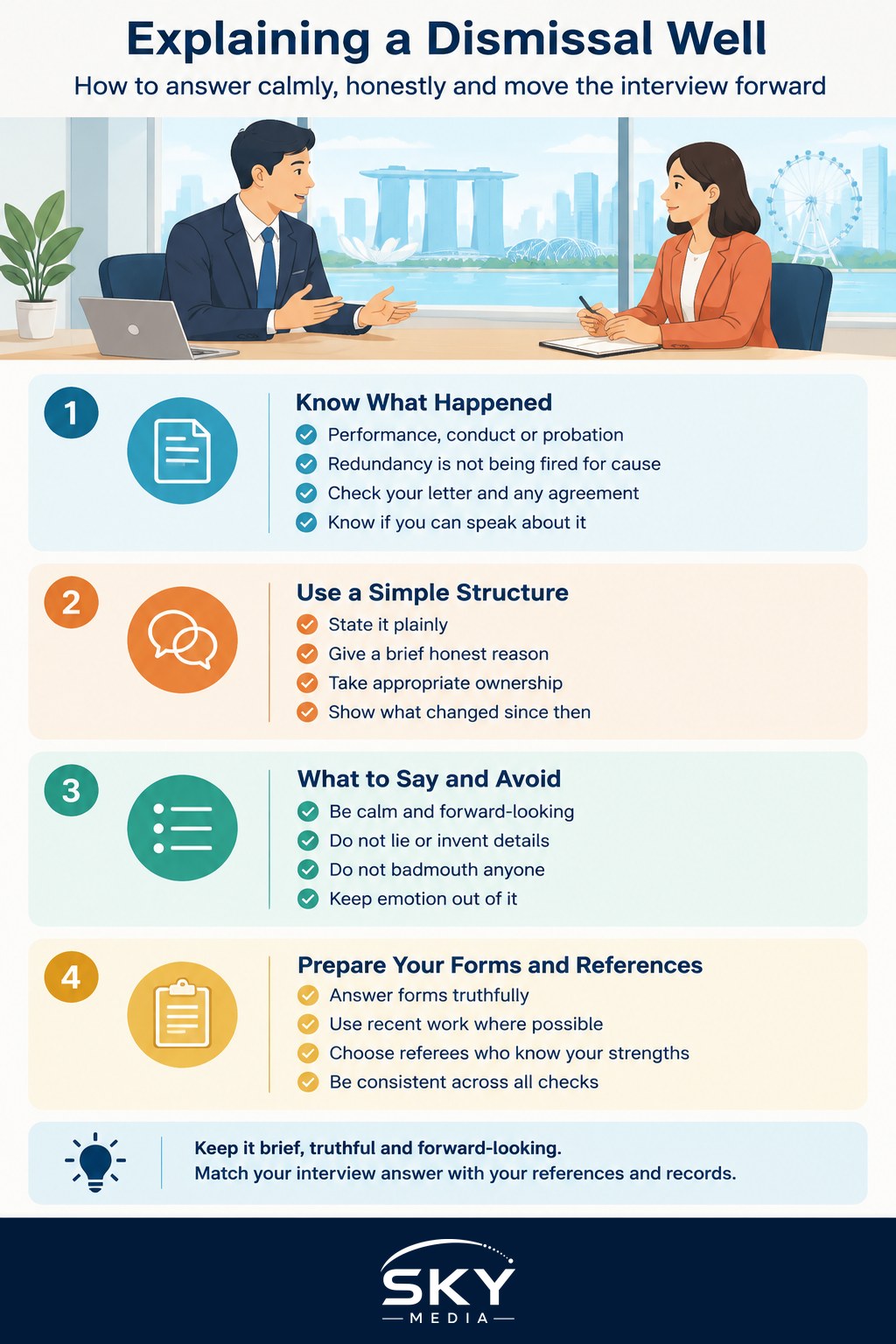
First, Be Clear About What Actually Happened
Before you prepare an answer, name the situation precisely. “Fired” covers very different events, and the right framing depends on which one applies.
- Dismissal for performance. You did not meet targets or expectations, often after feedback or a performance improvement plan.
- Dismissal for conduct. A specific incident or breach of company policy.
- Termination with notice where the employer simply ended the contract, sometimes during probation, without a single clear reason.
- Retrenchment or redundancy. Your role was cut for business reasons. This is not being fired for cause, and you should not describe it as if it were.
- Mutual separation. You and the employer agreed to part ways, sometimes with a settlement.
Check your termination letter and any agreement you signed. If there is a settlement or confidentiality clause, know what it allows you to say. If you think your dismissal was wrongful, that is a separate matter. In Singapore, the Tripartite Alliance for Dispute Management (TADM) and the Ministry of Manpower (MOM) provide information on employment disputes; check their websites for current guidance. This article is general information, not legal advice.
The Three-Part Answer Structure
A strong answer is short, usually under a minute, and follows a simple shape.
- State it plainly. “I was let go from my role at my last company.” Do not hide behind vague phrases that invite more probing.
- Give a brief, honest reason and take appropriate ownership. One or two sentences. Own your part without self-flagellation, and do not blame others.
- Show what you learned and what changed. This is where most of your time should go. Point to concrete steps, skills or decisions since then, and link them to the role you are interviewing for.
Example for a performance dismissal:
“I was let go after about a year in a sales role. Honestly, I struggled with the cold-calling volume the role required, and despite a performance plan, I did not hit my numbers. It taught me that I do my best work in account management, where I build relationships over time. Since then I have taken a course in key account management and spent four months handling renewals on a contract basis, where I retained most of my accounts. That is a big part of why this role appeals to me.”
Example for a probation termination:
“My contract was ended during probation. Looking back, the role turned out to be much more focused on data engineering than the analytics work I had expected, and I did not raise that gap early enough. I now ask far more detailed questions about day-to-day work before accepting an offer, which is partly why I asked about your team’s reporting tools earlier.”
Example for a conduct issue:
“I was dismissed after I missed a compliance step on a client file. It was a serious mistake and I accept that. Since then I have completed a compliance refresher, and I now use a checklist on every file. I would be happy to talk about how I approach accuracy now.”
Adjust the details to your real situation. Never invent courses, results or contracts; interviewers may check.
What to Say and What Not to Say
| Situation | Say something like | Avoid |
|---|---|---|
| Performance dismissal | “I did not meet the targets, and here is what I changed” | “My manager had it in for me” |
| Poor fit or probation | “The role was not the right match, and I now check fit more carefully” | Long stories about office politics |
| Conduct incident | “I made a mistake, took responsibility and put safeguards in place” | Minimising it or pretending it was minor |
| Retrenchment | “My role was made redundant in a restructuring” | Calling it being fired, which undersells you |
| Any situation | Short, calm, forward-looking | Lying, or criticising the former employer |
A few more rules:
- Do not lie. Background checks, reference calls and industry networks are more thorough than many candidates assume. Being caught in a lie about a dismissal does far more damage than the dismissal itself.
- Do not volunteer more than asked. Answer the question, then pivot to your strengths. You are not obliged to narrate every detail.
- Do not badmouth anyone. Even if you feel wronged, criticising a former employer makes interviewers wonder what you would say about them.
- Keep emotion out of it. If the topic still stings, practise aloud until you can say it evenly.
Handling Application Forms and Background Checks
Some application forms ask directly whether you have ever been dismissed. Answer truthfully. A false declaration can be grounds for withdrawing an offer or ending employment later. Where there is a comments box, add one line: “Happy to discuss at interview.”
On your CV, you do not need to write “fired” next to a role. List the job, dates and achievements as normal. Accurate dates matter, since gaps or overlaps will be noticed. If the dismissal left a gap, our guide on explaining employment gaps covers how to present that time.
Choosing and Preparing Your References
References are where a dismissal is most likely to surface, so plan ahead.
- Pick people who saw your good work. A former colleague, a client, a supervisor from an earlier role, or a manager from a different team who can speak to your strengths.
- Ask, do not assume. Contact referees before you list them, explain the role, and ask whether they are comfortable giving a positive reference.
- Understand company policy. Many employers only confirm dates of employment and job title through HR. Find out what your former employer’s HR typically says so there are no surprises.
- Be consistent. Your explanation in the interview should match what a referee or HR would say. If the stories differ, trust breaks down quickly.
- Use recent work. If you have done freelance, contract or volunteer work since the dismissal, a reference from there can carry significant weight because it shows the present version of you.
Rebuilding Confidence Before the Interview
The interview answer is the visible part; your preparation is what makes it convincing.
- Write your answer down, cut it to around 60 seconds, and rehearse it out loud with a friend.
- Prepare for the follow-up question, such as “What would your former manager say about you?” Answer honestly and balance it with strengths.
- Collect evidence of progress since the dismissal: new certifications, projects, results.
- Practise the rest of your interview just as hard. Our guide to acing job interviews in Singapore covers common questions and preparation.
If you face rejections along the way, do not take them as proof that the dismissal has ruined your prospects. Many hiring decisions come down to fit and timing. See how to reapply after being rejected if a company you like turns you down.
A clear, honest and brief explanation, backed by real evidence of growth, turns a difficult question into a chance to show maturity. Most interviewers have seen candidates bounce back from much worse. Your job is to show them you are one of those people.
Further reading: How to Explain Job Hopping on Your Resume