
Rhinoplasty, commonly called a nose job, is surgery that reshapes the nose. People choose it to change how their nose looks, to improve breathing, or both. If you are researching rhinoplasty in Singapore, this guide explains the main surgical options, what affects the cost, what recovery usually involves and how to choose a surgeon.
This is general information, not medical advice. Your own suitability, risks and expected results can only be assessed by a qualified doctor after a consultation. If you are considering a temporary, injection-based change instead, see our separate guide to nose fillers and nose thread lifts, which covers non-surgical options.
Types of Surgical Rhinoplasty
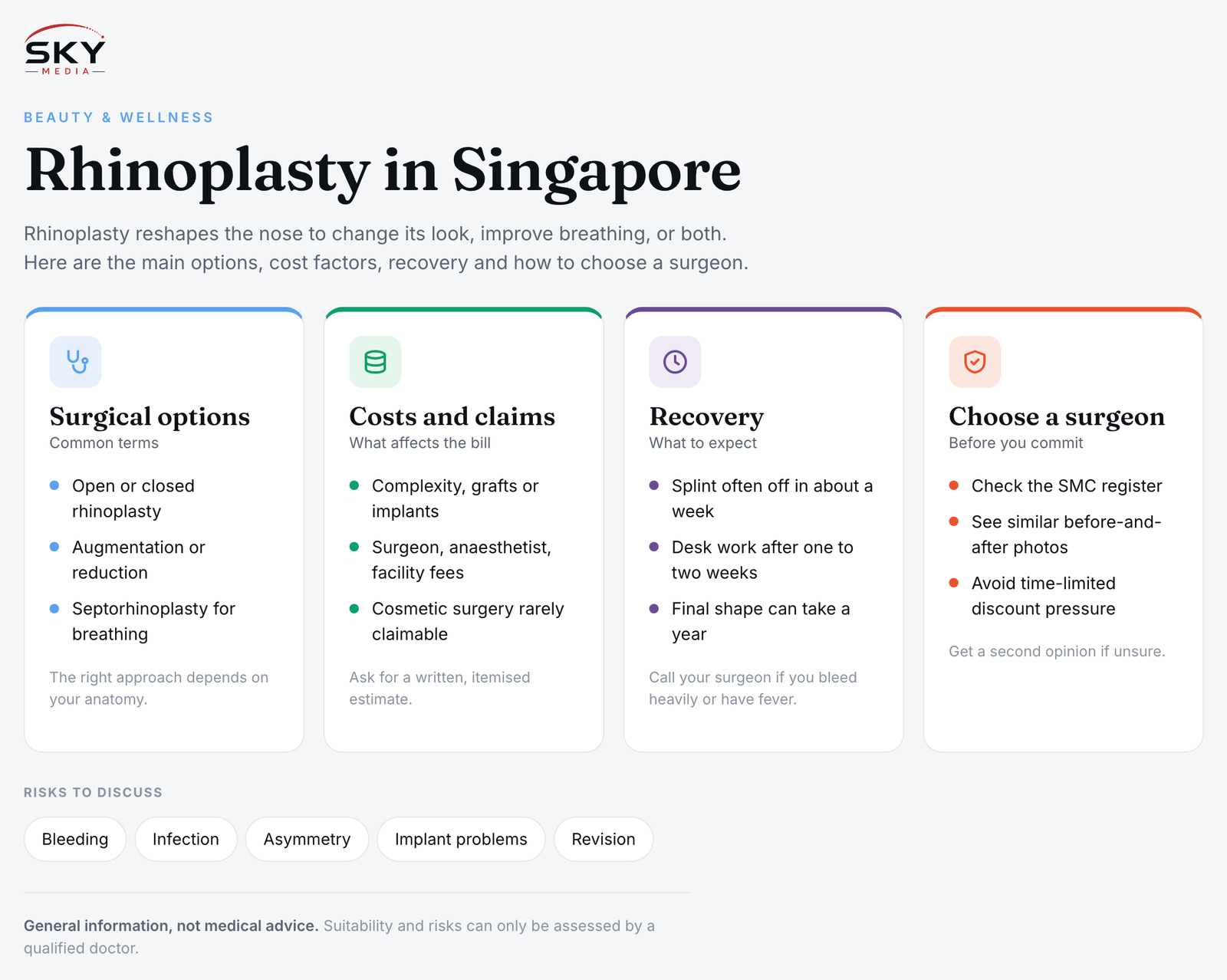
Surgeons describe procedures in several ways. Common terms you will hear include:
- Open rhinoplasty. A small incision is made across the columella (the strip of skin between the nostrils), in addition to incisions inside the nose. This gives the surgeon direct visibility and is often used for more complex changes.
- Closed rhinoplasty. All incisions are inside the nostrils, so there is no visible external scar. It may suit selected cases, depending on the changes needed.
- Augmentation rhinoplasty. Builds up the bridge or tip, which is a common request in Asia. Surgeons may use implants (such as silicone or other materials) or the patient’s own cartilage, taken from the septum, ear or rib.
- Reduction rhinoplasty. Reduces a hump, narrows the nose or refines a bulbous tip.
- Alar base reduction. Narrows wide nostrils, sometimes done alongside other changes.
- Septoplasty and septorhinoplasty. Septoplasty corrects a deviated septum to improve airflow. Combining it with cosmetic reshaping is called septorhinoplasty.
- Revision rhinoplasty. Corrects or adjusts a previous operation. It is usually more complex, and surgeons often advise waiting until earlier surgery has fully healed.
The right approach depends on your anatomy, skin thickness, breathing and goals, so expect your surgeon to examine your nose carefully and discuss what is realistic.
Rhinoplasty Compared With Non-Surgical Options
| Factor | Surgical rhinoplasty | Nose fillers or thread lift |
|---|---|---|
| Permanence | Long-lasting, intended to be permanent | Temporary, may need repeat sessions |
| What it can change | Bridge, tip, hump, width, nostrils, internal breathing structures | Mainly adds height or definition; cannot reduce size |
| Anaesthesia | Usually general anaesthesia or sedation | Usually local anaesthetic or numbing cream |
| Downtime | Typically one to two weeks before most people return to work, with swelling for months | Usually short |
| Can it fix breathing | Yes, when combined with septal or functional work | No |
What Affects the Cost of a Nose Job
Fees vary considerably between clinics and hospitals, so treat any price you see online with caution and ask for a written, itemised estimate after your consultation. Factors that typically affect the total include:
- The complexity of the procedure, and whether cartilage grafts or implants are used.
- Whether it is a first operation or a revision.
- Surgeon’s fees, anaesthetist’s fees and facility or operating theatre charges.
- Whether surgery is done in a day-surgery centre or requires a hospital stay.
- Pre-operative tests, medication, follow-up visits and any splints or dressings.
Ask what is included, what is charged separately, and how complications or revisions are handled.
MediSave, Insurance and Medical Need
Purely cosmetic surgery is generally not claimable under MediSave, MediShield Life or most insurance plans. If part of the surgery is medically necessary, such as correcting a deviated septum causing breathing problems or repairing injury, some portion may be claimable subject to the rules of the scheme and your policy.
Ask the clinic to explain which components are considered medical and whether they will help submit any claims. Confirm the current rules with the CPF Board and the Ministry of Health, and check your policy wording with your insurer or HR before committing. Do not assume coverage.
Recovery: What to Expect
Each surgeon gives their own aftercare instructions, and you should follow them closely. A general picture looks like this:
- First few days. Swelling, bruising around the eyes, a blocked feeling in the nose and some discomfort are common. Surgeons often advise keeping your head raised and resting.
- About the first week. An external splint or tape is often worn and removed at a follow-up appointment, along with any external stitches.
- One to two weeks. Many people feel comfortable returning to desk work or school, though some bruising may remain.
- Several weeks. Strenuous exercise, contact sports and heavy lifting are usually avoided for a period set by your surgeon. Glasses resting on the bridge may need to be avoided or supported.
- Months to a year. Swelling settles gradually, especially at the tip. The final shape can take a year or more to become clear.
Contact your surgeon promptly if you have heavy bleeding, increasing pain, fever, signs of infection, or difficulty breathing. Gentle activity, as described in our article on active recovery, may help general wellbeing, but only once your surgeon clears you for it.
Risks to Discuss Honestly
All surgery carries risk. With rhinoplasty, your surgeon should explain possibilities such as bleeding, infection, reactions to anaesthesia, scarring, breathing difficulties, asymmetry, numbness, implant problems such as shifting or exposure, and dissatisfaction with the result that may lead to revision. Ask how often they see these issues in their own practice and how they are managed.
How to Choose a Plastic Surgeon in Singapore
Take your time over this decision:
- Check registration. Confirm the doctor’s registration and specialty on the Singapore Medical Council’s online register, and whether they are accredited as a plastic surgeon or an ENT (ear, nose and throat) specialist with relevant training.
- Ask about experience. How many rhinoplasties of your type do they perform, and do they handle revisions?
- Look at before-and-after photos of patients with similar noses and ethnic features, while remembering that photos are selected.
- Expect an honest consultation. A good surgeon discusses limits, may say no, and does not pressure you with time-limited discounts.
- Clarify the facility. Ask where the surgery is performed and who administers anaesthesia.
- Get a second opinion if anything feels unclear.
Be wary of cheap packages abroad without proper follow-up, since complications can surface after you return home.
Questions to Bring to Your Consultation
- What changes are realistic for my nose and skin type?
- Open or closed approach, and why?
- Implant or my own cartilage, and what are the trade-offs?
- What will recovery look like for my work or studies?
- What are the total costs, and what is excluded?
A careful, well-informed decision gives you the best chance of a result you are happy with. For comparison with other procedures, our guide to eye bag removal options shows how surgical and non-surgical choices differ elsewhere on the face.