

Many people search for MediSave cosmetic surgery rules after a clinic quote lands higher than expected. The short answer is that MediSave and insurance are built to pay for medical treatment, not for changing how you look. The longer answer is more useful: some procedures that people think of as “cosmetic” are actually done to fix a medical problem, and those can sometimes be paid for with MediSave or claimed under insurance. The difference comes down to why the procedure is done, how the doctor documents it, and what your policy says.
This guide explains where the line sits, gives common examples, and lists the questions to ask before you book. It is general information, not medical or financial advice. Your doctor, the clinic’s billing team, the CPF Board and your insurer have the final word on any specific case.
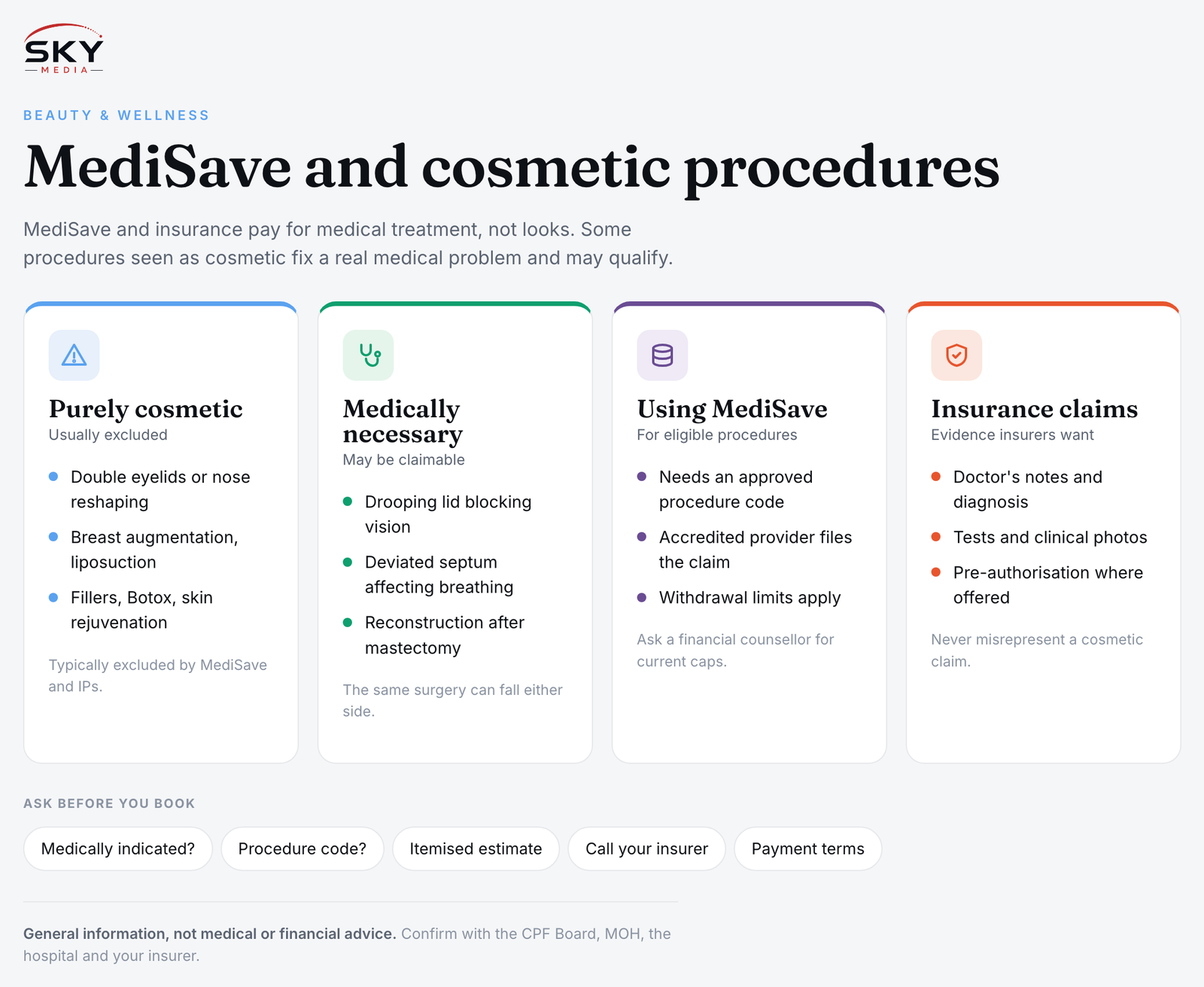
Medically Necessary vs Purely Cosmetic: Where the Line Sits
MediSave is part of your CPF savings set aside for approved healthcare costs. MediShield Life is the national basic health insurance plan, and Integrated Shield Plans (IPs) are private insurer add-ons that sit on top of it. All three are designed around treatment for illness, injury and medical conditions.
A procedure is generally treated as purely cosmetic when its main purpose is to improve appearance in someone whose body is otherwise working normally. Examples include double eyelid creation for looks, nose reshaping for aesthetics, breast augmentation, liposuction for body contouring, fillers and Botox for wrinkles, and most skin rejuvenation treatments. These are typically excluded across MediSave, MediShield Life and IPs.
A procedure may be treated as medically necessary when it corrects a functional problem, treats a disease, repairs injury or reconstructs after illness. The same operation can fall on either side depending on the reason. Eyelid surgery to lift a drooping lid that blocks your vision is very different, in funding terms, from eyelid surgery to create a crease.
What usually matters in practice:
- A diagnosed condition. There should be a recognised medical problem, recorded by a doctor.
- Functional impact. Symptoms such as blocked vision, breathing difficulty, chronic pain or skin breakdown.
- Objective evidence. Tests, measurements or clinical photographs that support the diagnosis.
- An approved procedure code. MediSave can only be used for procedures recognised under the Ministry of Health (MOH) surgical procedure listing, subject to withdrawal limits.
- An accredited provider. The clinic or hospital must be approved to make MediSave claims.
Common Examples and How They Are Usually Treated
The table below shows how some frequently asked procedures tend to be viewed. These are typical patterns only. Each case is assessed on its own facts, and your insurer’s policy wording decides what it will pay.
| Procedure | Usually seen as cosmetic when | May be seen as medically necessary when |
|---|---|---|
| Upper eyelid surgery | Done to create a double eyelid or refresh appearance | Drooping lid (ptosis) or excess skin blocks the field of vision, confirmed by an eye assessment |
| Breast reduction | Done mainly to change size or shape | Large breasts cause documented back, neck or shoulder pain, skin problems or posture issues not helped by other treatment |
| Nose surgery | Reshaping the nose for looks | Correcting a deviated septum or structural blockage that affects breathing |
| Breast reconstruction | Augmentation in a healthy breast | Rebuilding after mastectomy for breast cancer |
| Scar or lesion removal | Smoothing a scar or removing a harmless mole for looks | Removing a suspicious lesion for testing, or releasing a scar that restricts movement |
| Tummy tuck | Body contouring after weight loss or pregnancy | Rarely funded; may be considered for specific complications such as certain hernias, only on a doctor’s assessment |
A procedure can also be partly medical. For example, a surgeon fixing a breathing problem might be asked to reshape the outside of the nose in the same operation. In such cases the medical part may be claimable, while the cosmetic add-on is usually billed separately and paid in cash. Ask the clinic to itemise the bill so it is clear which portion is which.
How MediSave Works for Eligible Procedures
If your doctor confirms the procedure is medically necessary and it carries an approved surgical code, MediSave may be used for part of the bill. A few points to understand before you rely on it:
- Withdrawal limits apply. MediSave cannot always cover the full bill. There are caps per procedure and per day of hospital stay. These limits are set by MOH and can change, so ask the hospital’s financial counsellor for the current figures on your case.
- Family accounts can sometimes help. Within the rules, MediSave from immediate family members may be used for your bill. Check with the hospital or CPF Board for who qualifies.
- Outpatient vs inpatient matters. Day surgery and inpatient admissions are handled differently from outpatient consultations and treatments. Many purely outpatient aesthetic treatments are simply not claimable.
- The clinic files the claim. You usually sign an authorisation form at the clinic.
For a refresher on what MediSave can and cannot be used for generally, see our guide on understanding MediSave: uses and limits. The way funding works for a common eye operation is also shown in our article on cataract surgery costs and MediSave.
What MediShield Life and Integrated Shield Plans Cover
MediShield Life covers large hospital bills and selected costly outpatient treatments, and it excludes cosmetic surgery. Integrated Shield Plans follow a similar principle: their policy documents normally list cosmetic and aesthetic procedures as an exclusion, often with wording that excludes treatment “for beautification” or “to improve appearance”.
When a procedure is genuinely for a medical reason, the insurer will usually want evidence before agreeing to pay:
- A referral or clinical notes from the treating doctor stating the diagnosis.
- Results of relevant tests, such as a visual field test for eyelid surgery.
- Clinical photographs, where relevant.
- Confirmation that conservative treatment was tried first, for conditions like breast-related back pain.
Many insurers offer pre-authorisation, where they review the case before surgery and tell you whether they expect to cover it. A pre-authorisation is not always a final guarantee, so read what it says and keep a copy. Some plans also have waiting periods or exclusions for pre-existing conditions, which can affect whether a claim succeeds.
Corporate group insurance from your employer is separate again. Check your benefits handbook or ask HR, because some group plans have their own rules for day surgery and specialist care.
Questions to Ask Before You Book
Going in with the right questions saves you from a surprise bill.
- Ask the surgeon directly: “Is this procedure medically indicated for me, and will you document it that way?” A reputable doctor will only certify medical necessity if it is genuine.
- Ask for the procedure code and whether the clinic is accredited for MediSave claims.
- Ask for an itemised estimate that separates medical and cosmetic components, including surgeon, anaesthetist, facility and follow-up fees.
- Call your insurer with the code and diagnosis, and apply for pre-authorisation where available.
- Check payment terms for the part not covered, including deposits and refund terms if the surgery is postponed.
Never ask a clinic to describe a cosmetic procedure as medical to get a claim through. Misrepresenting a claim can lead to it being rejected, your policy being affected, and possible legal consequences.
When You Are Paying Cash
For treatments that are purely aesthetic, plan as you would any large personal purchase. Compare clinics on the doctor’s training and registration, the facility, aftercare and how complications are handled, not price alone. You can check a doctor’s registration on the Singapore Medical Council register. For non-surgical options, our guides on double eyelid tape, glue and procedures and cosmetic mole removal methods and aftercare explain what is involved.
Be cautious of packages that require large upfront payments for many sessions, and read cancellation terms carefully.
Rules and limits change, so confirm current details with the CPF Board, MOH, the hospital’s financial counsellor and your insurer before you commit.
Official sources: Ministry of Health (MOH)