
Work out how to pay for a trip and the rest of getting around falls into place. The ez-link simplygo singapore setup can confuse newcomers because two things share the stage: EZ-Link, the stored-value card people have tapped for years, and SimplyGo, the newer system that lets a contactless bank card or a phone do the same job. Add concession cards, top-ups and a fare app on top, and it is easy to feel you have missed a memo.
You have not. This guide untangles the fare payment landscape, so you know what to tap, how to top up, how to check what a journey cost, and, most usefully for a newcomer, what to get first. Because the exact fares, concession eligibility and account rules are all set by the authorities and change over time, treat this as a map of how the pieces fit and defer to LTA, SimplyGo and TransitLink for the current figures and conditions.
The Fare Payment Landscape
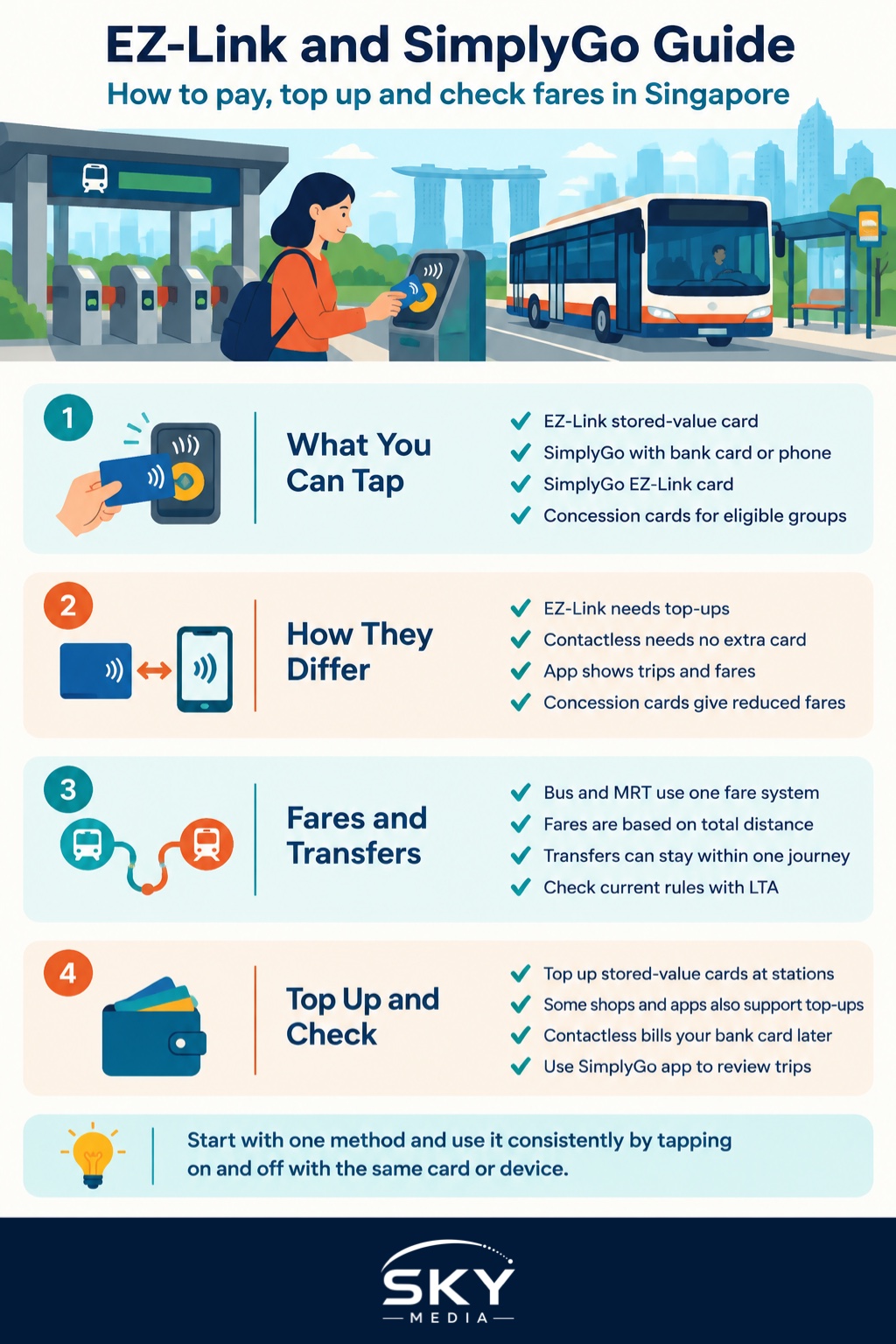
Every ride on the MRT and buses is paid by tapping in and, for buses and at station gates, tapping out, so the system can charge by distance. What you tap can be one of a few things.
- An EZ-Link card. A physical card you buy and load with value. You tap it at gates and on buses, and it has been the default way to pay for years.
- The SimplyGo system. An account-based backend that lets you tap a contactless Visa or Mastercard bank card, or a phone or smartwatch loaded with one, and be billed for your trips later. There is also a SimplyGo EZ-Link card that runs on this same account model rather than storing value on the card itself.
- Concession cards. Special-rate cards for those who qualify, such as students, senior citizens, full-time national servicemen and eligible workers under schemes like Workfare Transport Concession.
The practical split is stored-value versus account-based. A classic stored-value card holds money on the card. An account-based method, whether a bank card, a phone or a SimplyGo card, charges your linked account and lets you see journeys and fares in the app.
Cards Versus Contactless: The Trade-offs
Neither option is simply better; they suit different people. This is the comparison most newcomers actually want.
| Payment method | Pros and cons |
|---|---|
| EZ-Link (stored value) | Pro: works without a bank card, instant tap, no account needed. Con: you must top up, and the value sits on the card if lost |
| Contactless bank card or phone | Pro: nothing extra to buy, no topping up, journeys shown in the app. Con: needs an eligible card or device, and fares post to your account after the trip |
| SimplyGo EZ-Link card | Pro: a physical card that still shows fares and journeys in the app. Con: account-based, so fares are not shown instantly at the gate |
| Concession card | Pro: reduced fares for those who qualify. Con: eligibility and application required, and it is tied to the holder |
A key quirk: with account-based methods the exact fare and remaining amount are not always shown at the gate the way a stored-value balance is, because the charge is settled afterwards. If seeing your balance drop at the gate matters to you, a stored-value card feels more familiar; if you would rather never queue to top up, contactless wins.
How Distance Fares And The Transfer Cap Work
One thing that reassures newcomers: buses and trains share a single distance-based fare system. You are charged for the total distance of a journey, not per vehicle, so a trip that involves a bus then a train is treated as one journey with transfers, as long as you tap consistently and change within the allowed window. That is why a route with a transfer often costs little or no more than a direct one. The flip side is that leaving the paid area and re-entering, or waiting too long between legs, can break the journey into two and cost you more. The precise transfer rules, timing windows and fare tables are set by LTA, so check the current details there or in the app rather than assuming.
Topping Up and Checking Your Journeys
How you add value and review spending depends on which route you took.
- Topping up a stored-value card. Add value at MRT station machines, ticketing kiosks, convenience stores and through some apps. Keep a little buffer so a low balance never blocks you at the gate on a rushed morning.
- Contactless and account-based. There is nothing to top up; trips are billed to the bank card or account behind your phone or SimplyGo card, so you just keep that funded as usual.
- Checking fares and journeys. The SimplyGo app lets you register your card or device, see recent trips, view what each journey cost and track transfers. It is the simplest way to confirm you tapped out correctly and were charged the expected amount.
- Fixing a missed tap. If a fare looks wrong, perhaps you forgot to tap out and were charged a maximum fare, the app and the official channels are where you check and follow up.
For the exact top-up options, any card fees, and how to resolve fare issues, check SimplyGo, TransitLink and LTA, since these details are updated from time to time.
Concession Cards: Who Should Look Into Them
If you fit a category, concessions are worth the paperwork because the savings add up over a year of daily trips.
- Students at various levels can apply for concession cards with reduced fares and, often, monthly passes.
- Senior citizens above the qualifying age can get a senior concession card.
- Eligible workers may qualify under the Workfare Transport Concession Scheme.
- Full-time national servicemen have their own concession.
Eligibility, the application process and the fares attached to each concession are all governed by the authorities and can change, so verify who qualifies and how to apply through LTA and TransitLink. Our companion piece on SimplyGo and concession cards explained walks through how the concession types sit on the account-based system. If you are a short-term visitor or a new arrival who does not fit a concession category, a standard card or contactless payment is the straightforward choice.
What a Newcomer Should Get First
Keep the first decision small. You can always change later.
- Already have a contactless bank card or a phone wallet? Just tap it and go on day one. No card to buy, no top-up, and every trip shows up in the SimplyGo app. For most new arrivals this is the fastest start.
- Prefer a physical card or no bank-card link? Pick up an EZ-Link or SimplyGo card, load some value, and tap that. It is handy if you would rather not put transit on a bank card, or if you are buying a card for a child or visitor.
- Think you qualify for a concession? Sort that out early, since it lowers every fare you pay, then use it as your main method.
Whichever you choose, the golden rule is consistency: tap on and off with the same card or device every time so the system calculates your distance and applies the transfer cap correctly. Get that habit right and the whole ez-link simplygo singapore puzzle stops being a puzzle. For a step-by-step of the account side, see using SimplyGo for public transport in Singapore.
Common Questions From Newcomers
Do I still need an EZ-Link card if I can tap my phone?
No. If your phone wallet or bank card is contactless and eligible, you can tap it directly and skip buying a card. An EZ-Link or SimplyGo card is useful mainly if you would rather not link transit to a bank card, or you are buying for a child or visitor.
Why was I charged a higher fare than expected?
The most common cause is a missed tap-out, which can trigger a maximum fare. Check the trip in the SimplyGo app, and follow up through the official channels if it looks wrong. Tapping on and off consistently prevents most of these.
Can visitors use these cards for a short trip?
Yes. A short-term visitor can either tap an eligible contactless bank card or phone, or buy a stored-value card and load a small amount. Both work across MRT and buses; which is simpler depends on whether you already carry a contactless card.
Does the same card work for the JB crossing?
Cross-border travel to Johor Bahru has its own arrangements rather than running on the local fare card the same way. Our guide to the JB Singapore RTS Link explained covers what to expect, and you should confirm the current ticketing there before you travel.
What happens if I lose my EZ-Link card? Any stored value on an ordinary card can generally be used by whoever finds it, so treat it like cash. Some account-based or registered cards may let you stop or replace them. Check TransitLink or SimplyGo for what your card type allows and how to report a loss.
Can I get a refund for the remaining balance on my card? It depends on the card type and its terms, and a fee may apply. Many people simply keep using up the value. Check with TransitLink or the card issuer for the current refund options, and top up in small amounts to avoid leftovers.
Can two people tap on the same card? No, each traveller needs their own card or device. The fare system tracks one person’s tap in and tap out per journey, and tapping the same card for two people will cause a wrong charge or a blocked gate. Buy a separate card for a child or visitor.
Will I earn credit card rewards when I tap my bank card on public transport? Possibly, but it depends on your card issuer’s rules, since some treat transit as a special spending category and exclude it from rewards. Check your card’s terms or ask your bank. Also see whether any overseas or admin fees apply to foreign-issued cards.
What if my phone battery dies before I can tap out? A phone with no power will not work at the gate, so you may be stopped from exiting. Go to the station’s passenger service centre and explain; staff can help you through. Carry a backup card or power bank, and keep your payment method consistent for the whole journey.
Explore more
Once you can pay, put it to use: The MRT System Explained covers the rail network end to end, and Bus Travel in Singapore shows how the same tap gets you onto the buses and through the shared fare cap.
Official sources: Land Transport Authority (LTA)
Further reading: How China Newcomers Can Top Up EZ-Link Cards Easily