

Worried about your child’s anxiety, meltdowns, school refusal, attention or learning difficulties? Finding a child psychologist in Singapore usually starts with one decision: go through the public system with a referral, or book directly with a private practice. Both routes lead to qualified help, but they differ in waiting time, cost and how you get in the door. This guide walks parents through each route, what affects the bill, and what really happens at a first session.
This article is general information, not medical advice. If your child is in immediate danger or talking about harming themselves, call 995 or go to the nearest hospital Emergency Department straight away.
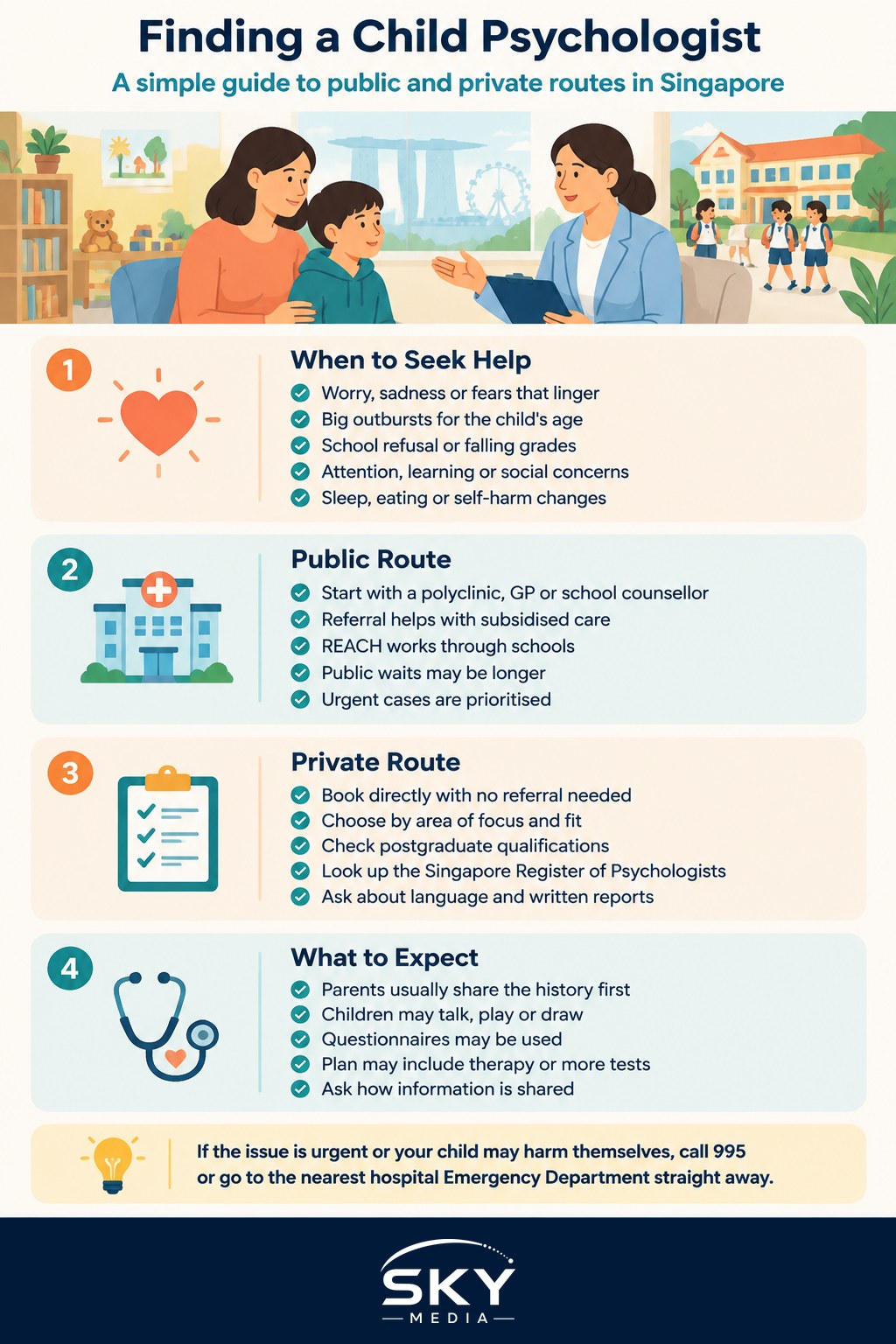
Signs It May Be Time to Seek Help
Every child has hard weeks. It is worth speaking to a professional when difficulties are lasting, getting worse, or affecting daily life. Common reasons parents seek a child psychologist include:
- Persistent worry, fears or sadness that do not ease after a few weeks
- Frequent emotional outbursts that are out of step with the child’s age
- Refusing to go to school, or a sudden drop in school performance
- Concerns about attention, learning, speech or social development
- Sleep or eating changes, withdrawal from friends, or self-harm talk
- Difficulty coping after a big change such as a move, divorce or bereavement
If you are unsure, a good first step is a chat with your child’s form teacher or school counsellor, or a visit to your family doctor. They can help you decide whether a psychologist, a paediatrician or another specialist is the right fit.
The Public Route: Polyclinic, Hospital and REACH
Singapore’s public healthcare system offers child mental health and developmental services through hospitals and community teams. The usual entry points are:
Polyclinic or GP referral. A polyclinic doctor or GP can assess your child briefly and, where needed, refer you to a public hospital service. Public child and adolescent mental health services are offered at places such as the Institute of Mental Health’s (IMH) Child Guidance Clinic, KK Women’s and Children’s Hospital and the National University Hospital. Developmental concerns in younger children may be directed to child development services instead. A referral matters because it is generally what allows you to be seen as a subsidised patient. Check the current referral and subsidy rules with the polyclinic or the hospital.
REACH through the school. REACH (Response, Early intervention and Assessment in Community mental Health) is a community mental health programme run under IMH that works with schools. Teams support students with emotional and behavioural concerns, and referrals typically come through the school counsellor rather than directly from parents. If your child is in a mainstream school, ask the school counsellor whether a REACH referral is suitable.
School and community support. Many schools have counsellors who can see students for early support. Family Service Centres, which are community social service agencies, can also help families under stress and link you to further care.
The trade-off in the public route is time. Waiting lists for a first appointment can be long, especially for non-urgent cases. Urgent concerns are usually prioritised, so tell the referring doctor clearly if things are getting worse.
The Private Route: Booking a Psychologist Directly
Private clinical and educational psychologists can usually see you sooner and you do not need a referral. You can also choose a psychologist based on their focus, such as anxiety, ADHD assessment, autism assessment, learning difficulties or family therapy.
There is currently no compulsory licensing law for psychologists in Singapore, so checking credentials is your job. When choosing:
- Look for a relevant postgraduate qualification in clinical, educational or counselling psychology
- Check whether they are listed on the Singapore Register of Psychologists, a voluntary register run by the Singapore Psychological Society
- Ask how much experience they have with children of your child’s age and with your specific concern
- Ask whether they offer formal assessments with written reports, if you need one for school accommodations
- Confirm the language they work in, especially if your child is more comfortable in Mandarin
The same habit of checking qualifications applies to any practitioner you see for your child, as we covered in How to Find a Child Dentist in Singapore and How to Find a TCM Practitioner in Singapore.
Public vs Private at a Glance
| Factor | Public route (referral, hospital, REACH) | Private practice |
|---|---|---|
| How to get in | Referral from polyclinic, GP or school counsellor | Book directly, no referral needed |
| Waiting time | Can be weeks to months for non-urgent cases | Often days to a few weeks |
| Cost | Subsidised rates for eligible patients | Full private fees, set by each practice |
| Choice of psychologist | Assigned by the service | You choose based on focus and fit |
| Team support | Access to psychiatrists, therapists and social workers in one setting | Varies; some work alone, some in multidisciplinary clinics |
| Reports for school | Available through the service | Available, usually charged separately |
What Affects the Cost
Fees vary widely, so we do not quote numbers here. The main factors are:
- Subsidy status. Subsidised rates in public hospitals usually depend on a valid referral and your child’s citizenship or residency. Foreign children typically pay non-subsidised rates.
- Type of service. A full psychological or developmental assessment, with testing and a written report, generally costs more than a regular therapy session.
- Session length and number. Therapy is usually a series of sessions, so ask about the likely number at the start.
- Insurance and MediSave. Many insurance plans exclude or limit outpatient psychology. Check your policy wording or ask your employer’s HR, and check with the clinic and the CPF Board whether any MediSave use applies to your case.
Always ask for a written fee breakdown before booking an assessment.
What Happens at the First Session
Parents are often anxious about the first visit, and children even more so. Knowing what to expect helps everyone.
- Intake and history. The psychologist will usually meet the parents first, sometimes without the child, to hear the concern, family background, developmental milestones and school history. Bring past reports, school feedback and any notes on when the problem started.
- Meeting the child. Younger children are often seen through play and drawing, while older children and teens may simply talk. The aim is to build trust, not to test or judge.
- Questionnaires. You and sometimes the teacher may be asked to complete standard rating forms.
- Next steps. By the end of the first session or two, the psychologist will usually suggest a plan: more assessment, a course of therapy, parent coaching, or a referral to a psychiatrist or paediatrician if medical review is needed.
- Confidentiality. Ask how information is shared with parents and the school, particularly for teenagers who may want some privacy.
Preparing Your Child for the Visit
- Explain it simply: “We are going to see someone who helps kids with big feelings.”
- Avoid framing it as a punishment or a sign something is wrong with them
- Keep the day calm, with a snack and something comforting
- Let older children ask their own questions and have some say in the process
Tips for Newcomer Families
If you have recently moved from mainland China or elsewhere, the system may feel different from home, where parents often go straight to a hospital department. In Singapore, the family doctor or polyclinic is the usual gatekeeper for subsidised specialist care. Your child’s school counsellor is also a valuable, free first contact. Ask early about language support, as many psychologists and counsellors work in both English and Mandarin.
Explore more: How to Find a Child Dentist in Singapore
Frequently Asked Questions
Do child psychologists in Singapore need to be licensed? There is currently no compulsory licensing law for psychologists, so checking credentials is your job. Look for a relevant postgraduate qualification, check the voluntary Singapore Register of Psychologists run by the Singapore Psychological Society, and ask about experience with your child’s age and concern.
Can a school counsellor refer my child for help? Yes. Many schools have counsellors who can see students for early support, and REACH referrals typically come through the school counsellor rather than directly from parents. Ask the counsellor whether a REACH referral suits your child. It is also a free first contact.
How long will we wait to see a public child psychologist? Waiting lists for a first appointment can be long, from weeks to months for non-urgent cases. Urgent concerns are usually prioritised, so tell the referring doctor clearly if things are getting worse. Private practices can often see you sooner, though at full private fees.
Will insurance or MediSave pay for child psychology sessions? Many insurance plans exclude or limit outpatient psychology, so check your policy wording or ask HR. Check with the clinic and the CPF Board whether MediSave applies to your case. Ask for a written fee breakdown before booking an assessment.
Should I get a formal assessment report for my child’s school? Only if you need one for school accommodations. A formal assessment with testing and a written report generally costs more than a regular therapy session, and private reports are usually charged separately. Ask the psychologist whether a report suits your purpose before you book.