

If you bottle sambal, bake cookies for retail, import snacks or sell drinks in sealed packs, your label is a legal document as much as a marketing one. The food labelling requirements Singapore sets out apply to prepacked food, meaning food sealed in a package before it is offered for sale. Getting it right protects shoppers with allergies and avoids costly reprints or recalls.
This guide walks through what a compliant label generally needs, how allergen declarations and date marks work, and where Nutri-Grade fits in. It is general information, not legal advice. Rules are updated from time to time, so always confirm the current details with the Singapore Food Agency (SFA), which administers the Food Regulations under the Sale of Food Act, and with the Health Promotion Board (HPB) for nutrition labelling programmes.
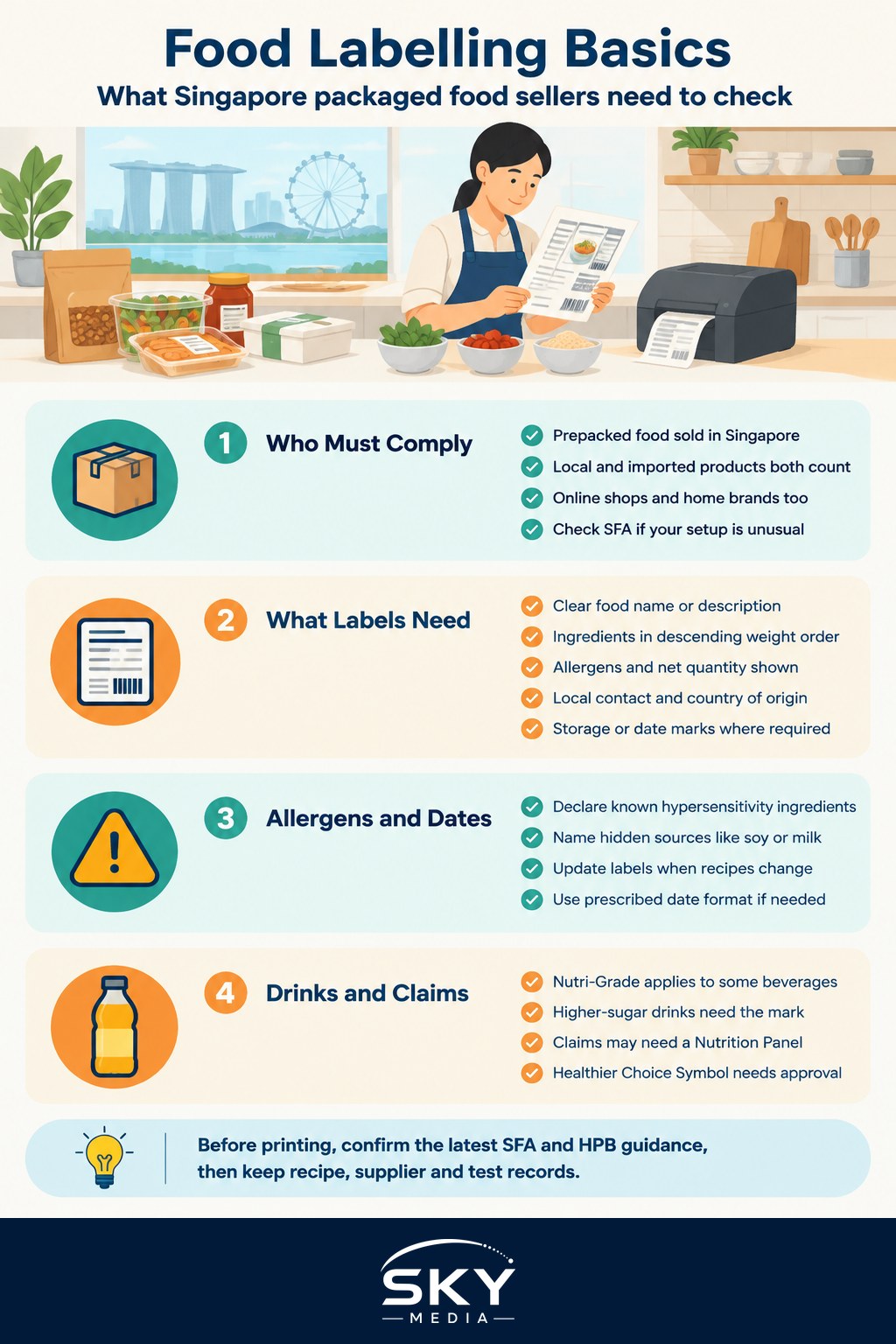
Who the Labelling Rules Apply To
The labelling rules cover prepacked food sold in Singapore, whether it is made locally or imported. That includes:
- Small brands selling packaged products through shops, supermarkets, online marketplaces or their own websites.
- Importers and distributors bringing in packaged food from overseas. If the original label does not meet local rules, you may need to add a compliant sticker before sale.
- Home-based food businesses that move into packaged retail. Selling a few cakes to neighbours is a different situation from supplying sealed jars to a café or an online store, so check with SFA on which licensing and labelling rules apply to your setup.
Food prepared and served on the spot, such as a plate of noodles at a stall, is generally not “prepacked” in the same sense. Freshly prepared drinks, however, have their own Nutri-Grade rules, covered below.
What a Compliant Label Generally Needs to Show
SFA’s Food Regulations list the information that must appear on prepacked food. The core items usually include:
- Name or description of the food. It should tell buyers what the product truly is. A fancy brand name alone is not enough; “chilli paste with dried shrimp” tells the shopper what they are buying.
- Ingredient list. Ingredients are listed in descending order by weight, from most to least. Food additives are typically declared by their function and name or recognised number.
- Allergen declaration. Certain foods and ingredients known to cause hypersensitivity must be declared (more on this below).
- Net quantity. The net weight or volume of the contents, in metric units.
- Name and address of the local party responsible. For local products, the manufacturer, packer or distributor. For imported products, the local importer, distributor or agent.
- Country of origin. Required for imported food.
- Date marking where prescribed. Some foods must carry a “use by” or “expiry” date in a specified format.
- Special storage or usage conditions. For example, “keep refrigerated” when the food needs it to stay safe.
Labels must be in English, though you may add other languages such as Chinese or Malay alongside. The information must be legible, prominent and not misleading. Claims like “no added sugar”, “high in calcium” or “low fat” have specific conditions attached, and making a nutrition claim generally means you must also include a Nutrition Information Panel (NIP). Health claims are more tightly controlled still, so check SFA’s guidance before printing any.
Allergen Declarations: Getting the Details Right
Allergens are where small sellers most often slip up, and where the consequences for shoppers are most serious. The Food Regulations require declaration of foods and ingredients known to cause hypersensitivity. These commonly include cereals containing gluten, crustaceans, eggs, fish, peanuts, soybeans, milk, tree nuts and sulphites above a set level. Check SFA’s current list, as it can be revised.
Practical tips:
- Declare hidden sources. Soy sauce contains soy and often wheat. Many curry pastes contain shrimp paste. Butter, ghee and whey come from milk. Name the allergen clearly.
- Check your suppliers’ labels. A ready-made ingredient you buy in may itself contain allergens. Keep its specification sheet on file.
- Think about cross-contact. If you make a peanut cookie and a plain cookie on the same equipment, many sellers add a precautionary note such as “may contain traces of peanuts”. Use this honestly, not as a blanket disclaimer.
- Update the label when recipes change. Swapping one brand of stock cube for another can introduce a new allergen.
Date Marking, Storage and Shelf Life
Not every food must carry a date, but SFA prescribes date marking for certain categories, such as some dairy products, infant foods and other perishable items. Where a date is required, the format and wording are set out in the regulations, and the date should be shown in a way that leaves no doubt about day, month and year.
Even where not compulsory, a clear best-before date helps retailers manage stock. Base it on evidence, not guesswork; some sellers ask a food testing laboratory to assess shelf life, especially for sauces and pickles. Pair the date with storage instructions, because a “best before” only holds if the product is stored as directed.
Nutri-Grade Marks for Beverages
Nutri-Grade is Singapore’s labelling measure for drinks, administered with HPB. Beverages are graded from A to D based on their sugar and saturated fat content. In broad terms:
- Prepacked beverages in the higher-sugar grades must carry the Nutri-Grade mark on the package.
- Freshly prepared beverages, such as those from bubble tea or coffee chains, are covered by separate rules on displaying the grade on menus.
- Advertising of the least healthy grade is restricted.
The thresholds, which drinks are in scope and how the mark must be printed are set by the authorities and can change. The government has also announced extensions of Nutri-Grade style labelling to other nutrients and product groups, so if you sell sauces, seasonings or similar products, keep an eye on SFA and HPB announcements. Before launching a drink, get its sugar and saturated fat values from a lab analysis or a reliable calculation, then check its grade against HPB’s current criteria.
Separately, the Healthier Choice Symbol is a voluntary HPB programme. You may apply to use it if your product meets the criteria, but you must not print it without approval.
Common Label Mistakes Versus Better Practice
| Common mistake | Better practice |
|---|---|
| Only a brand name on the front | Add a clear description of what the food is |
| Ingredients listed in random order | List by descending weight, with additives named |
| “Contains nuts” as the only allergen note | Name each allergen, including those inside sauces and pastes |
| No local contact on imported goods | Add a sticker with the local importer’s name and address |
| “Low sugar” printed with no nutrition panel | Check claim conditions and include the Nutrition Information Panel |
| Date in an unclear format | Use the prescribed wording and a clear day, month and year |
A Pre-Print Checklist for Small Sellers
Before you order a print run, run through this list:
- Have you read the current SFA guide to food labelling and advertisements, and checked any product-specific standards (some foods, such as certain sauces or juices, have compositional standards)?
- Is the English information complete, legible and on the package itself, not only on a website?
- Are all allergens declared, including those from bought-in ingredients?
- Does the net quantity match what you actually fill?
- If you make a nutrition or health claim, does the product meet the conditions, and is there an NIP?
- For drinks, have you confirmed the Nutri-Grade grade and whether a mark is required?
- Is the local responsible party’s name and address correct?
- Have you kept records of recipes, supplier specs and test results in case SFA or a retailer asks?
Retailers often run their own label checks too. If unsure, SFA publishes guidance and accepts enquiries, and food consultants can review artwork before you print.
Building labelling into your launch checklist from day one is far cheaper than fixing it after stock is on the shelves.
Explore more: What a Valid Tax Invoice Must Show Under Singapore GST and AGM Rules and Exemptions for Singapore Private Companies.
Frequently Asked Questions
Can I use handwritten labels or stickers for small batches? Labels can be stickers if all the required information is present, legible, accurate and stays on the pack. Handwriting may look unprofessional and is easy to get wrong, so printed labels are safer. Confirm with SFA what format they accept for your product.
Do I need a Nutrition Information Panel if I make no nutrition claims? The article notes that making a nutrition claim generally means including one. Without claims, requirements depend on the type of food, so do not assume you are exempt. Check SFA’s current guidance for your product category before you print.
Do I need halal certification to label my food as halal? If you want to say your product is halal, check with MUIS, which runs halal certification in Singapore, on what is required before you use the claim. Never use halal wording or a halal logo without proper certification, as customers rely on it.
Who checks food labels and what happens if mine is wrong? SFA enforces the rules, and retailers and marketplaces often run their own checks too. A faulty label can mean relabelling, withdrawing stock or penalties under the Sale of Food Act. Check your artwork with SFA’s guidance or a food consultant before you print a large run.
Official sources: Singapore Food Agency (SFA)
Further reading: Consumer Product Safety Rules for Online Sellers in Singapore · Basic Food Hygiene Course and Food Handler Registration in Singapore