

Gallstones are common, and many people only find out they have them during a scan for something else. When they do cause trouble, though, the pain can be sudden and intense. Knowing the usual gallstones symptoms, and which signs mean you should seek urgent care, helps you get the right help at the right time.
This article is general information, not medical advice. If you have abdominal pain or any of the warning signs below, see a doctor. In an emergency, go to the nearest hospital emergency department or call 995.
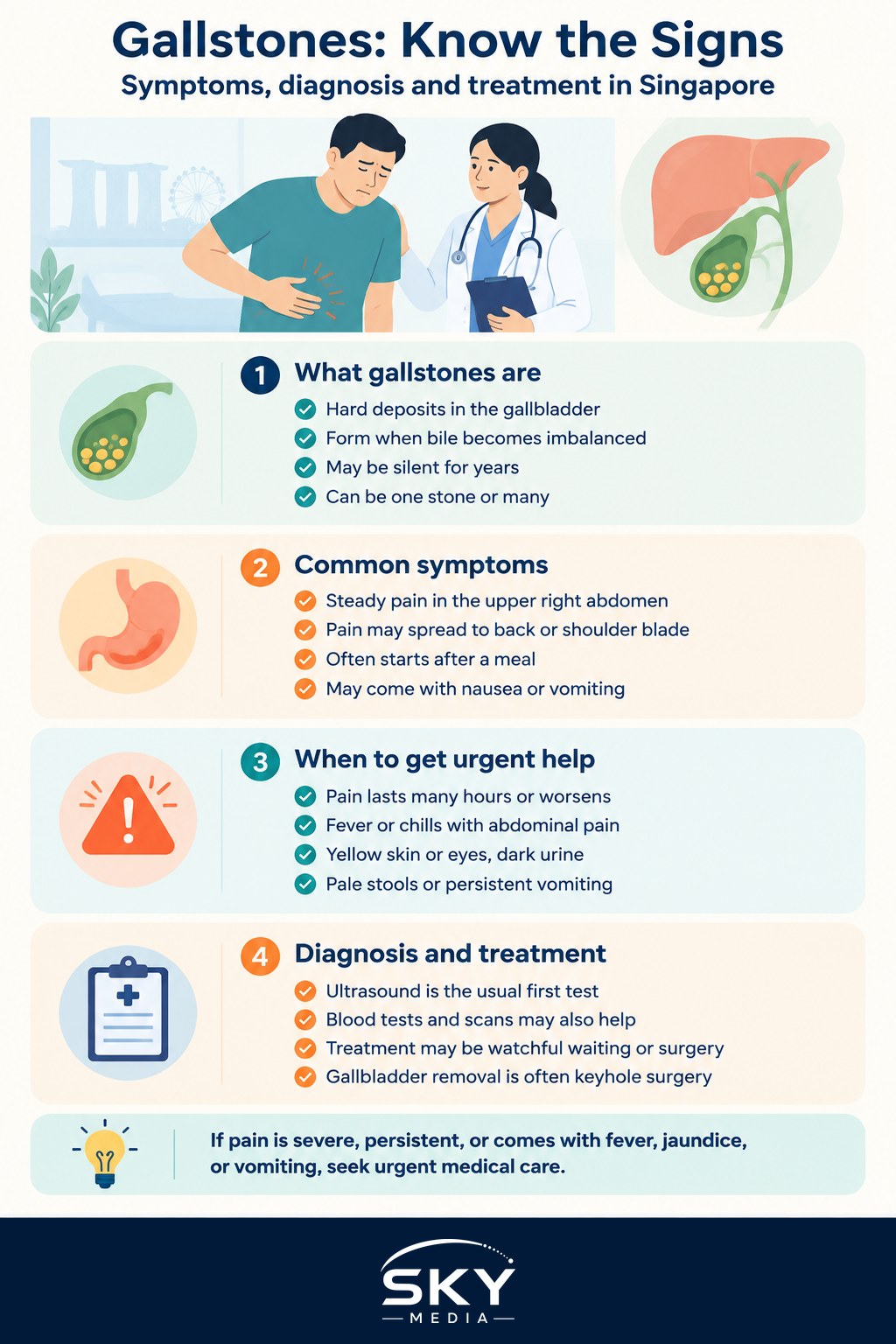
What Gallstones Are and Why They Form
The gallbladder is a small, pear-shaped organ tucked under the liver on the upper right side of the abdomen. It stores bile, a digestive fluid made by the liver that helps break down fats. After a meal, especially a fatty one, the gallbladder squeezes bile into the small intestine through a series of ducts.
Gallstones are hard deposits that form in the gallbladder when bile becomes imbalanced. Some are made mainly of cholesterol; others are pigment stones linked to bilirubin, a breakdown product of red blood cells. They can be as small as grains of sand or as large as a marble, and you may have one or many.
Doctors recognise several factors that can raise the chance of developing gallstones, including:
- Getting older
- Being female, and pregnancy
- Excess weight, and also very rapid weight loss
- A family history of gallstones
- Some medical conditions, such as certain blood disorders and liver conditions
- Some medicines, which your doctor can advise on
Having a risk factor does not mean you will get gallstones, and people with none can still develop them.
Common Gallstones Symptoms to Watch For
Many people have “silent” gallstones that never cause symptoms. Problems usually begin when a stone blocks a duct, even briefly.
The classic symptom is biliary colic, a type of gallbladder pain:
- Steady, often severe pain in the upper right abdomen or the upper middle part of the abdomen, just below the breastbone
- Pain that may spread to the right shoulder blade or the back
- Episodes that often start after a meal, sometimes in the evening or at night
- Pain lasting from around half an hour to several hours, then easing
- Nausea or vomiting alongside the pain
Some people also notice bloating, burping or indigestion, but these are common and not specific to gallstones, so they are harder to link to the gallbladder on their own.
When Gallstone Pain Needs Urgent Attention
Gallstones can lead to complications, such as inflammation of the gallbladder, infection of the bile ducts, or inflammation of the pancreas. Seek urgent medical care if you have:
- Abdominal pain that is severe, lasts for many hours, or keeps getting worse
- Fever or chills together with abdominal pain
- Yellowing of the skin or the whites of the eyes (jaundice)
- Dark urine or pale, clay-coloured stools
- Persistent vomiting, or being unable to keep fluids down
- Pain spreading across the upper abdomen into the back, with feeling very unwell
Upper abdominal pain can also come from the heart, stomach, liver or other organs. Chest pain, breathlessness or pain spreading into the arm or jaw should always be treated as an emergency.
How Gallstones Are Diagnosed in Singapore
If you have repeated episodes of upper right abdominal pain, start with a general practitioner (GP), a family clinic or a polyclinic. The doctor will ask about your symptoms, examine your abdomen and decide on tests. If needed, they can refer you to a specialist, usually a general surgeon or a gastroenterologist, at a public hospital or a private clinic.
Tests your doctor may consider include:
- Abdominal ultrasound: the most common first test for gallstones. It is painless, uses sound waves and does not involve radiation. You are often asked to fast beforehand.
- Blood tests: to check liver function, signs of infection or inflammation, and pancreatic enzymes.
- CT scan: sometimes used when pain is severe or the diagnosis is unclear.
- MRCP (magnetic resonance cholangiopancreatography): a type of MRI scan that gives detailed pictures of the bile ducts, used if a stone may be stuck in a duct.
- ERCP (endoscopic retrograde cholangiopancreatography): a procedure using a flexible scope passed through the mouth, which can both find and remove stones in the bile ducts.
Your doctor will choose the tests that suit your situation, so do not worry if you only need one or two.
Treatment Options at a Glance
Treatment depends mainly on whether the stones are causing symptoms or complications. This table summarises the general approaches doctors discuss; your own plan should come from your doctor.
| Situation | Typical approach | What it usually involves |
|---|---|---|
| Stones found by chance, no symptoms | Watchful waiting | No treatment, but report any new pain to your doctor |
| Repeated biliary colic | Planned gallbladder removal | Keyhole surgery arranged as a scheduled operation |
| Inflamed gallbladder (cholecystitis) | Hospital care, then surgery | Fluids, pain relief and antibiotics if needed; removal during or after admission |
| Stone blocking a bile duct | ERCP, then surgery | Stone removed through a scope, gallbladder often removed later |
| Not fit for surgery | Medication or other procedures | Options chosen case by case by specialists |
Medicines that dissolve some cholesterol stones exist, but they work slowly, only for certain stones, and stones may return after stopping. Doctors generally reserve them for specific situations.
What Gallbladder Removal Involves
Removing the gallbladder is called a cholecystectomy. Most are done as laparoscopic (keyhole) surgery under general anaesthesia: the surgeon makes a few small cuts in the abdomen and uses a camera and slender instruments. Sometimes an open operation with a larger cut is needed, for example if there is heavy inflammation or scarring.
Things patients often want to know:
- Hospital stay: many people go home the same day or after a short stay, but this depends on your health and the surgeon’s plan.
- Recovery: most people return to light daily activities fairly soon, with heavier lifting and strenuous exercise avoided for a period your surgeon will specify.
- Living without a gallbladder: bile then flows directly from the liver into the intestine. Most people digest normally. Some notice looser stools or discomfort after fatty meals for a while.
- Risks: all surgery carries risks, such as bleeding, infection and, rarely, injury to the bile ducts. Ask your surgeon to explain these for your situation.
On costs, Singapore residents can typically use MediSave and MediShield Life for approved hospital treatment, subject to their rules and limits, and integrated shield plans or company insurance may cover more. Check the current details with your hospital’s financial counsellors, the Ministry of Health (MOH) website, your insurer and your employer’s HR.
Eating Well Before and After Treatment
There is no diet that reliably dissolves gallstones, but some habits may help with comfort:
- Eat regular meals rather than skipping and then eating a very large, rich meal.
- Notice which foods seem to set off discomfort and discuss them with your doctor.
- If you are trying to lose weight, aim for steady loss rather than crash diets, which can make gallstones more likely.
- After surgery, reintroduce fried and fatty foods gradually.
If you are managing other conditions, our guides to lymphedema treatment in Singapore and lipedema symptoms and care explain how to work with specialists on long-term care. For reliable health information and appointments, use HealthHub and follow your doctor’s advice on your specific case.
Frequently Asked Questions
Can gallstones go away on their own? Gallstones usually do not disappear without treatment, though some people never have symptoms and need only watchful waiting. Medicines that dissolve certain cholesterol stones exist but work slowly and stones may return. Your doctor will advise whether to monitor or operate.
Which foods should I avoid if I have gallstones? No diet reliably dissolves gallstones, but fatty or very rich meals can trigger discomfort in some people. Eat regular meals, note which foods set off pain and discuss them with your doctor. Avoid crash diets, as very rapid weight loss can make stones more likely.
Is gallbladder removal safe, and can I live normally without it? Gallbladder removal is a common operation, usually done by keyhole surgery, though all surgery carries risks such as bleeding or infection. Most people digest normally afterwards, although some notice looser stools or discomfort after fatty meals for a while. Your surgeon can explain the risks for you.
Can I use MediSave for gallstone surgery? Singapore residents can typically use MediSave and MediShield Life for approved hospital treatment, subject to their rules and limits. Integrated shield plans or company insurance may cover more. Ask the hospital’s financial counsellors and your insurer, and check the MOH website for current details.
How can I tell gallstone pain from a heart problem or indigestion? You cannot reliably tell at home. Gallstone pain is typically in the upper right or upper middle abdomen after meals, but the heart, stomach and liver can cause similar pain. Chest pain, breathlessness or pain spreading to the arm or jaw is an emergency, so call 995.
Official sources: HealthHub
Further reading: Appendicitis in Adults: Warning Signs and What to Do