

A slipped disc is one of the more common reasons people in Singapore see a doctor for back or neck pain, whether it starts after lifting a heavy box, a sudden twist or years of long hours at a desk. This slipped disc Singapore guide explains what is actually happening in the spine, which symptoms point to a disc problem, and how the main treatment routes, physiotherapy, injections and surgery, compare. It is general information, not medical advice. Only a doctor who has examined you can diagnose and advise on your situation.
What a Slipped Disc Actually Is
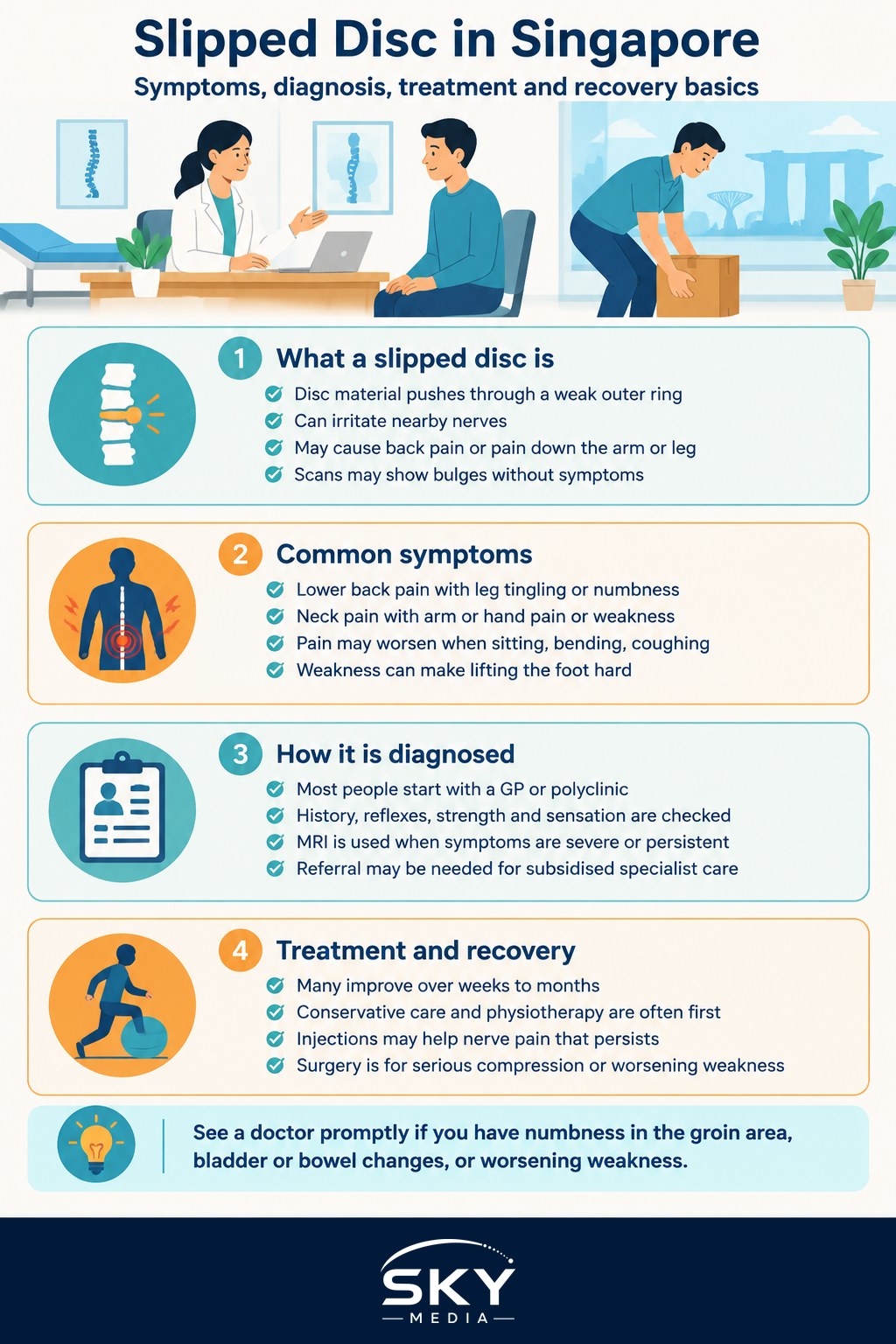
Your spine is made up of bones (vertebrae) separated by rubbery discs that act as shock absorbers. Each disc has a tough outer ring and a softer, gel-like centre. A “slipped” disc does not really slip out of place. Instead, part of the soft centre pushes through a weakness in the outer ring. Doctors call this a herniated, prolapsed or bulging disc, depending on the extent.
The trouble usually starts when the bulging material presses on or irritates a nearby nerve. That is why a disc problem in the lower back can cause pain down the leg, and one in the neck can cause pain down the arm. Disc changes are also common with age, and many people have disc bulges on scans without any symptoms at all.
Risk factors often mentioned by doctors include repeated heavy lifting with poor technique, long periods of sitting, smoking, excess body weight and a family history of disc problems.
Symptoms That Suggest a Disc Problem
Symptoms depend on where the disc is and which nerve is affected. Common patterns include:
- Lower back (lumbar) disc: back pain, plus pain, tingling or numbness that travels into the buttock, thigh, calf or foot. This leg pain is often called sciatica, and it can feel worse than the back pain itself.
- Neck (cervical) disc: neck pain with pain, pins and needles or weakness spreading into the shoulder, arm or hand.
- Pain that worsens with sitting, bending forward, coughing or sneezing.
- Weakness in a leg or arm, such as difficulty lifting the front of the foot.
Red flags that need urgent care
Go to an emergency department (A&E) or call 995 straight away if back pain comes with any of the following:
- Numbness around the groin, inner thighs or buttocks (the “saddle” area)
- New difficulty passing urine, loss of bladder or bowel control
- Rapidly worsening weakness in both legs
- Back pain with fever, unexplained weight loss, or after a major fall or accident
These can signal serious nerve compression or another condition that needs prompt assessment.
How a Slipped Disc Is Diagnosed
Most people start with a GP (general practitioner) or a polyclinic. The doctor will ask how the pain began, test your reflexes, strength and sensation, and may do simple tests such as raising your straight leg while you lie down. Many cases can be diagnosed from the history and examination alone.
Scans are not always needed early on. An MRI (magnetic resonance imaging) scan shows discs and nerves clearly and is usually considered when symptoms are severe, not improving after several weeks, or when surgery or an injection is being thought about. If needed, a GP or polyclinic can refer you to a specialist such as an orthopaedic surgeon, a neurosurgeon or a pain specialist. Subsidised specialist care at public hospitals generally requires a referral, so check with your doctor or polyclinic on how this works for you.
Physio vs Injections vs Surgery
Treatment usually follows a step-by-step approach. The good news is that many slipped discs improve on their own over weeks to months as the body reabsorbs the bulging material.
| Option | What it involves | When it is usually considered | Points to discuss with your doctor |
|---|---|---|---|
| Conservative care | Relative rest, staying gently active, pain relief and anti-inflammatory medicine as prescribed | First line for most people without red flags | Which medicines suit you, and how long to try before reviewing |
| Physiotherapy | Assessment, specific exercises, posture and movement advice, manual therapy | Early on and alongside other treatment | Number of sessions, home exercise plan, return to work or sport |
| Spinal injection | An image-guided injection, often a steroid, near the irritated nerve | When nerve pain persists despite physio and medicine | Expected benefit, how long relief may last, risks |
| Surgery | Commonly a microdiscectomy to remove the part of the disc pressing on the nerve | Severe or worsening weakness, red flags, or pain that does not settle | Recovery time, risks, success rates for your case |
Physiotherapy
A physiotherapist will tailor exercises to your symptoms. Early sessions often focus on calming pain and finding positions that ease leg or arm symptoms. Later sessions build core and hip strength, flexibility and safer ways to bend and lift. The exercises you do at home between sessions matter as much as the sessions themselves.
Injections
An epidural or nerve root injection places medicine close to the inflamed nerve, usually under X-ray guidance. The aim is to reduce pain enough for you to progress with rehabilitation. It is not a cure on its own, and the doctor will explain the possible side effects and how many injections are appropriate.
Surgery
Surgery is usually reserved for people with serious nerve compression, worsening weakness, the red flags above, or disabling pain that has not improved with other treatment. The most common operation removes the herniated portion of the disc through a small incision. Ask the surgeon about the expected recovery, risks and alternatives so you can make an informed decision.
Recovery and Getting Back to Normal Life
Recovery varies widely. Some people feel much better within a few weeks; others take several months. Some practical points:
- Keep moving gently. Prolonged bed rest is generally not recommended. Short walks and changing position often are usually better than lying still all day.
- Pace your return to work. If you sit all day, take breaks to stand and walk, and set up your chair and screen so you are not hunched forward. Discuss light duties or medical leave with your doctor and HR if your job involves heavy lifting.
- Lift with care. Bend at the hips and knees, keep loads close to your body and avoid twisting while carrying.
- Build long-term strength. Once your physiotherapist agrees, activities such as walking, swimming or structured strength training can help protect your back.
- Watch for changes. Seek a review if pain spreads, weakness develops or symptoms are not improving as expected.
For costs, check what your health insurance, Integrated Shield Plan or company medical benefits cover for specialist visits, scans, physiotherapy and procedures. MediSave may be usable for some treatments, subject to limits, so confirm current rules with your hospital, insurer or the Ministry of Health (MOH).
If you are recovering from other musculoskeletal problems, our guides to trigger finger treatment and ankle sprains and recovery follow a similar approach of staged rehab and knowing when to see a doctor.
Official sources: HealthHub
Further reading: Gallstones in Singapore: Symptoms, Diagnosis and Treatment · Understanding Sciatica