

If you grew up in China, you may remember herbs and medicinal plants as part of daily life: goji berries in soup, chrysanthemum tea in summer, perilla leaves for cooking. After moving to Singapore, many newcomers want to grow some of these familiar plants at home. Can you grow goji berry in Singapore? The honest answer is yes, but not quite the way it grows in Ningxia or other northern regions. This guide explains which Chinese medicinal plants cope with the tropics, which ones struggle, and how to give them the best chance on an HDB (public housing) balcony, corridor or condo garden.
A quick note: this is a gardening guide, not health advice. If you plan to use any plant medicinally, speak to a doctor or a registered TCM (Traditional Chinese Medicine) practitioner first, especially if you are pregnant, breastfeeding or taking other medicines.
How Singapore’s Climate Differs From Northern China
Most traditional Chinese herb-growing regions have clear seasons: cold winters, warm summers and dry periods. Singapore is very different:
- No winter. It is warm and humid all year. Plants that need a cold rest period to flower or fruit may grow leaves but produce little else.
- High humidity and heavy rain. Many herbs from dry areas dislike wet roots and are prone to fungal problems here.
- Strong but sometimes limited sun. Open areas get intense sun, but many HDB balconies and corridors only receive a few hours of direct light each day.
- Steady day length. Days are close to twelve hours year round, which affects plants that flower in response to changing seasons.
Think of it this way: in China, you choose plants for the season. In Singapore, you choose plants that are happy with one long, warm, wet season.
Growing Goji in a Tropical Home
Goji (枸杞, gou qi) is a hardy shrub, which is good news. It tends to grow leafy stems readily in Singapore. Fruiting is less reliable because the plant usually prefers drier conditions and cooler periods, so many local growers harvest the leaves rather than expecting lots of berries.
The young leaves, known as gou qi cai (枸杞菜), are a popular vegetable in Cantonese and Southern Chinese cooking, often cooked in soup with egg. You may already have seen bundles of these leafy stems at wet markets. Some gardeners root these market cuttings at home.
Care tips for goji:
- Light: give it as much direct sun as possible, ideally at least half a day.
- Soil: use a well-draining potting mix. Mixing in some coarse material helps water drain quickly.
- Watering: water when the top layer of soil feels dry. Avoid keeping the pot constantly wet, as roots can rot.
- Pruning: cut stems regularly to harvest leaves. This encourages bushy new growth.
- Pests: watch for aphids and leaf-mining insects. Remove affected leaves and rinse plants with water before trying stronger options.
- Fruit: if you want to try for berries, give the plant full sun and slightly drier conditions. Treat any fruit as a bonus.
Goji stems can be thorny, so wear gloves when pruning, and keep pots out of the way of children and pets.
Which Chinese Medicinal Plants Cope Well, and Which Struggle
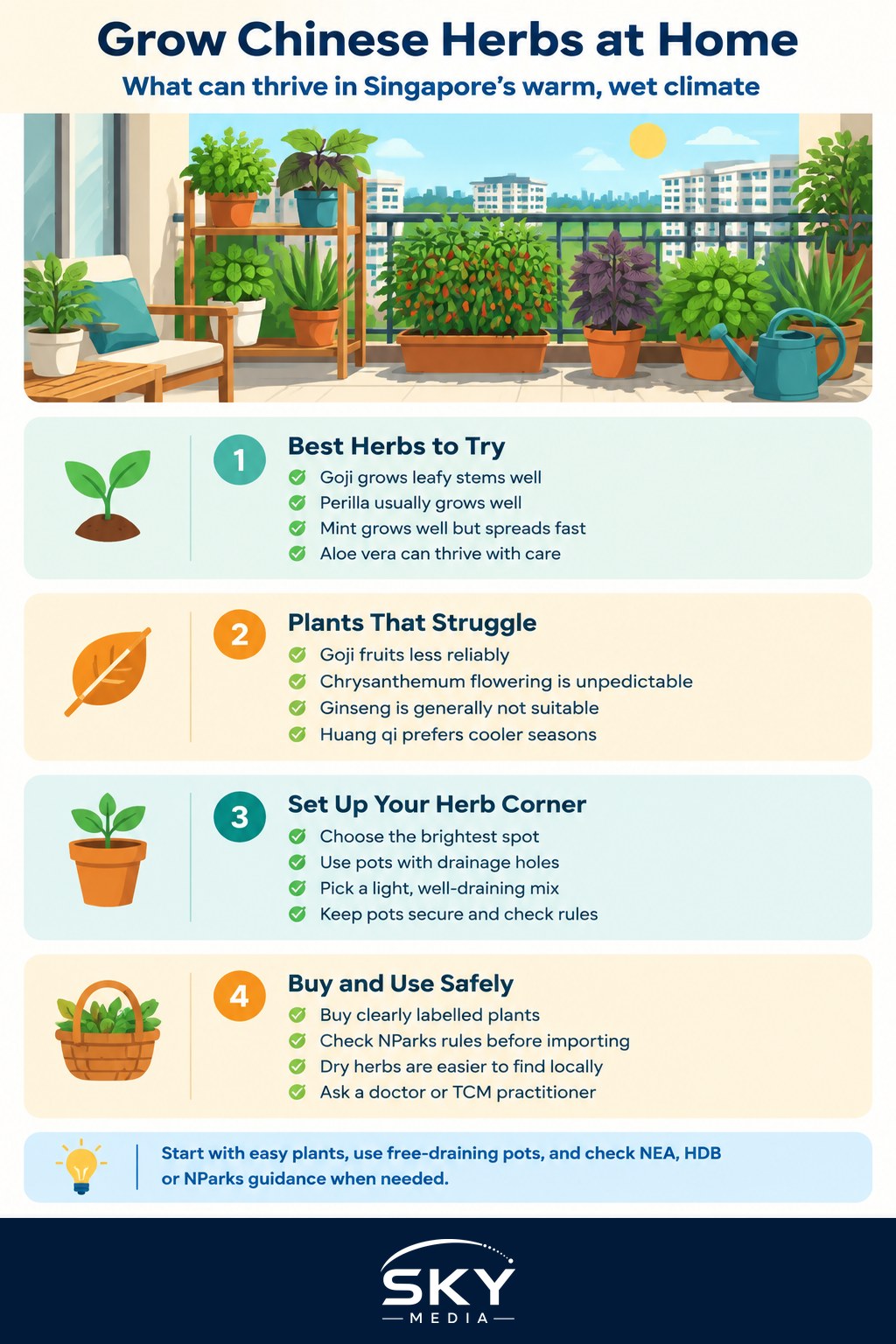
The table below gives a general picture based on climate needs. Results vary with your exact spot, so treat it as a starting point and experiment.
| Plant | Chinese name | How it copes in Singapore | Main tips |
|---|---|---|---|
| Goji | 枸杞 gou qi | Grows leaves well, fruits less reliably | Full sun, fast-draining soil, prune often |
| Perilla | 紫苏 zi su | Usually grows well | Partial to full sun, pinch tips to keep bushy |
| Chrysanthemum (tea type) | 菊花 ju hua | Can grow, flowering is less predictable | Plenty of sun, avoid waterlogging |
| Mint | 薄荷 bo he | Grows well, can spread quickly | Grow in its own pot, water regularly |
| Aloe vera | 芦荟 lu hui | Thrives with care | Bright light, let soil dry between watering |
| Ginseng | 人参 ren shen | Generally not suitable | Needs cool forest conditions and cold seasons |
| Huang qi (astragalus) | 黄芪 | Difficult | Prefers dry, cooler climates with seasons |
A few more plants many Chinese families appreciate also do well in tropical pots, such as ginger (姜) and Chinese chives (韭菜). Our guide on how to grow pandan and local herbs covers other easy tropical herbs that pair well with these.
Plants that need cold winters, such as ginseng and many northern roots, are best bought dried from TCM halls rather than grown. Trying them at home usually ends in disappointment.
Setting Up a Small Herb Corner on Your Balcony
Most newcomers live in HDB flats or condominiums, where space and light are limited. Some practical ideas:
Find the brightest spot. Watch your balcony or window for a full day. Note where direct sun falls and for how long. Put sun-loving plants like goji and chrysanthemum there, and use shadier spots for mint or perilla.
Choose the right pots. Pots with drainage holes are essential in Singapore’s rain. Terracotta pots let roots breathe and dry out faster, which suits herbs from drier climates.
Use good potting mix. Ordinary garden soil can become heavy and compact in pots. A light, well-draining mix works better.
Follow building rules. HDB and many condos have rules about plants on ledges and in common corridors, mainly for safety and fire access. Keep pots secured and away from ledges, and check your town council or management for current guidelines.
Prevent mosquito breeding. This is very important in Singapore. Empty water from saucers and pot trays regularly, and do not let water collect anywhere. The National Environment Agency (NEA) shares guidance on preventing mosquito breeding at home, and it is worth following closely.
If you are new to container gardening, our guides to growing herbs and vegetables at home and growing mulberry at home give more detail on pots, soil and watering.
Buying Plants and Seeds Responsibly
You can find many herb plants at local nurseries, garden centres and some wet market stalls. A few things to know:
- Bringing plants or seeds from China: Singapore has rules on importing plants, seeds and soil to protect local agriculture and nature. The National Parks Board (NParks) handles these rules. Check the current requirements on the NParks website before bringing any plant material into Singapore, rather than packing it in your luggage.
- Dried herbs for cooking: goji berries, chrysanthemum flowers and other dried herbs are widely sold in supermarkets and TCM halls. Seeds inside dried berries may not grow well, so buying young plants is often easier.
- Correct identification: some plants look similar. Buy from sources that label plants clearly, and never eat or use a plant if you are unsure what it is.
Using What You Grow, Safely
Many people grow these plants simply for cooking and the comfort of something familiar. Goji leaves in soup, perilla in stir-fries and mint in drinks are everyday uses. For anything beyond normal food use, such as making herbal remedies, please consult a registered TCM practitioner or doctor. Herbs can interact with medicines, and doses matter.
Growing a small Chinese herb corner can be a lovely way to feel at home in a new country. Start with the easy plants, enjoy the leafy goji harvest, and accept that a few northern favourites are better bought than grown. Your balcony will soon smell a little like home.
Further reading: Can You Grow Lavender in Singapore?