

Every year, many families from mainland China choose Singapore for their children’s education: a bilingual system, safe streets and a familiar food culture. When the child is young, one parent, usually the mother, often comes along to look after them. In Chinese this is known as 陪读妈妈 (péidú māma), and in Singapore people often say “study mother”. This guide explains how the study mother Singapore route generally works, what to prepare, and what daily life looks like, so you can plan with clear expectations.
This is general information, not immigration advice. The rules are set by the Immigration and Checkpoints Authority (ICA) and the Ministry of Manpower (MOM), and they can change. Always confirm current requirements on the ICA and MOM websites before applying.
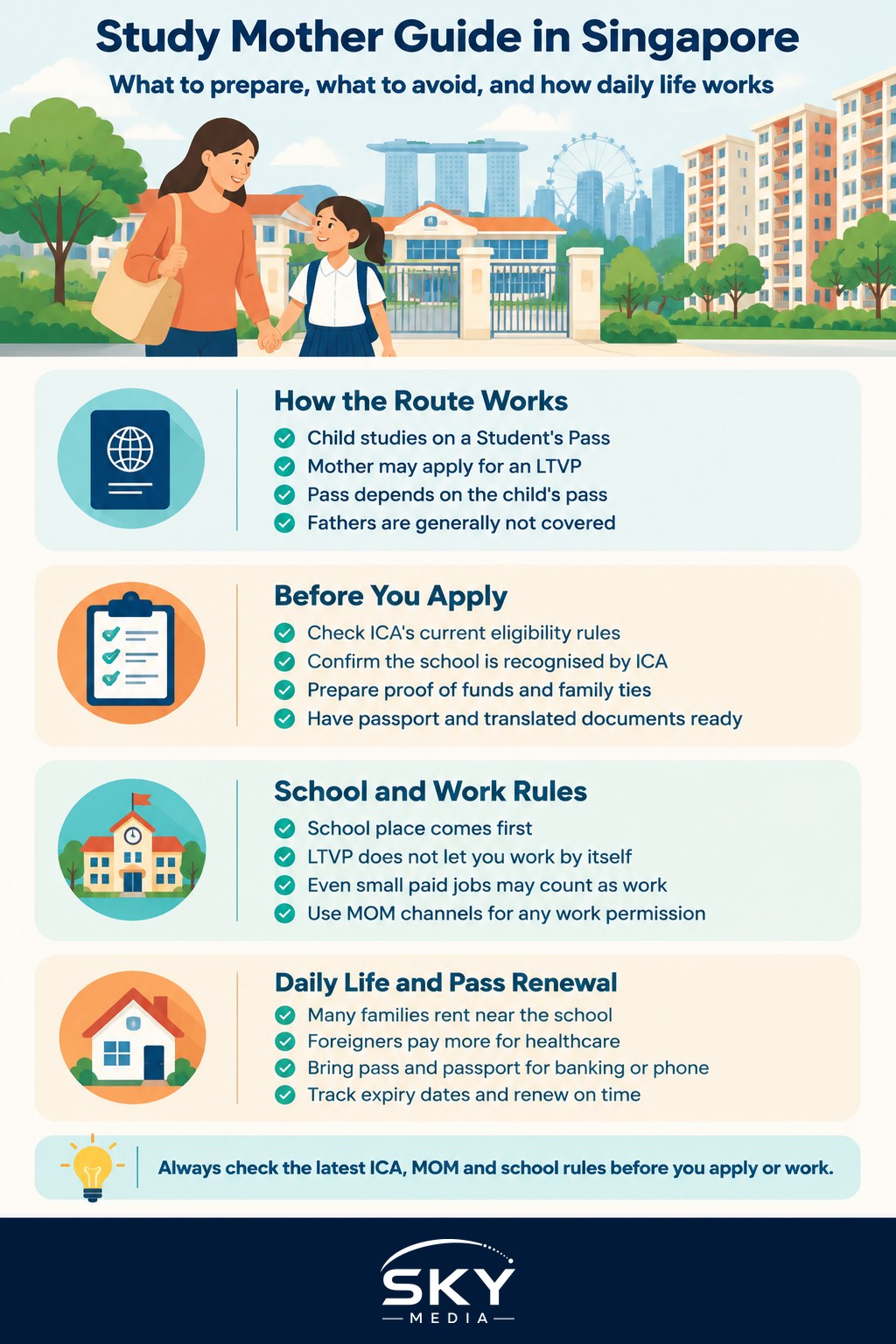
How the Study Mother Route Works
In China, a parent can simply move to the city where their child studies. In Singapore, every foreigner who stays long term needs a pass, and the child and the mother each need their own.
- The child studies on a Student’s Pass, issued by ICA after the child is accepted by a school.
- The mother may apply for a Long-Term Visit Pass (LTVP) to accompany the child. ICA has a category for mothers (and in some cases grandmothers) of foreign students studying in Singapore. Fathers are generally not covered by this route.
Your pass depends on your child’s pass. If the child’s Student’s Pass ends, is cancelled, or the child changes school without renewing properly, your LTVP is likely to be affected too. Some readers know this pass by other names, such as the “Student’s Guardian Pass”; our article on the Student’s Guardian Pass for mothers of foreign students covers the same idea from the school-admission side. For the general LTVP system, see the Long-Term Visit Pass explained.
Before You Apply: What to Check
ICA sets the eligibility rules, such as which schools and age groups qualify and what financial ability you need to show. Do not rely on agents or social media posts for these details, because they change. Check ICA’s website directly for:
- Eligible schools and levels. The route is linked to the child studying full time at a school ICA recognises for this purpose. Ask the school as well.
- Your child’s age or level. There may be limits on when a mother can accompany a child.
- Financial proof. ICA usually expects evidence you can support yourself and your child without working here.
- Documents. Expect passports, your child’s birth certificate showing you as the mother, the child’s Student’s Pass details, and possibly marriage or custody papers. Documents not in English may need official translation.
Getting a school place comes first. For MOE government schools, international students usually go through a central admissions test called AEIS (Admissions Exercise for International Students) run by MOE. International schools and some private schools have their own admission processes.
Comparing Your Main School Routes
Your choice of school affects your costs, your child’s routine, and whether the study mother route fits. Here is a broad comparison.
| School type | How children usually get in | What to think about |
|---|---|---|
| MOE government schools | Central admissions test for international students (AEIS) and placement by MOE | Lower fees than private options but higher than for citizens; placement depends on vacancies |
| International schools | School’s own application and assessment | Higher fees; foreign curricula such as IB; check whether the school qualifies for your pass route |
| Private schools and enrichment centres | Varies by school | Check whether the course qualifies for a Student’s Pass at all before enrolling |
Fees for international students change, so confirm the current figures with MOE or the school.
Work Rules: What You Can and Cannot Do
This is the area where study mothers most often get into trouble, so read it carefully.
- An LTVP does not let you work by itself. In China you might find casual work easily. In Singapore, working without the correct permission is an offence, and it can put both your pass and your child’s education at risk.
- There have been restrictions on employment for study mothers, especially in the first period of stay. If you want to work later, a Singapore employer generally has to apply for a work pass or permission for you through MOM.
- “Small jobs” still count. Tutoring for cash, working at a relative’s shop, selling food from home or doing beauty services for payment may all count as work.
Check MOM and ICA’s websites for the current rules before taking any paid work.
Daily Life as a Study Mother
Life in Singapore can feel familiar in some ways and new in others. Practical points many study mothers find helpful:
- Housing. Many families rent a room or a whole flat near the school. HDB flats are public housing; renting a whole HDB flat or room has its own rules, and some landlords prefer certain tenants, so view carefully and read the tenancy agreement.
- Healthcare. Foreigners pay higher rates at polyclinics and public hospitals than citizens, and schemes such as CHAS (subsidies at private GP clinics) are generally for Singaporeans. Buy health insurance for yourself and your child before arrival.
- Banking and phones. Bring your pass and passport to open a bank account or get a mobile line. Requirements vary by bank.
- School life. Schools communicate through apps and emails in English. Join the parent group chat, and ask teachers if you are unsure about anything.
- Language. English is the main language at school. Mandarin is widely spoken in daily life, but learning basic English will make dealing with schools, clinics and landlords much easier.
- Community. Many mothers find support through other study mothers, community centres, and religious or cultural groups. Building friendships helps a lot with loneliness, especially if your husband stays in China.
Keeping Your Pass Valid Over the Years
A study mother’s stay often lasts several years. To avoid problems:
- Track two sets of dates: your child’s Student’s Pass and your own LTVP. Set reminders well ahead of each expiry.
- Renew on time using ICA’s online services, and follow any instructions to collect new cards.
- Tell the school and ICA about changes such as a change of school, address or passport.
- Keep your child’s attendance good. Schools report attendance, and poor attendance can affect a Student’s Pass.
- Plan for transitions, such as moving from primary to secondary school, when passes may need fresh applications.
Is This Route Right for Your Family?
Being a study mother is a big decision. It can give your child a strong education and a close bond with you, but it often means living apart from your husband, a higher cost of living, and limits on working. Talk openly as a family about money, time frames and what happens if plans change.
If you are also thinking about bringing grandparents to help, our guide on bringing your parents to Singapore explains the options. Whatever you decide, plan with official information from ICA, MOE and MOM, and you will start your new life on solid ground.
Official sources: ICA
Further reading: Long-Term Visit Pass for Chinese Spouses