

A Hakuba ski trip from Singapore puts you in the Northern Japan Alps, in a valley of linked ski areas in Nagano Prefecture that hosted events at the 1998 Winter Olympics. It is a popular alternative to Hokkaido for Singaporeans because it pairs big mountain scenery with an easy add-on of Tokyo, and the route there is entirely by train or bus once you land.
This guide focuses on what is specific to Hakuba: the journey from Tokyo, how the different resorts compare, how the valley’s lift passes work, and how to budget. If you are still deciding between destinations, start with planning a ski trip from Singapore, and compare with Niseko from Singapore for the Hokkaido option.
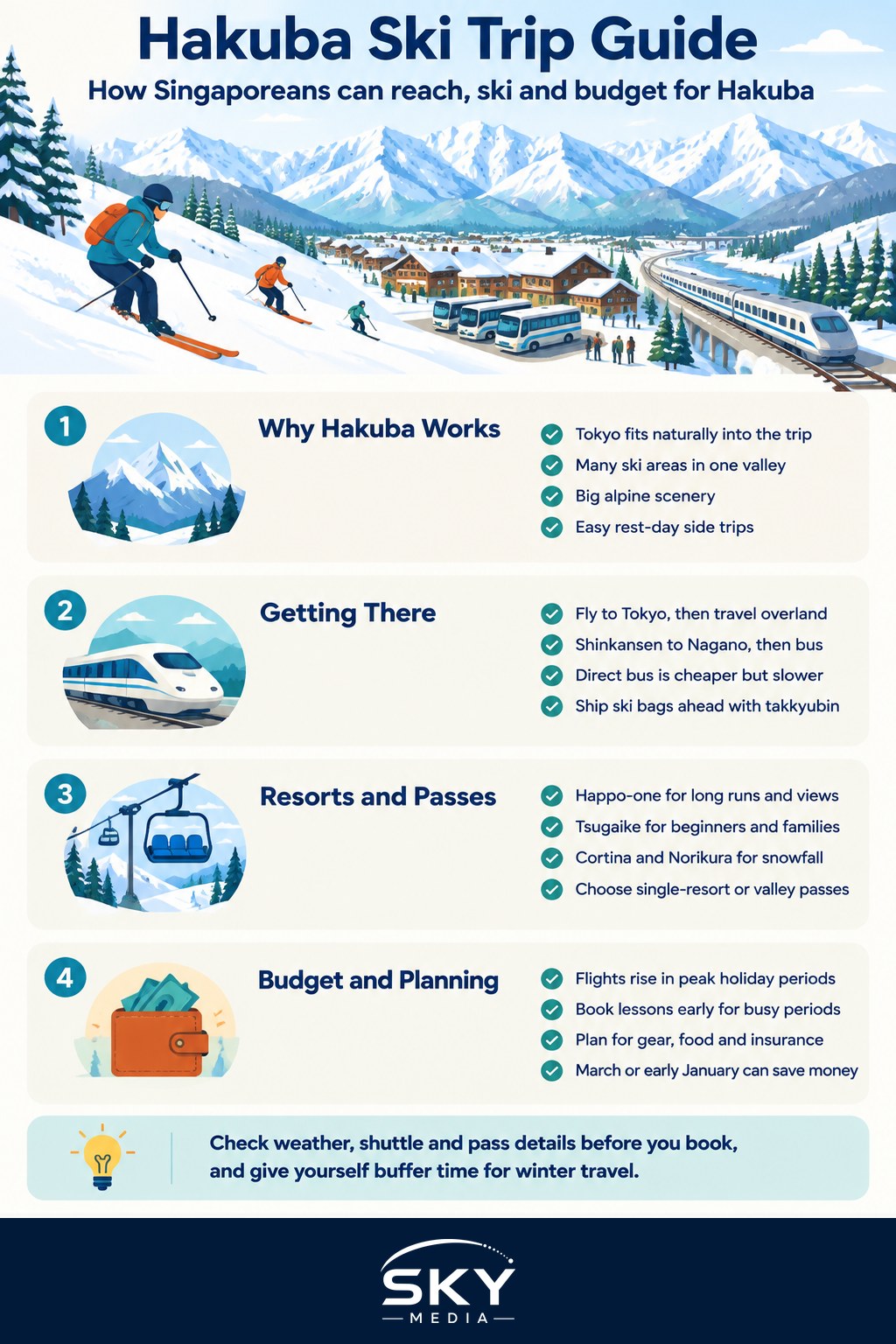
Why Singaporeans Pick Hakuba Over Hokkaido
Hakuba and Niseko are often compared, and both are good. Hakuba tends to appeal for a few reasons:
- Tokyo is on the way. Most travellers fly into Tokyo anyway, so it is natural to spend a few days in the city before or after the mountains.
- Many resorts in one valley. Hakuba Valley groups around ten ski areas, from wide beginner slopes to steep, open bowls. You can try a different hill on different days.
- Alpine scenery. The resorts sit beneath tall, jagged peaks, which gives a very different feel from Hokkaido’s rounded volcanic terrain.
- Easy side trips. Matsumoto Castle, the snow monkeys at Jigokudani near Yudanaka and Nagano city’s Zenko-ji temple are all reachable on rest days.
Snow quality in Hakuba can be excellent, but it is generally a little less consistent than Hokkaido’s famously dry powder, and lower slopes can be affected by warmer spells early or late in the season. Most skiers aim for January and February for the most reliable conditions.
Getting to Hakuba via Tokyo and Nagano
There are no direct flights from Singapore to Nagano. The usual pattern is to fly to Tokyo (Narita or Haneda), then travel overland. Your main options:
| Route | How it works | Best for | Things to watch |
|---|---|---|---|
| Shinkansen to Nagano, then bus | Hokuriku Shinkansen from Tokyo Station to Nagano, then an express bus to Hakuba | Most travellers; fast and comfortable | Two legs with luggage; check the bus timetable before booking trains |
| Direct highway bus from Tokyo | Long-distance bus from central Tokyo or the airports to Hakuba | Travellers on a budget or with lots of gear | Longer journey; seasonal schedules; snow can slow roads |
| Limited express via Matsumoto | Train from Tokyo (Shinjuku) to Matsumoto, then a local line or bus to Hakuba | Travellers combining a stop in Matsumoto | Slower; more connections |
| Private or shared transfer | Pre-booked van from Tokyo or Nagano to your lodge | Families and groups | Higher cost per head unless the group is large |
Practical tips for the journey:
- Ship your bags. Japan’s luggage forwarding services (called takkyubin) can send ski bags or suitcases from the airport to your hotel, which makes the train leg much easier. Book a day or two ahead.
- Check JR pass value. Whether a rail pass is worth it has changed over the years as prices were revised. Compare it with buying point-to-point tickets for your actual itinerary.
- Allow buffer time. Winter weather can delay buses. Avoid planning a tight connection to an evening flight on your departure day.
Hakuba Valley Resorts at a Glance
The ski areas are spread along the valley, with shuttle buses linking the villages and main lodging areas in season. A rough guide to the better-known names:
- Happo-one: The best known, with long runs and big views, and the Olympic downhill heritage. Lots of intermediate and advanced terrain, close to the main village area of restaurants and bars.
- Hakuba 47 and Goryu: Linked areas popular with intermediates, with a good mix of groomed runs and terrain parks. Goryu’s lower slopes are handy for beginners.
- Iwatake: A smaller mountain with valley views, often quieter, and a good choice on windy days.
- Tsugaike: Known for wide, gentle slopes that suit beginners and families, with backcountry-style terrain higher up for experienced skiers with the right guidance.
- Cortina and Norikura: At the northern end, known for heavy snowfall and tree skiing, with a quieter, more local feel.
- Smaller areas: Spots such as Jigatake, Kashimayari and Sanosaka are useful for families and those wanting fewer crowds.
Where you stay shapes the trip. Echoland and the Happo area are lively and walkable to restaurants. Staying near Tsugaike or Goryu can be calmer and suits families who want to ski in and out of the same base each day.
Lift Passes and Lessons
Hakuba offers both individual resort tickets and a valley-wide pass that covers multiple ski areas, usually with access to the shuttle buses between them. How to choose:
- Staying at one resort with beginners? A single-resort ticket is often enough, especially if your group is spending most days in ski school.
- Confident skiers wanting variety? The valley pass lets you move between mountains depending on snow and weather.
- Multi-day passes usually work out cheaper per day than buying daily, and some can be bought online in advance.
Prices change each season and differ by age and number of days, so check the official Hakuba Valley and individual resort websites for the current rates. For lessons, English-speaking ski and snowboard schools operate in the valley. Book group or private lessons early for Singapore’s December school holidays and Chinese New Year, when demand peaks.
If you plan to go off-piste or into the backcountry, only do so with a qualified local guide and proper avalanche equipment. Respect closed areas and resort boundary rules; they exist for safety.
Budgeting for a Hakuba Ski Trip
It is difficult to give a single figure because costs depend on dates, group size and style. The main budget lines to plan for:
- Flights from Singapore to Tokyo, which rise sharply in the December school holidays.
- Transport from Tokyo to Hakuba and back, plus luggage forwarding.
- Accommodation, ranging from simple guesthouses and pensions to apartments and hotels with onsen.
- Lift passes, lessons and equipment rental (skis or snowboard, boots, helmet and clothing if you do not own them).
- Food and drinks. Village restaurants are often busy in peak weeks, so book dinner tables ahead or choose accommodation with a kitchen.
- Travel insurance with winter sports cover. Check that your policy includes skiing or snowboarding and the medical evacuation you might need.
Ways Singaporeans commonly keep costs down include travelling in early January after the New Year rush or in March, renting winter clothing rather than buying, sharing an apartment as a group and eating some meals from convenience stores.
A Sample Week in Hakuba
A typical seven-night structure that works well from Singapore:
- Day 1: Arrive in Tokyo, take the Shinkansen and bus to Hakuba, collect rentals.
- Days 2 to 5: Ski different resorts; use the shuttle buses and book lessons for the first two days if you are new.
- Day 6: Rest day for the snow monkeys or Nagano city, then an onsen soak.
- Day 7: Final ski day.
- Day 8: Return to Tokyo for a night or two before flying home.
Pack proper thermal layers, waterproof gloves and sunglasses or goggles, as the sun reflects strongly off snow. If it is your first time in serious cold, layer up in the morning and remove a layer at lunch rather than starting underdressed.
Frequently Asked Questions
What is the best month for skiing in Hakuba? Most skiers aim for January and February, when conditions are usually the most reliable. Lower slopes can be affected by warmer spells early or late in the season, and the snow is generally a little less consistent than Hokkaido’s.
Is Hakuba good for first-time skiers and families? Yes, parts of it are. Tsugaike is known for wide, gentle slopes that suit beginners and families, and Goryu’s lower slopes are handy for learners. English-speaking ski schools operate in the valley, so book lessons early.
How do I get from Tokyo to Hakuba without hauling luggage on trains? Use Japan’s luggage forwarding service, called takkyubin, to send ski bags or suitcases from the airport to your hotel. Book a day or two ahead. A pre-booked private or shared transfer also avoids carrying gear between train and bus.
Do I need a Hakuba Valley pass or a single-resort ticket? A single-resort ticket is often enough if you are staying at one resort with beginners. Confident skiers wanting variety may prefer the valley pass, which covers several ski areas. Check current prices on the official Hakuba Valley and resort websites.
Does regular travel insurance cover skiing in Japan? Not necessarily. Many policies exclude winter sports unless you add cover, so confirm that yours includes skiing or snowboarding and medical evacuation. Off-piste skiing should only be done with a qualified local guide and avalanche equipment.
Further reading: The Scottish Highlands From Singapore: A Road Trip Guide · Margaret River From Singapore: Wine, Beaches and Caves · Karuizawa From Singapore