
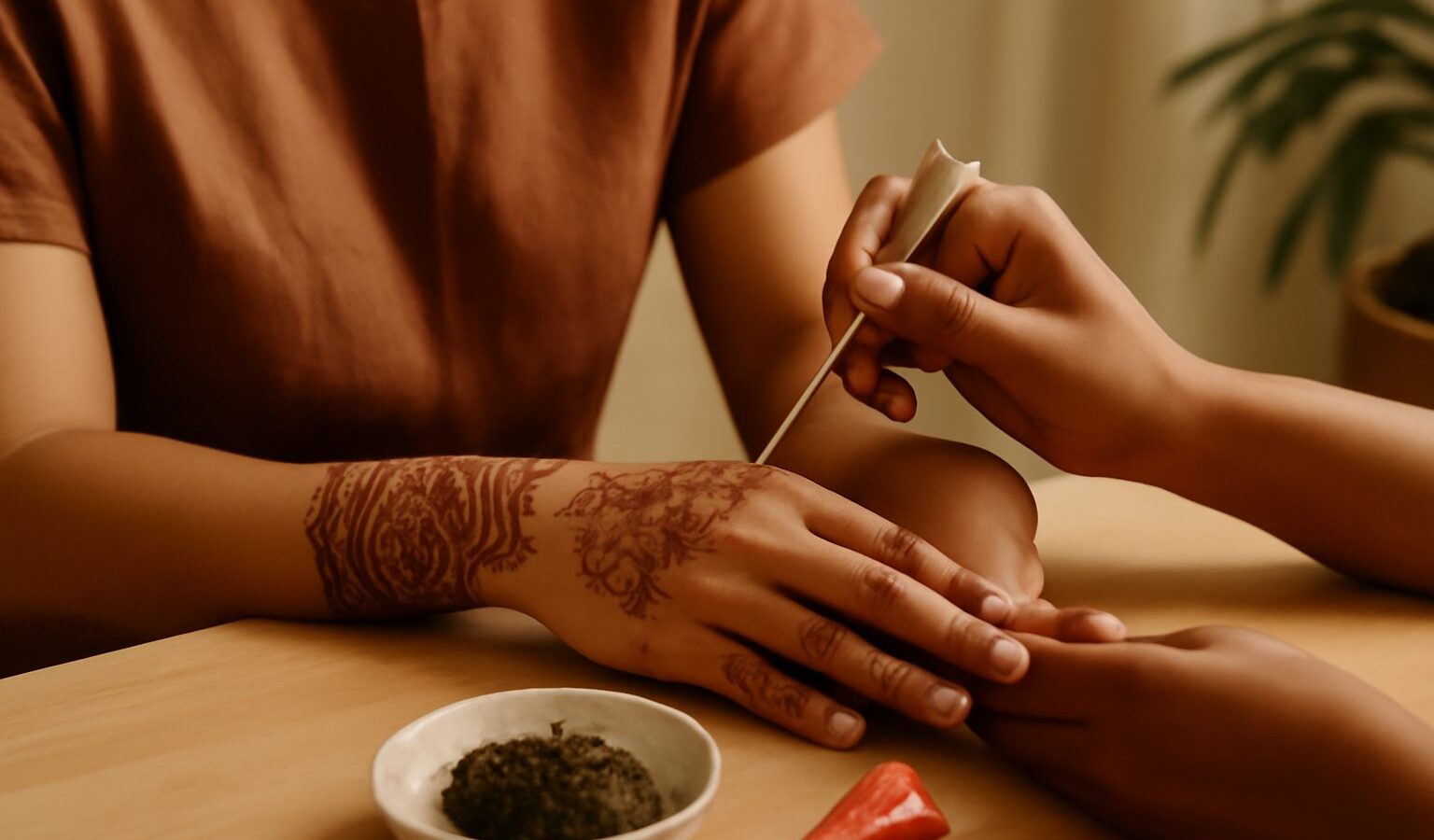
Reddish brown patterns curling across the back of a hand, growing more elaborate towards the wrist, are one of the most recognisable images of celebration across South Asia and the Middle East. In Singapore, henna is a familiar sight around weddings and festivals, worn with pride by brides and guests alike. Exploring henna in Singapore means meeting a plant based art form that crosses several communities, from Indian to Malay to Arab, and that welcomes newcomers to admire and even try it. This guide explains what henna and mehndi are, how the designs are applied, where to find them, and the customs that surround this warm tradition.
What Henna and Mehndi Are
Henna is a natural dye made from the leaves of the henna plant, a shrub that grows in hot, dry regions across South Asia, the Middle East and North Africa. The dried leaves are ground into a powder, then mixed into a paste that stains skin, hair and nails a rich reddish brown. Applied to the skin in patterns, it leaves a temporary design that deepens over a day or two and fades over one to three weeks as the skin naturally renews.
Mehndi is the word used across the Indian subcontinent for this art of decorating the body with henna, and by extension for the designs themselves. The term comes from Hindi and Urdu, and in South Asian weddings a whole celebration, the mehndi function, is often devoted to adorning the bride’s hands and feet. In Arabic speaking cultures the same art is often simply called henna. In Singapore you will hear both words, sometimes interchangeably, reflecting the many communities who practise it.
The art is worn most for joyful occasions. A bride’s henna is often the most intricate, with designs flowing from fingertips up the forearms, and guests and family members may wear simpler versions to share in the celebration. Because henna sits within cultural and, for some, religious festivity, the specific customs around it vary widely by community, family and personal choice, and are best understood from the people celebrating rather than assumed.
How Henna Is Applied
Modern henna artists usually work with a fine cone or a bottle with a thin nozzle, piping the paste onto the skin in delicate lines, much like decorating a cake. The general steps are:
- Prepare the paste. Henna powder is mixed with a mild liquid and left to rest so the dye is released and ready to stain.
- Plan the design. The artist and the wearer agree on a pattern, from a small motif to full hands and forearms.
- Apply the paste. Working freehand, the artist pipes fine lines, dots, paisleys, flowers and lattice work onto the skin.
- Let it set. The paste must dry and stay on the skin for a period, often an hour or more, so the stain develops.
- Remove and reveal. Once dry, the crumbly paste is gently scraped off, leaving a pale design that darkens over the next day or two.
Design styles differ by tradition. Indian and Pakistani mehndi tends towards dense, all over patterns with fine detail, Arabic henna often features bolder, more open floral trails, and contemporary artists blend these freely. Aftercare matters too, as keeping the area warm and avoiding water at first helps deepen the colour.
A word on safety is worth noting gently. Traditional henna is plant based and produces a brown stain. Products marketed as black henna can contain additives that some people react to, so many artists and health bodies advise sticking to natural henna, doing a small patch first, and choosing a reputable artist.
Where to Find Henna in Singapore
Henna is easy to encounter across the island, especially around the festival calendar, and you do not need to belong to any one community to appreciate or wear it.
- Little India, where shops and stalls along Serangoon Road and nearby lanes often offer henna application, busiest before Deepavali, the festival of lights.
- Malay and Muslim celebrations, where henna, sometimes called inai in Malay, features around Hari Raya and at wedding customs.
- Festival bazaars and cultural events, where visiting artists set up booths and passers by can have a small design done.
- Weddings and private celebrations, where professional artists are booked for the bridal party, always to be enjoyed as a welcomed guest.
- Community workshops and heritage programmes, which sometimes teach the basics to people of all backgrounds.
To place henna within the wider story of the Indian community here, pair it with a visit to the Indian Heritage Centre in Little India. If floor art catches your eye at the same festivals, our guide to kolam and rangoli art covers the doorway patterns you will often see nearby.
Henna Across Singapore’s Communities
Henna is one of those traditions that several communities share, each with their own accent. The table below sketches broad tendencies for a newcomer, though individual practice always varies by family and personal taste.
| Aspect | South Asian mehndi | Arabic henna | Malay inai |
|---|---|---|---|
| Common name | Mehndi | Henna | Inai |
| Typical style | Dense, fine, all over patterns | Bolder, open floral trails | Often applied at wedding customs |
| Key occasions | Weddings, Deepavali, celebrations | Weddings, Eid, festivities | Wedding rituals, Hari Raya |
| Usual placement | Hands, forearms, feet | Hands and feet | Hands, sometimes fingertips |
| Who wears it | Brides, family, guests | Brides, family, guests | Bride and groom, family |
Why Henna Still Matters
Henna endures in Singapore because it is affordable, temporary and deeply social. Applying it is often a communal event, with women gathering to laugh and talk while designs take shape, and the shared reddish stain becomes a visible sign of belonging to a celebration. Its impermanence is part of the appeal, as a design marks an occasion and then gently fades, ready to be renewed at the next.
The art is also evolving. Younger artists post their work online, blend regional styles and experiment with new motifs, while festivals and bazaars bring henna to a broad, multiracial public. For a newcomer, the respectful way to take part is straightforward. Enjoy the artistry, choose a reputable artist and natural henna, and if you attend a wedding or festival where henna is offered, accept it in the celebratory spirit it is given.
To keep discovering Singapore’s living traditions, explore our guides to traditional lantern making and kolam and rangoli art. Together they show how colour, pattern and light carry meaning across the island’s many communities, and how a curious visitor is almost always welcome to look, learn and join in.