
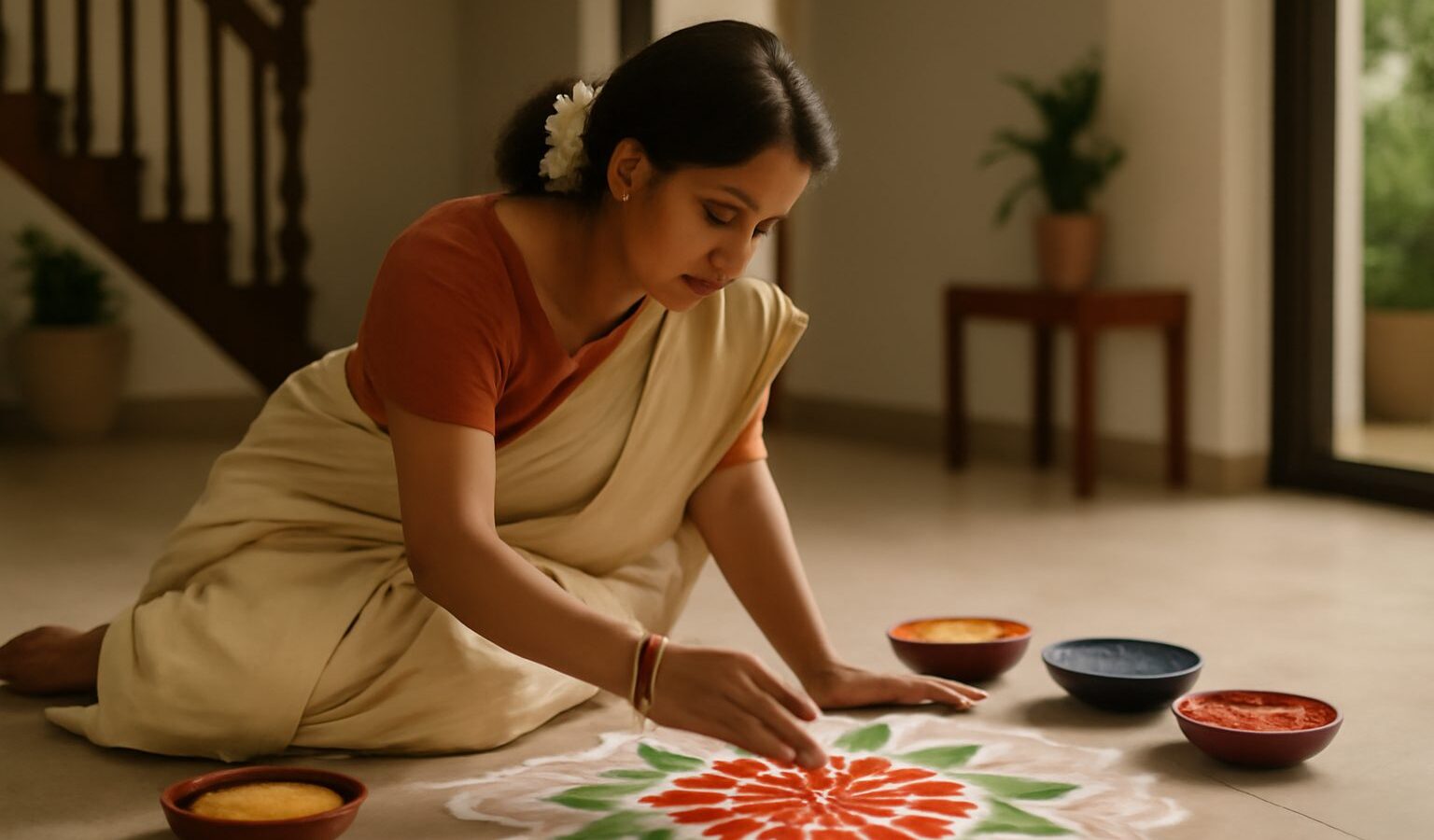
Walk through Little India in the days before Deepavali and you may notice intricate patterns of colour and line spreading across floors and thresholds. This is kolam art, a South Indian tradition of drawing geometric and floral designs on the ground, and its northern cousin rangoli. In Singapore, where the practice travelled with Tamil and other Indian communities, these floor patterns are a warm, visible part of the cultural landscape, especially during festivals. This guide explains what kolam and rangoli are, how they are made, where a curious newcomer can encounter them, and why they still matter to the people who make them.
What Kolam and Rangoli Are and Where They Come From
Kolam is a form of decorative floor drawing from Tamil culture in southern India. The word comes from Tamil and refers to the patterns themselves, which are traditionally drawn freehand at the entrance of a home. A maker usually works with rice flour, ground stone powder or chalk, letting it fall in a controlled stream from between the fingers to form dots, loops and lines. Classic kolam is built around a grid of dots, called pulli, which the maker connects with continuous looping lines or joins into shapes. Many designs are symmetrical and unbroken, a single line that winds around the dots and returns to where it began.
Rangoli is a broader term used across much of India, and in the north especially, for coloured floor art made during festivals and celebrations. Where much traditional kolam is drawn in white or a single tone, rangoli often uses vivid coloured powders, and sometimes flower petals, coloured rice or sand, to fill in bold shapes. In everyday Singapore usage the two words are often heard together, and you will see both plain white patterns and richly coloured ones. In some Tamil homes the same practice is also called muggu, a regional term.
For many families the daily or festival act of drawing a kolam carries meaning beyond decoration. It is widely understood as a gesture of welcome and auspiciousness at the threshold of a home, and in its traditional form, made with rice flour, as a small offering that feeds ants, birds and other small creatures. Because these designs sit within a living cultural and religious tradition, the deeper spiritual significance is best understood from practitioners and the community’s own teachers rather than from any single fixed explanation.
How a Kolam Is Made
At its simplest, a kolam is a pattern of dots joined by lines, but skilled makers turn that framework into remarkable complexity. The general process looks like this:
- Clean and prepare the ground. Traditionally the threshold is swept and sometimes dampened so the powder holds.
- Lay out the dot grid. The maker places a grid of pulli, evenly spaced, which sets the size and symmetry of the design.
- Draw the lines. Holding powder in one hand, the maker lets it flow while tracing loops that curve around the dots or connect them into petals, stars and knots.
- Fill and finish. Coloured powders or petals may be added for a rangoli effect, along with borders and repeated motifs.
Common motifs include lotuses, peacocks, mango shapes, lamps and geometric knots, each drawn from a long visual vocabulary. A daily kolam might be small and quick, while a festival piece for Deepavali or a wedding can be large, layered and worked on by several people. Because the powder is loose, the art is deliberately impermanent. It is walked over, blown away or swept up and drawn fresh the next day, which is part of its quiet meaning.
Where to See Kolam Art in Singapore
Singapore offers plenty of chances to encounter this tradition, particularly around the Indian festival calendar. The most reliable time is the run-up to Deepavali, the festival of lights, usually falling between October and November, when the Little India district is decorated and community groups create large display pieces.
- Little India and Serangoon Road, where shopfronts, community spaces and event stages often feature large seasonal kolam and rangoli during Deepavali.
- Cultural institutions and heritage venues, which sometimes host demonstrations, workshops or floor-art displays around Indian festivals.
- Temples, weddings and home celebrations, where you may see kolam at entrances, always to be viewed respectfully and photographed only with permission.
- Community centres and schools, which occasionally run kolam or rangoli activities open to residents of all backgrounds.
To understand the wider setting of this art, it is worth pairing a visit with the Indian Heritage Centre in Little India, which tells the story of the Indian community in Singapore and the region. For festival context, kolam often appears alongside temple activity described in our guide to deity birthdays and temple processions.
Kolam and Rangoli Compared
The two traditions overlap a great deal and the words are often used loosely, but it helps newcomers to see the general distinctions side by side. These are broad tendencies rather than strict rules, and practice varies by family and region.
| Feature | Kolam (Tamil and South Indian) | Rangoli (broader, often North Indian) |
|---|---|---|
| Typical base | Rice flour, stone powder or chalk | Coloured powders, sometimes petals or rice |
| Usual colour | Often white or a single tone | Frequently bright and multi-coloured |
| Core structure | Built on a grid of dots and looping lines | Often filled shapes and freehand designs |
| Everyday use | Can be drawn daily at the doorway | More often for festivals and special days |
| Common occasions | Daily practice, Deepavali, weddings | Deepavali, celebrations and events |
Why the Tradition Endures
Kolam and rangoli survive in Singapore because they are practical, beautiful and full of meaning at once. A pattern at the doorway signals that a home is cared for and that guests are welcome, and the act of making one can be a daily meditation or a shared family effort before a festival. Passed from grandparents to children, often mother to daughter, the skill carries memory as much as technique.
The tradition is also adapting. Some makers now use pre-drawn templates, stickers or coloured stencils for convenience, and competitions and public displays keep the art form visible to a wide, multiracial audience. Schools and community groups increasingly invite people of every background to try their hand, which turns a household custom into a shared civic celebration.
For a newcomer, the respectful way to appreciate kolam art is simple. Admire the designs, ask before photographing anyone or their doorstep, and if you are invited to a workshop or a home during Deepavali, accept with curiosity and warmth. To keep exploring related crafts and customs, see our guides to henna and mehndi and traditional lantern making, two more living traditions that light up Singapore’s festival seasons.
Kolam is a reminder that some of the most striking art around us is made to last only a day. That impermanence, far from a weakness, is the point. Each morning brings a fresh chance to draw welcome across the threshold once more.