

If you are viewing a flat and notice a locked green door marked with an electrical warning sign at the void deck, or a cluster of antennas on the roof, you are not alone in wondering what it means. Buying a home near substation Singapore listings often raises the same questions: is it safe, will it hum, and will the next buyer care? This guide walks through the facts on electromagnetic fields (EMF), how Singapore regulates them, what you can actually check during a viewing, and how perception affects resale.
This is general information, not medical or professional advice. For specific readings or health concerns, refer to the National Environment Agency (NEA), the Infocomm Media Development Authority (IMDA) and your doctor.
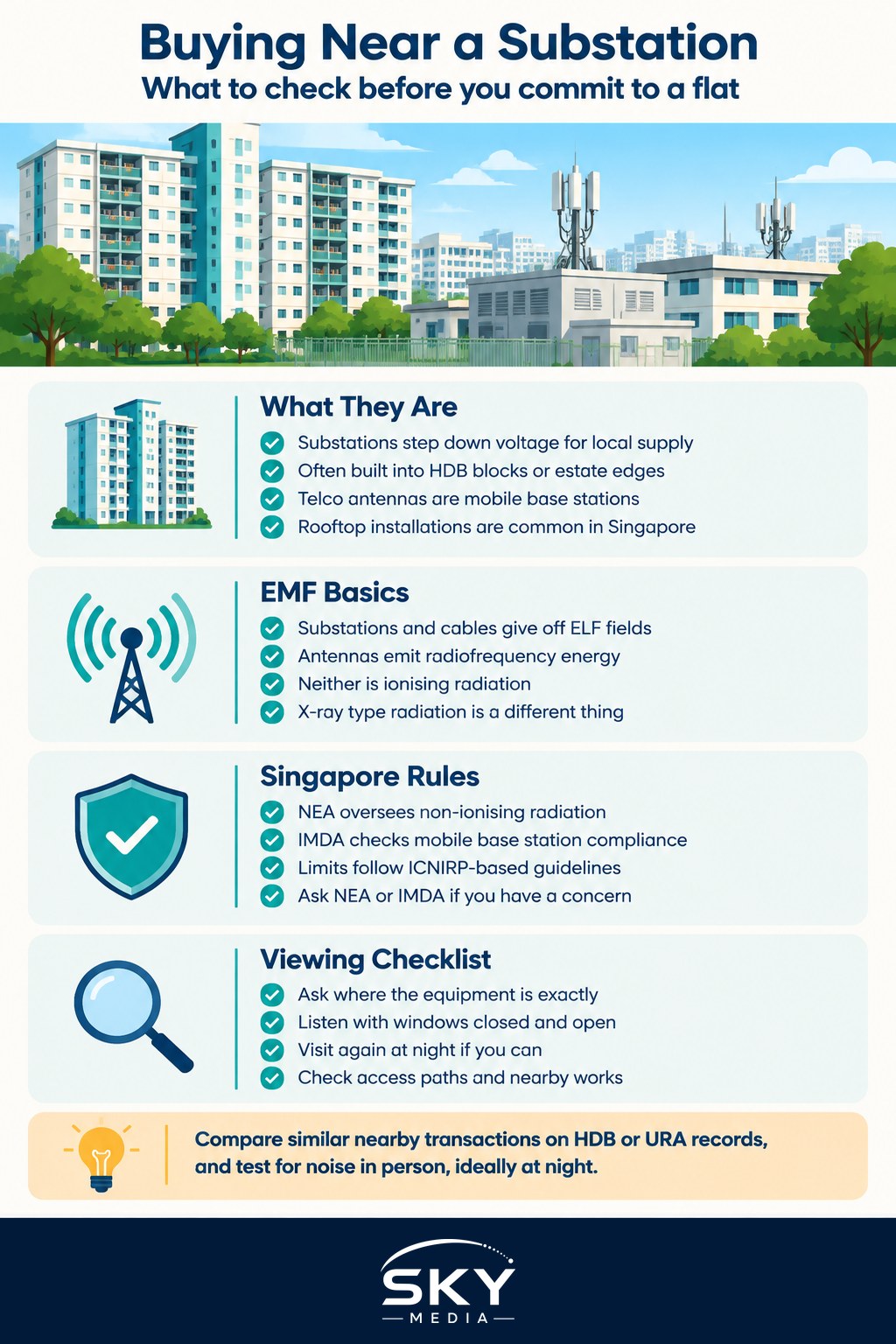
What These Structures Actually Are
Singapore’s power grid runs mostly underground, so the electricity reaching your home passes through a network of distribution substations. Many are built into the ground floor of HDB blocks, at the edge of a condo carpark, or as a small standalone building in an estate. They step down voltage for local supply and are maintained by the grid operator, SP Group.
Telco antennas, often called mobile base stations, are the boxes and panels you see on HDB rooftops and condo roofs. They carry mobile and data signals for the operators. Because Singapore is dense and residents expect strong coverage indoors, rooftop installations are common and, in many estates, unavoidable.
The two produce different kinds of fields:
- Substations and power cables produce extremely low frequency (ELF) electric and magnetic fields, linked to the flow of electricity.
- Telco antennas emit radiofrequency (RF) energy, the same type of non-ionising radiation used by your own phone and home Wi-Fi.
Neither is ionising radiation of the kind associated with X-rays. That distinction matters when you read alarming posts online.
How Singapore Sets EMF Limits
Singapore does not leave exposure levels to chance. NEA is the agency responsible for non-ionising radiation and references international guidelines, notably those of the International Commission on Non-Ionizing Radiation Protection (ICNIRP), which the World Health Organization also points to. IMDA requires mobile operators to ensure their base stations comply with exposure limits based on these guidelines.
In practice, this means:
- Base stations are designed and positioned so that areas accessible to the public stay within the limits. Antennas point outward, not down into the block below.
- Measurements taken around homes near substations and antennas generally show levels far below the guideline limits, and fields drop off quickly with distance and walls.
- If you have a specific concern, you can contact NEA or IMDA. Agencies have historically responded to public requests about EMF levels, though how this is handled can change, so check their current websites for the right channel.
Do not rely on cheap handheld EMF meters sold online. They are often uncalibrated, measure the wrong frequency range, and spike near ordinary appliances like your fridge or induction hob, which can cause needless worry.
Practical Issues That Matter More Than EMF
For most buyers, the real day-to-day considerations are not radiation but noise, access and layout. Here is how the two structures compare.
| Factor | Electrical substation (ground level) | Telco antenna (rooftop) |
|---|---|---|
| Type of field | Low frequency electric and magnetic fields | Radiofrequency signals |
| Possible noise | Low hum from transformers, fans or ventilation, mainly for units right above or beside it | Usually silent; occasional equipment cooling noise near the rooftop |
| Units most affected | Ground and lower floors directly above or next to the room | Top floor units, mainly from maintenance access and roof works |
| Maintenance activity | Occasional SP Group works, vehicle access, temporary barricades | Periodic technician visits through the rooftop access |
| Buyer perception | Mixed; some buyers avoid, many do not notice | Mixed; some buyers worry about health, others value strong signal |
Checking for noise
Transformer hum is a low, constant drone. Whether you hear it depends on the unit’s position, the wall between you and the equipment, and ambient noise from traffic. During a viewing:
- Ask the agent or seller exactly where the substation room is relative to the unit.
- Stand in the bedroom closest to it with windows closed, and then open. Listen for a minute.
- Visit again at night, when background noise is lower and a hum is more noticeable.
- Ask the neighbours on the same stack whether they notice anything.
Checking for access and works
Substations need clear access for maintenance vehicles. If the substation door faces your ground floor window or patio, you may occasionally see works and barricades outside. For top floor units below antennas, ask whether roof access hatches are near your door and whether technicians pass through the common corridor.
How Buyer Perception Affects Resale
Even when the science is reassuring, some buyers will still hesitate. In feng shui terms, some people prefer not to live directly above or facing utility installations, and others simply feel uneasy. This can mean:
- A slightly smaller pool of interested buyers when you sell, particularly for units directly above a substation.
- More questions at viewings, which you can answer calmly with facts about NEA and IMDA oversight.
- Possible negotiation leverage for you as a buyer today, since some sellers may accept a lower offer.
On the other hand, many buyers do not notice or care, and a strong mobile signal is a quiet benefit, especially for anyone working from home. Check recent transaction prices for comparable units in the same block on HDB’s resale price records or URA’s private property data before assuming any discount or premium. Prices depend on many factors, and a substation is rarely the deciding one.
If you are weighing other nearby features that can affect value, see our guides on buying a home near an industrial area and buying a home near a bus interchange, which use a similar checklist approach.
Questions to Ask Before You Commit
Bring these to your viewing or ask your property agent to find out:
- Where exactly is the substation or antenna? Get the floor, stack and distance from the unit.
- Is it existing or planned? Ask whether any new installation is being proposed. Town councils or MCSTs (Management Corporation Strata Titles, the body that manages a condo) may know of upcoming works.
- Has anyone complained about noise? For condos, check MCST meeting minutes if available. For HDB, ask neighbours.
- What faces the bedroom? A substation beside the living room matters less than one under the master bedroom.
- How is the indoor mobile signal? Ironically, units right under rooftop antennas sometimes have average indoor signal, since antennas beam outward.
Weighing It Up for Your Family
If someone in the household is pregnant, has a medical implant such as a pacemaker, or has particular health concerns, speak to your doctor about everyday exposure. Device makers and doctors can tell you whether everyday environmental fields are relevant to a specific implant, and most give guidance on keeping phones at a set distance rather than avoiding buildings.
For everyone else, the useful approach is to separate measurable facts from feelings. If the noise check is fine, the unit suits your needs, and the price reflects the market, a nearby substation or antenna is usually a minor factor. If you know it will keep bothering you, it is fair to walk away; peace of mind is part of a home’s value.
It also helps to compare against other common concerns buyers have, such as living close to an MRT depot or a bin centre, where the trade-offs are more about noise and smell than invisible fields.
Key Takeaways
- Substations produce low frequency fields; telco antennas produce radiofrequency signals. Both are non-ionising.
- NEA and IMDA oversee exposure, with limits based on international ICNIRP guidelines. Check their websites for current rules and how to raise a concern.
- Noise, maintenance access and resale perception are the practical issues. Test them in person, ideally at night.
- Check comparable transaction prices through HDB or URA rather than assuming a discount.
- Health questions about implants or pregnancy belong with your doctor.
Further reading: Buying a Home Near a Hospital or Columbarium: What to Weigh