

Temples are woven into Singapore’s neighbourhoods. You will find Chinese temples tucked between HDB blocks, Hindu temples along busy roads, Buddhist centres in landed estates and small shrines near hawker centres. If you are viewing a home near temple grounds, the location can be a quiet bonus or a source of friction, depending on the temple, the unit and your own habits.
This guide looks at the practical trade-offs: festival noise, traffic and parking, incense and smoke, and how other buyers may see the location when you eventually sell. It is written for buyers of every background and is not a judgement on any faith. Temples are valued parts of their communities, and many residents live beside them happily for decades.
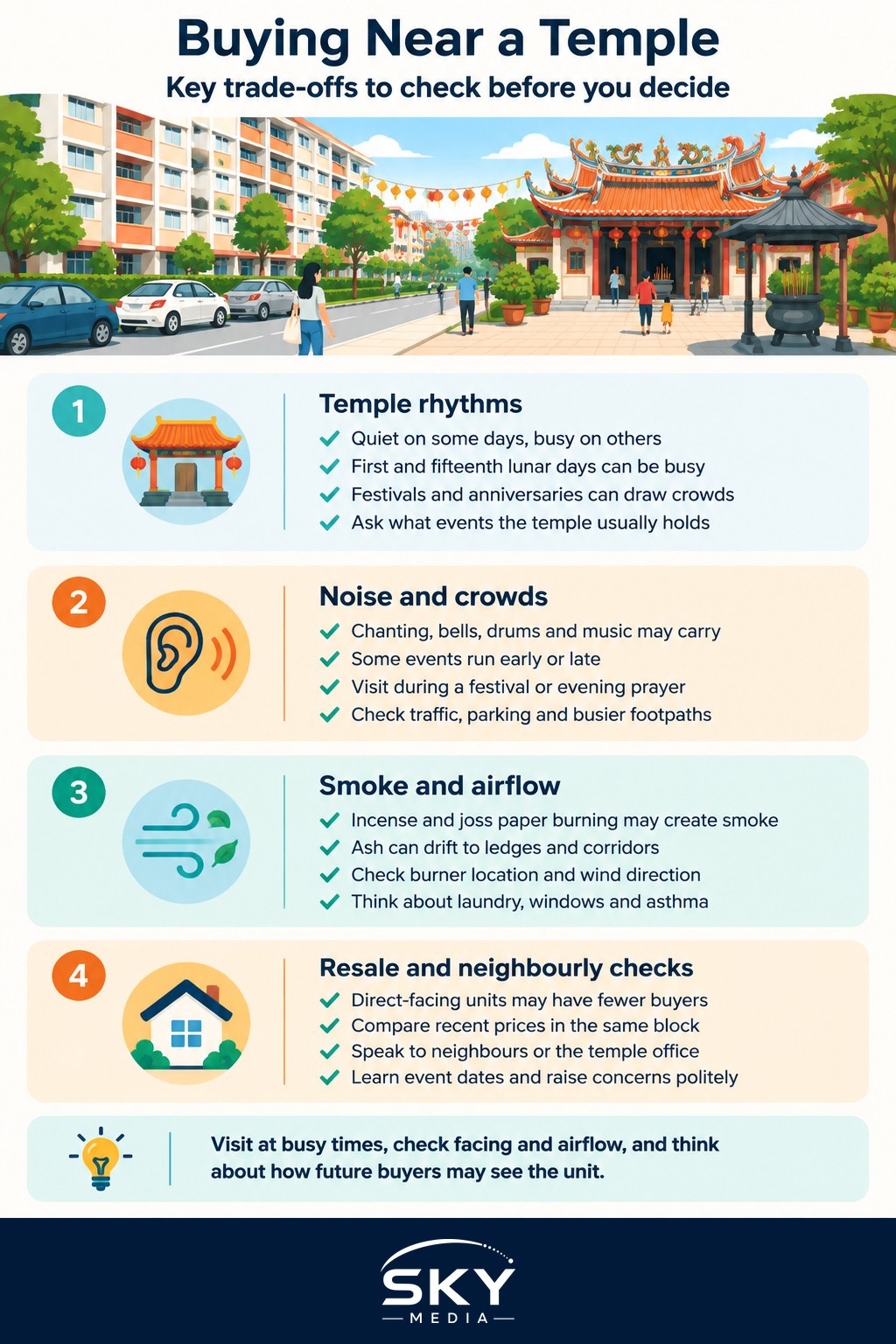
Why Location Next to a Temple Deserves Its Own Check
Most homes near a place of worship are perfectly ordinary to live in. The difference is that temples have rhythms. A temple may be almost silent on a Tuesday morning and packed on the first and fifteenth days of the lunar month, during a deity’s birthday celebration or over a major festival. If you view only once, at a quiet hour, you may form the wrong impression.
The impact also varies by type and size of temple. A small neighbourhood shrine has a very different footprint from a large temple that draws visitors from across the island. Before falling for a unit, find out:
- What kind of temple it is and how many people it typically draws.
- Which festivals and annual events it observes.
- Whether it hosts regular evening prayers, classes or community meals.
- How far the unit is from the main gate, prayer hall and any burning area.
Festival Noise and Event Days
Celebrations are the part buyers ask about most. Depending on the temple, you may hear chanting, bells, drums, gongs, music or amplified speeches during prayers and festivals. Some events run late into the evening, and some start early in the morning.
Common busy periods in Singapore include Chinese New Year, the Hungry Ghost Festival in the seventh lunar month, the Nine Emperor Gods Festival, Vesak Day, Thaipusam, Deepavali and each temple’s own anniversary or deity celebrations. Not every temple marks every event, and practices vary between communities, so ask rather than assume.
To gauge the noise:
- Visit during an event. Ask the temple office or a nearby resident about the next big celebration and return then, ideally in the evening.
- Stand inside the unit with windows open. Sound carries differently on different floors and facings.
- Ask neighbours. People living on the same stack will tell you whether noise is occasional or frequent.
- Check the unit’s position. A unit facing the temple’s courtyard hears far more than one facing away.
Most temples are considerate neighbours and many events are only a few days a year. If you work from home, have a newborn or sleep early, factor it in more heavily.
Traffic, Parking and Weekend Crowds
Popular temples can draw crowds that spill into nearby roads. On festival days and some weekends, you may notice:
- Cars circling for parking or stopping along the road.
- Tour buses or chartered coaches dropping off devotees.
- Busier bus stops and footpaths around the temple entrance.
- Temporary tentage, stalls or road closures for large events.
For HDB residents, this can mean a fuller multi-storey carpark on some days. For landed homes, it can mean cars parked near your gate. Visit on a weekend and during a festival to see how traffic flows, and check where visitors usually park.
Incense, Joss Paper and Air Quality
Many Chinese temples burn incense, and some have furnaces for burning joss paper offerings. During festivals, especially the seventh lunar month, burning can increase noticeably. Smoke and ash may drift with the wind, which matters for laundry hung outside, open windows and residents with asthma or other breathing sensitivities.
When viewing, check:
- Where the burners or furnaces are located relative to the unit.
- The prevailing wind direction and whether your windows face the temple.
- Signs of ash on ledges, corridors or air-conditioner compressors.
- Whether the household includes anyone sensitive to smoke.
If air quality is a health concern for your family, speak to your doctor about what is sensible for your situation, and weigh this factor seriously.
How Buyers Perceive the Location
Perception affects both your own comfort and your future resale price. Views differ widely:
- Some buyers see it as a positive. Being near a temple can feel peaceful, convenient for worship and part of a lively community.
- Some buyers avoid it. A portion of buyers prefer not to live directly facing a place of worship for personal or feng shui reasons. Feng shui is a traditional Chinese practice about the arrangement and orientation of spaces, and beliefs about it vary greatly between families.
- Many buyers do not mind at all. For them, what matters is noise, traffic and air quality, not the building’s purpose.
The practical upshot is that a unit directly facing a temple may attract a smaller pool of interested buyers than an otherwise similar unit facing elsewhere. That can mean a little more negotiating room when you buy, and potentially a longer time to sell. Check recent transaction prices for different stacks in the same block or development to see whether the market treats them differently.
What to Compare Before Making an Offer
| Factor | What to check | Best time to check |
|---|---|---|
| Noise | Chanting, bells, music, amplified events | During a festival or evening prayer |
| Traffic and parking | Road congestion, carpark occupancy, drop-offs | Weekend mornings and festival days |
| Smoke and ash | Burner location, wind direction, ash on ledges | Seventh lunar month or major celebrations |
| Unit facing | Whether windows look into the temple grounds | Every viewing |
| Resale perception | Price differences between stacks | Before negotiating, using recent transactions |
This is the same kind of location-specific weighing you would do when buying a home near a future construction site or buying property near an MRT line: the feature itself is neither good nor bad, but its effect on your daily life and your eventual buyers is what counts.
Living Well Beside a Temple
If you go ahead, a few habits make for good neighbourly relations:
- Learn the calendar. Knowing when big events fall lets you plan, close windows or schedule a weekend away.
- Introduce yourself. Temple committees are often happy to share event dates with nearby residents.
- Raise concerns politely. If something bothers you, speaking to the temple office first usually works better than escalating. For persistent issues in HDB estates, your town council can advise on the right channel.
- Use the upside. Many temples run free community activities, festive meals or cultural performances that are open to all.
Buying a home near a temple can work very well for the right household. Visit at the busy times, look closely at facing and airflow, and price in how future buyers may see the location before you sign the Option to Purchase.
Further reading: Buying a Home Near a Hospital or Columbarium: What to Weigh