
Japan is home to some of the world’s best-known carmakers, electronics firms, game studios and trading houses, and many Singapore investors want a slice of that market. The good news is that it is straightforward to buy Japanese stocks from Singapore through a broker with access to the Tokyo Stock Exchange (TSE). The details that trip people up are the board lot size, the yen conversion, dividend tax and trading hours.
This guide walks through the practical steps and compares direct shares with Japan-focused funds. It is general information, not financial advice. Fees, products and tax rules change, so check the current details with your broker, and consider speaking to a licensed financial adviser before investing.
Choosing a Broker With Tokyo Market Access
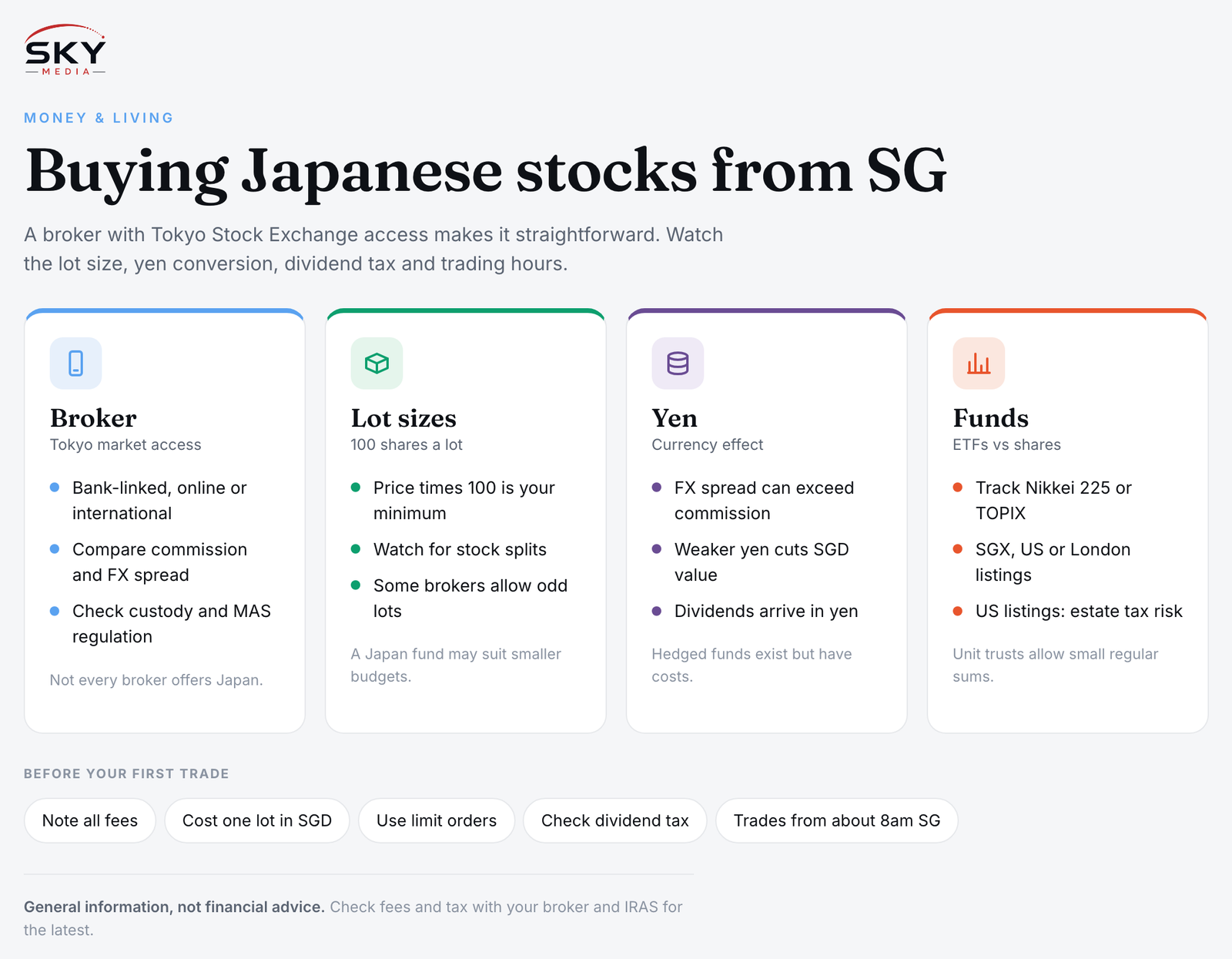
Not every Singapore broker offers Japanese shares, so the first step is checking market coverage. Brokers generally fall into a few groups:
- Local bank-linked brokers. Some offer access to Japan alongside SGX, often with a familiar app and the option of a custodian account. Commissions on foreign markets can be higher.
- Online multi-market brokers. Many app-based brokers offer Japan among a long list of markets, often with lower commissions, though the exact fees vary.
- International brokers. Platforms aimed at active investors tend to offer the widest market access and competitive currency conversion, with more complex interfaces.
When comparing, look at the commission per Japanese trade (including any minimum fee), the currency conversion spread, custody or platform fees, and whether shares are held in your name or in a custodian account. Check that the broker is regulated by the Monetary Authority of Singapore (MAS) or another reputable regulator. If you already invest abroad, our guides on US stocks and Hong Kong stocks cover similar broker questions for those markets.
Understanding Lot Sizes and Share Prices
On SGX you buy in board lots of 100 shares. Japan uses the same unit: most TSE-listed shares trade in units of 100. What makes Japan different is that some share prices are high in yen, so one lot of a popular company can cost a substantial sum once you multiply by 100.
A few things help:
- Check the total cost of one lot before you get attached to a company. Price times 100, converted to Singapore dollars, is your minimum outlay.
- Look out for stock splits. Several large Japanese companies have split their shares in recent years, partly to make lots more affordable to retail investors.
- Fractional or odd-lot trading. Some brokers let you buy fewer than 100 shares of Japanese stocks, but this is not universal and may carry different pricing. Ask your broker.
If one lot is too large a slice of your portfolio, a Japan-focused fund may be a better way in.
Converting Singapore Dollars to Yen
Japanese shares are priced and settled in yen, so currency is part of every trade. Brokers handle this in one of two ways: they convert automatically at the time of the trade, or they let you hold a yen balance that you convert yourself.
Points to watch:
- The conversion spread can quietly cost more than the commission. Compare the rate your broker offers against the mid-market rate.
- Currency risk works both ways. If the yen weakens against the Singapore dollar, your holding can be worth less in SGD even when the share price is unchanged, and the reverse is also true.
- Dividends arrive in yen. Find out whether your broker converts them automatically or credits them to a yen balance.
Some Japan funds offer currency-hedged versions that aim to reduce the effect of yen movements. Hedging has costs and does not suit everyone, so read the fund documents.
Direct Shares Versus Japan ETFs
You do not have to pick individual Japanese companies. Exchange-traded funds (ETFs) track a basket of Japanese stocks, such as a broad index like the Nikkei 225 or TOPIX. Here is how the main routes compare.
| Route | How you buy | Main advantages | Main things to watch |
|---|---|---|---|
| Direct TSE shares | Broker with Tokyo access, in yen | Own specific companies, receive dividends directly | Lot cost, FX spread, single-company risk |
| Japan ETF listed on SGX | Any SGX broker, in the listed currency | Familiar local market and hours | Check which Japan ETFs are listed now, as offerings change |
| Japan ETF listed in the US | Broker with US access, in USD | Many choices, high liquidity | US estate tax exposure, dividend withholding layers |
| Japan ETF listed in London (UCITS) | Broker with London access | Often more tax-efficient for Singapore investors than US listings | Fewer brokers, check the fund’s domicile |
| Japan unit trust | Bank, robo-adviser or fund platform | Small regular amounts possible | Ongoing fees can be higher |
If you are considering a US-listed Japan ETF, read our explainer on US estate tax risk for Singapore investors first, because it applies to US-domiciled funds as well as shares.
Dividends, Tax and Paperwork
Japan generally withholds tax on dividends paid to non-resident investors, so the dividend you receive is smaller than the declared amount. The rate is set by Japanese law and any applicable tax treaty, and can change, so check with your broker for the rate they currently apply. In most cases, an individual investor in Singapore does not pay further Singapore tax on these foreign dividends or on capital gains from investing, but your own situation may differ. Confirm with the Inland Revenue Authority of Singapore (IRAS) if you are unsure, especially if trading is a significant activity for you.
Japanese companies commonly pay dividends twice a year, and many have financial years ending in March, so results and dividend announcements tend to cluster around certain months. Our guide to ex-dividend dates explains how timing affects who gets paid.
Some Japanese companies also offer shareholder perks to holders above a certain number of shares, such as vouchers or product gifts. These are often designed for local investors and may be hard to redeem from overseas, so treat them as a bonus, not a reason to buy.
Trading Hours From Singapore
Japan is one hour ahead of Singapore. The TSE runs a morning session and an afternoon session with a lunch break in between. In Singapore time, that means trading starts around 8am and finishes in mid-afternoon, which is convenient compared with the US market. Exchange hours do get revised from time to time, so check the current schedule with the exchange or your broker. Note that Japanese public holidays, such as Golden Week in late April and early May, close the market even when SGX is open.
A Simple Checklist Before Your First Trade
- Confirm your broker offers Japanese shares and note all fees, including FX.
- Decide between individual companies and a Japan fund.
- Work out the cost of one 100-share lot in SGD.
- Decide whether to convert yen manually or let the broker convert.
- Read the company’s investor relations pages, many of which are available in English.
- Place a limit order rather than a market order, especially on less-traded shares.
- Keep records of trades and dividends for your own tracking.
Buying Japanese stocks from Singapore takes a few more steps than buying local shares, but once your account is set up, it is routine. Start small, understand the currency effect, and diversify sensibly. For broker-specific questions, contact the broker directly, and check MAS’s website to confirm a provider is regulated.