

Most families do not run out of money because they overspend every month. They get caught out because money arrives on one date, bills leave on another, and big yearly costs land without warning. A household cash flow system fixes the timing problem. Instead of tracking every cent, you set up a few accounts with clear jobs and let money move between them on a schedule.
This is different from a budgeting method such as envelopes or percentage rules. A budget decides how much goes where. A cash flow system is the plumbing that makes that decision happen automatically, month after month. It is general information, not financial advice, and you should check product terms with your own bank.
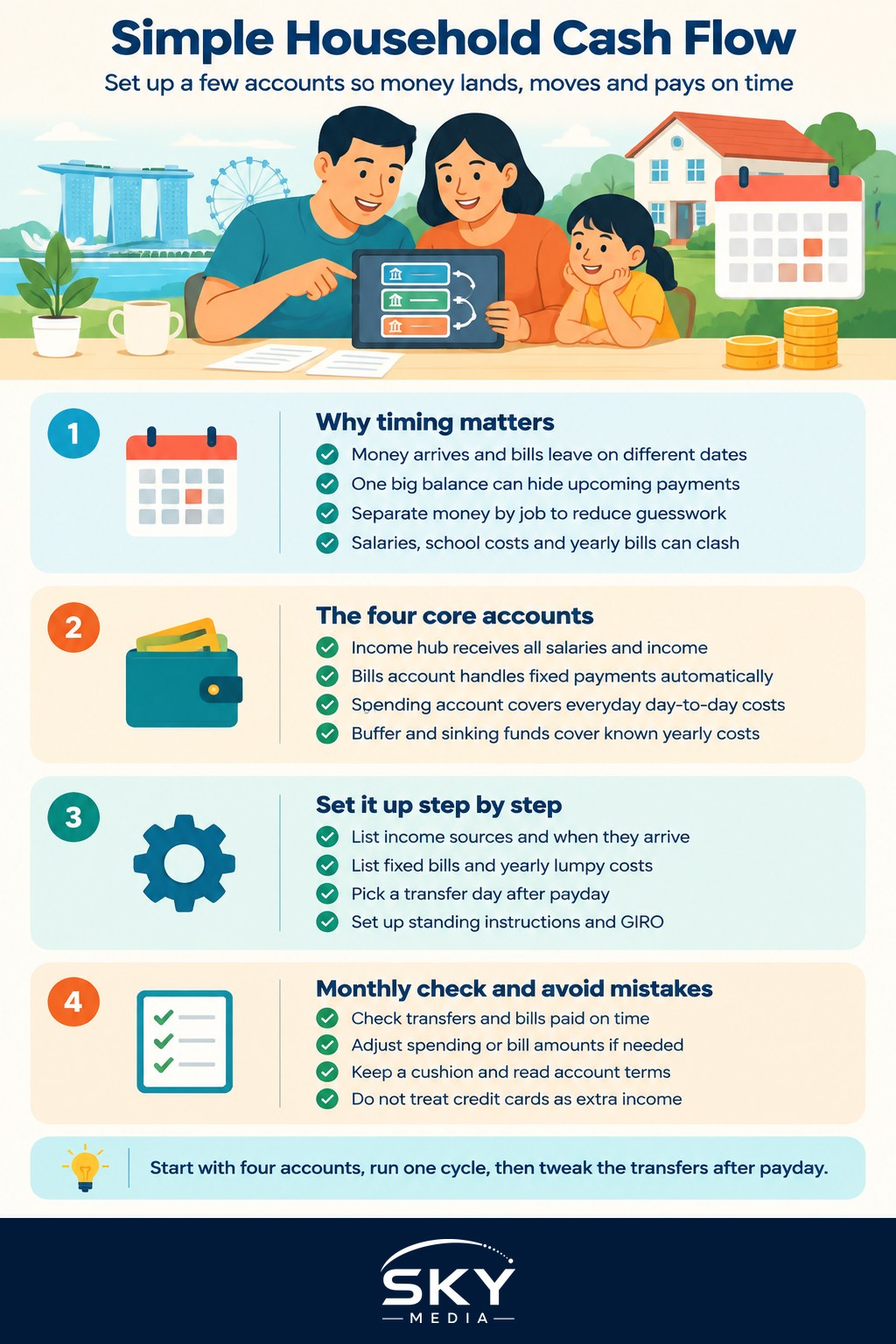
Why Timing Matters More Than You Think
Picture a typical Singapore household. Salaries arrive near the end of the month. The housing loan, insurance premiums, phone and utilities bills each leave on different days. School-related costs come in bursts at the start of terms. Then there are the irregular ones: property tax, car-related costs, annual insurance, Chinese New Year red packets, year-end holidays and festive gifts.
When everything sits in one account, the balance looks healthy right after payday and alarming a week before the next one. It is hard to know what is genuinely free to spend. People either overspend because the number looks big or feel anxious even when they are fine. Separating money by job removes that guesswork.
The Four Accounts at the Heart of the System
You do not need many accounts. Four roles cover most households, and some couples run a shared version of each plus small personal spending accounts.
| Account role | What goes in | What goes out | Ideal balance pattern |
|---|---|---|---|
| Income hub | All salaries and other income | Scheduled transfers to the other three | Near zero a few days after payday |
| Bills account | A fixed monthly transfer | Loan, utilities, insurance, telco, school fees via GIRO | Never dips below a small cushion |
| Spending account | A weekly or monthly allowance | Groceries, food, transport, everyday shopping | Runs down to the end of the cycle |
| Buffer and sinking funds | A fixed monthly transfer | Planned yearly costs and genuine emergencies | Grows steadily, drawn down on purpose |
Income hub. Every income stream lands here first. Nothing is paid directly from it. Its only job is to receive money and pass it on, which makes it easy to see what the household actually earns.
Bills account. Fixed and predictable outgoings live here. Set up GIRO (Singapore’s interbank direct debit arrangement) or standing instructions so bills are paid from this account automatically. Add up your monthly bills, include an allowance for the ones that vary, and transfer that amount in each month.
Spending account. This is the money you can spend without thinking. Link your everyday card or PayNow wallet to it. When it runs low, you slow down. No spreadsheet required.
Buffer and sinking funds. This holds your emergency cushion and the “sinking funds” for known yearly costs, meaning small monthly amounts set aside so a large bill is already covered when it arrives. Some banks let you create sub-accounts or labelled savings goals, which works well for this.
Setting It Up Step by Step
Give yourself a quiet weekend afternoon and work through these steps together if you share finances.
- List every income source and its date. Include salary, rental income, freelance pay and regular allowances. Note which arrive monthly and which are irregular.
- List every fixed bill and its due date. Pull the last few months of bank and card statements so you do not miss anything. Look for annual items you only remember once a year.
- Build a year-at-a-glance calendar of lumpy costs. Write down property tax, insurance renewals, road tax if you drive, school-related payments, festive spending, birthdays and holidays. Divide each yearly total by twelve to get a monthly sinking fund amount.
- Pick a transfer day. Choose a date a day or two after your main income arrives. All transfers out of the income hub happen on that day.
- Set up standing instructions. Schedule automatic transfers from the hub to the bills account, the buffer account and the spending account. Move bill GIRO arrangements over to the bills account.
- Run it for one cycle, then adjust. The first month will reveal bills you forgot or a spending allowance that is too tight. Tweak the numbers rather than abandoning the system.
If income is irregular, as with commission or freelance work, a useful approach is to let income build up in the hub and pay yourself a steady “salary” from it on the same day each month. Your spending then stays smooth even when earnings are not.
Handling the Lumpy Costs
The year-end period is a classic stress point. Christmas gifts, school holiday travel and festive gatherings all compete for money just before the new year brings its own costs. With sinking funds, these stop being surprises.
A few practical habits help:
- Name each sinking fund. “Holiday”, “Festive and gifts”, “Insurance renewals”, “Home maintenance”. Named pots are much harder to raid casually.
- Pay big items from the buffer, not the spending account. When a planned bill arrives, move exactly that amount across and pay it. Your day-to-day allowance stays intact.
- Decide in advance what to do with bonuses. If you receive a year-end bonus or other one-off income, decide a split before it arrives, for example topping up the buffer, prepaying a known cost and keeping a share to enjoy. Deciding beforehand avoids it quietly disappearing.
- Keep the true emergency cushion separate in your mind. Planned costs are not emergencies. If you keep dipping into the cushion for predictable things, increase the relevant sinking fund instead.
The 15-Minute Monthly Check-In
The system runs itself, but a short monthly review keeps it honest. Pick a regular slot, such as the weekend after payday.
- Check that every transfer went through and every bill was paid on time.
- Look at how the spending account ended the month. Did it run out early, or was there plenty left?
- Review sinking fund balances against the upcoming months on your calendar.
- Note any new subscriptions or bills and adjust the bills transfer.
- Once or twice a year, revisit the bigger picture: insurance coverage, savings goals and CPF statements. CPF Board and MoneySense, the national financial literacy programme, have helpful free resources.
Common Mistakes and How to Avoid Them
- Too many accounts. More than five or six pots usually becomes hard to manage. Start with four and add only when a real need appears.
- No cushion in the bills account. Utility bills vary. Keep a small buffer so a high month does not cause a failed GIRO deduction, which can bring charges from the bank or billing organisation.
- Forgetting account fees and conditions. Some accounts have minimum balance rules, fall-below charges or conditions on interest. Read your bank’s current terms before choosing which account plays which role.
- Treating credit cards as extra income. If you use a card for everyday spending, pay it in full from the spending account so the allowance still reflects real money.
If you prefer something more hands-on for daily spending, the system pairs well with cash stuffing and envelope budgeting. Business owners will recognise the same principles from managing business cash flow, and it is worth keeping household and business money in separate systems.
Frequently Asked Questions
How do I set up a cash flow system with irregular freelance income? Let income build up in your income hub and pay yourself a steady salary from it on the same day each month. Your spending then stays smooth even when earnings are uneven, and the other accounts still receive fixed transfers.
How much should go into sinking funds each month? List your yearly lumpy costs, such as insurance renewals, festive spending and holidays, then divide each yearly total by twelve. The sum of those amounts is your monthly sinking fund transfer. Adjust after the first cycle if something was missed.
Why does my GIRO fail even though I have money in the bank? The money may be in the wrong account. If bills draw from an account that has dipped below what the bill needs, the deduction can fail and may bring charges. Keep a small cushion in the bills account for months when utilities run high.
Can I still use a credit card with a cash flow system? Yes, as long as you pay the balance in full from the spending account. That keeps the allowance tied to real money rather than borrowing. Treating the card as extra income is one of the common mistakes.
What should I do with a year-end bonus under this system? Decide the split before it arrives, for example topping up the buffer, prepaying a known cost and keeping a share to enjoy. Deciding in advance stops it quietly disappearing into everyday spending.
Further reading: How to Handle a Sudden Drop in Household Income · How to Build a Moving-Out Fund Before Renting in Singapore · A Q2 Money Reset Checklist for Singapore Households