

Learning focus and recompose in Singapore is one of those small skills that quietly makes your photos look more intentional. The idea is simple. You lock focus on your subject, then move the camera to arrange a nicer composition before you press the shutter. It sounds fiddly, but once it becomes muscle memory, you will do it without thinking, whether you are shooting a friend at Gardens by the Bay or a bowl of laksa at a hawker centre.
This technique matters because many cameras place the sharpest, most reliable autofocus point right in the centre of the frame. That is great for nailing focus, but terrible for composition, since putting your subject dead centre often looks flat. Focus and recompose lets you have both: crisp focus and a balanced frame.
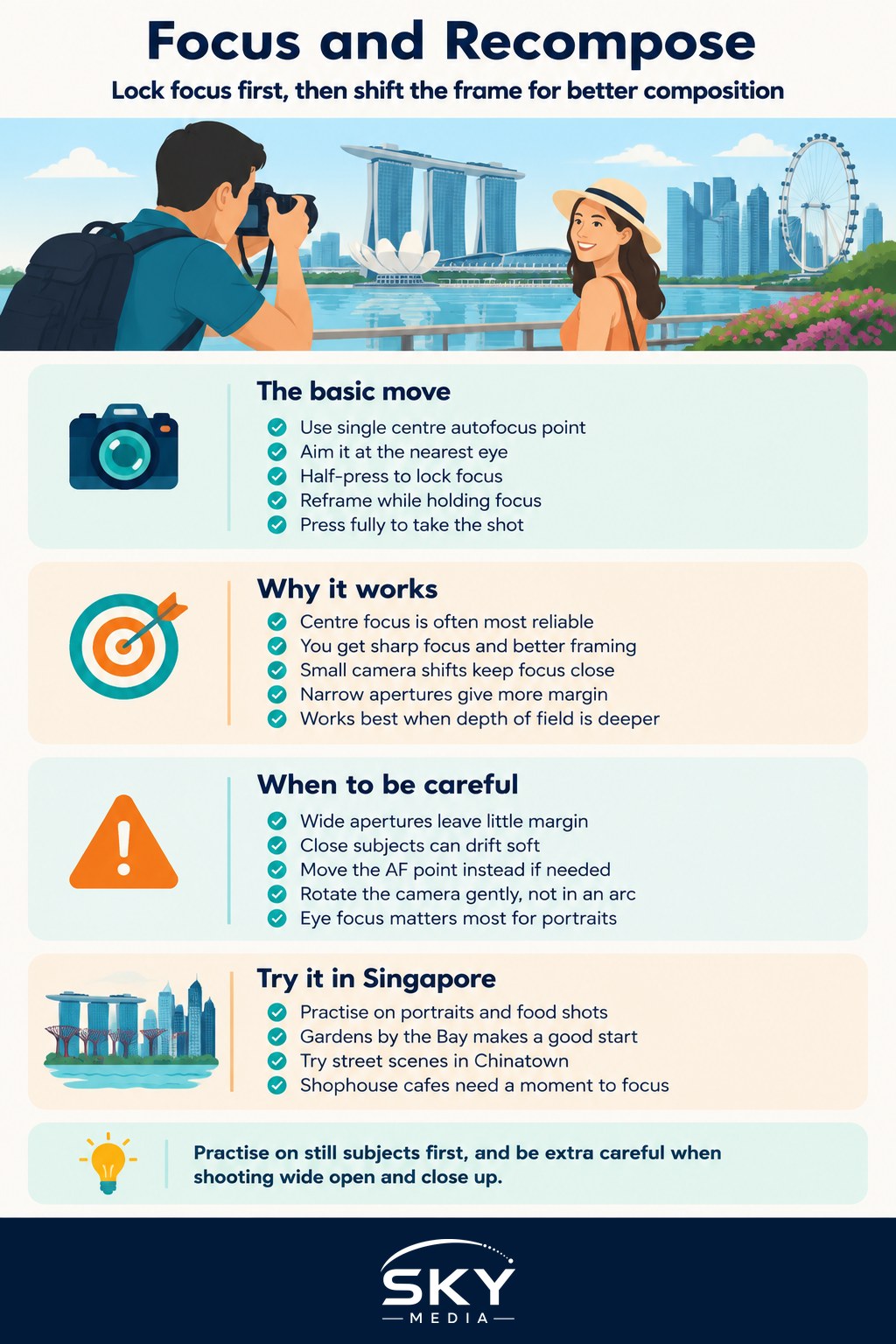
What Focus and Recompose Actually Means
Here is the basic move, step by step.
- Select your single centre autofocus point. On most cameras you can switch from a wide, automatic mode to single-point AF in the menu or with a quick button.
- Aim that centre point at the most important part of your subject. For a person, that is almost always the nearest eye.
- Half-press the shutter button to lock focus. You should hear a beep or see a focus confirmation light.
- Keep the shutter held at that halfway point, then move the camera to frame the scene the way you want.
- Gently press the shutter the rest of the way to take the photo.
That is the whole thing. The camera keeps the focus distance locked while you reframe, so your subject stays sharp even though it is no longer in the middle of the frame.
Many photographers prefer to separate the focusing action from the shutter entirely. If you are curious about that approach, our guide on how to use back button focus explains how to move focusing onto a dedicated thumb button, which pairs beautifully with recomposing.
Why It Works and When It Fails
Focus and recompose works because you are only pivoting the camera slightly. The focus distance to your subject barely changes, so the subject stays within the sharp zone. This is closely tied to how much of your scene is in focus at once, which is your depth of field. When you shoot at a narrow aperture like f/8 or f/11, you have plenty of margin and this technique is very forgiving.
The catch appears when you shoot with a very wide aperture, such as f/1.8, and stand close to your subject. Here your depth of field can be paper thin, sometimes just a few centimetres. When you tilt the camera to recompose, the focus plane shifts and your subject can drift out of that thin sharp zone. The eye you carefully focused on ends up slightly soft.
If you love that dreamy, blurred-background look, it helps to understand what is happening behind the scenes. Our article on controlling depth of field walks through how aperture, distance, and focal length interact, so you can judge when recomposing is safe and when it is risky.
Tips to keep your shots sharp
- Recompose by rotating the whole camera, not by swinging it in a big arc. Small movements introduce less focus shift.
- If you are shooting wide open and close up, consider moving your actual autofocus point over the subject instead of recomposing. Modern mirrorless cameras make this quick.
- For portraits, aim for the eye every single time. A sharp eye reads as a sharp photo, even if other areas are soft. For more on this, see our guide on understanding autofocus modes.
- Practise on still subjects first. A potted plant, a coffee cup, or a friend sitting patiently at a kopitiam are all forgiving teachers.
Putting It to Work in Singapore
Singapore gives you endless chances to practise. Try it on candid portraits along the Marina Bay waterfront, on street scenes in Chinatown, or on your food before you tuck in. In bright, contrasty midday light your camera will lock focus fast, which makes the whole sequence feel effortless. In dimmer settings, such as a shophouse cafe, give the camera a moment to confirm focus before you recompose.
Remember to be considerate when photographing people, especially strangers and children. A smile and a nod go a long way, and it keeps the whole experience pleasant for everyone.
Focus and recompose is a habit worth building. Start slow, check your images, and adjust. Within a week of regular shooting you will be doing it automatically, and your compositions will thank you for it. Grab your camera, head out to a spot you enjoy, and give it a go today.
Frequently Asked Questions
When should I move the focus point instead of recomposing? When shooting wide open and close to your subject, where depth of field is paper thin, tilting the camera can shift focus. Moving the autofocus point over the subject is safer. Modern mirrorless cameras make this quick.
Does focus and recompose work with phone cameras? Many phones let you tap to focus and lock it, but they have deep depth of field, so recomposing is rarely a problem. Check whether your phone has a focus and exposure lock option. Hold it steady and move only slightly.
Why does my subject’s eye look soft after I recompose? At a wide aperture and close distance, the sharp zone is very thin, so a small tilt can move your subject outside it. Rotate the camera in small movements, use a narrower aperture or move the focus point instead.
What is back button focus and does it help here? It moves autofocus to a thumb button, separating focusing from the shutter. You then lock focus, recompose and shoot without refocusing. Many photographers find it makes recomposing smoother.
How do I practise focus and recompose as a beginner? Start on still subjects such as a potted plant, a coffee cup or a friend sitting patiently. Use single-point AF, lock focus on the nearest eye, recompose and shoot. Check your images and repeat until it feels automatic.
Further reading: How to Use Focus Peaking