

Fitness photography is all about energy, effort, and the human form in motion. Done well, a gym shoot captures strength and focus in a single frame. Done carelessly, it is a blur of bad light and awkward poses. This fitness photography singapore guide covers the practical technique for shooting workouts, plus the consent and permission steps that keep your shoot ethical and welcome.
Start with the ground rules, because gyms are different from public parks. Always get clear consent from the person you are photographing, and if the images are for any commercial use, get a written model release. Just as importantly, get permission from the gym or venue before you shoot. Most private gyms and studios require you to arrange a shoot in advance, and turning up with a camera unannounced is a fast way to be asked to leave. Be mindful of other members too, since nobody wants to appear in your frame without agreeing to it. Our guide to model release and consent explains why this matters and how to do it properly.
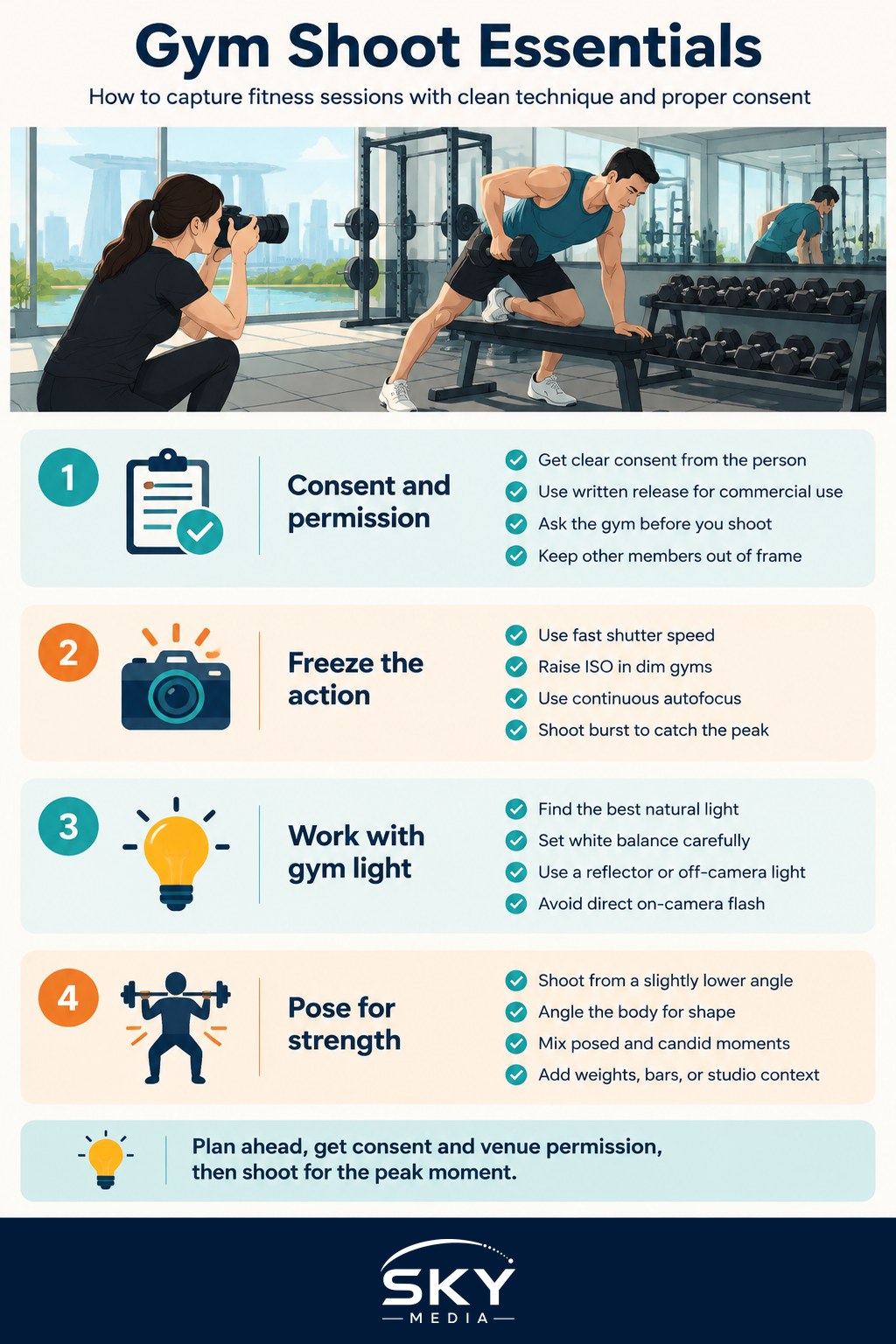
Locking In Consent and Venue Permission
A little planning here saves a lot of trouble later. Before the shoot day, sort out the logistics.
- Ask the gym owner or manager for permission and agree on a time, ideally a quieter slot so you are not in members’ way.
- Confirm what areas you can use, whether you can bring lights or a tripod, and any house rules.
- Get your subject’s consent in writing, and a model release if the photos will be published or sold.
- Keep other members out of frame, or ask them first if they happen to be nearby.
Treat the space and the people in it with respect and you will be invited back. For a smooth session, plan your frames ahead using the ideas in our guide on making a shot list for a shoot.
Freezing Motion and Effort
Fitness is dynamic, so your camera settings need to keep up with jumps, lifts, and sprints. A crisp, frozen moment of peak effort is the classic fitness shot.
- Use a fast shutter speed, around 1/500 or quicker, to freeze a rep, a jump, or flying sweat.
- Raise your ISO as needed, since many gyms are dimmer than they look. A little grain is fine.
- Use continuous autofocus and burst mode to catch the exact peak of a movement, like the top of a jump or the strain of a heavy lift.
- Ask your subject to repeat the movement a few times so you can nail the timing. Our notes on freezing fast motion go deeper on this.
Look for the moment of maximum tension: the veins, the grip, the focused face. That is where the story lives.
Handling Gym Lighting
Gym lighting is often a mixed bag of overhead fluorescents, window light, and coloured LEDs, and it can be unflattering straight out of the box. You have a few ways to tame it.
- Find the best natural light in the space, often near a window or an open shutter, and pose your subject there.
- Watch your white balance, because mixed light sources can throw odd colour casts. Set it deliberately rather than trusting auto in tricky rooms. Our guide to setting white balance walks through this.
- If the venue allows, a single off-camera light or even a reflector can lift and shape your subject far better than the flat ceiling lights.
- Embrace moody, low-key looks when the light is dim. Deep shadows and a single pool of light can make a lifter look heroic.
Avoid on-camera flash pointed straight at your subject, since it flattens the muscle definition you are trying to show off.
Posing and Angles for Strong Bodies
Good posing turns an ordinary gym-goer into a poster. The camera angle changes everything, so experiment.
- Shoot from a slightly lower angle to make your subject look powerful and tall.
- Angle the body rather than shooting flat on, so the frame shows shape and definition.
- Capture both posed strength shots and candid mid-workout moments for variety.
- Watch the hands, the posture, and the jaw, since tension in the right places reads as effort while tension in the wrong places just looks stiff.
Include some environmental context, like weights, bars, or the studio, to root the image in the world of fitness. Wide establishing shots plus tight detail shots of grip and muscle give you a full set.
Bringing It Together
Strong fitness photography comes from preparation and respect as much as from fast shutter speeds. Get consent, get the venue’s permission, then focus on freezing genuine effort in flattering light. Shoot from low, wait for the peak of the movement, and mix posed hero shots with candid grit. Look after your gear in our humidity afterwards, and keep building a rapport with the people you shoot. Do that and your gym frames will pulse with the energy that makes fitness photography so much fun to create.
Frequently Asked Questions
How do I ask a gym owner for permission to shoot there? Contact the owner or manager ahead of time with a short, polite message explaining who you are, what you plan to shoot and when you would like to come. Offer to share the photos and suggest a quiet time. Be ready to show a portfolio and follow their house rules.
How do I help a self-conscious client feel comfortable on a fitness shoot? Start with a chat, show them a few frames early and give calm, specific direction. Let them choose clothes they feel good in and keep the set small and private. Praise what works, avoid comments about their body and stop anything they are uncomfortable with.
What lens works best for gym photography? A fast wide-angle or standard prime is practical in cramped gyms and dim light. It lets you shoot close to the action and keep shutter speeds high. A short telephoto adds compression and flattering proportions for tighter portraits when you have more space.
How much should I retouch fitness photos? Keep it natural and consistent. Adjust exposure, contrast and colour, and remove small distractions, but avoid reshaping bodies. Heavy retouching can feel dishonest and unsettle clients. Agree on the level of editing before the shoot so expectations are clear on both sides.
Can I run an outdoor workout shoot in a park or void deck instead? Often yes, since public spaces are more flexible and the light is good. Still, commercial shoots, lights and tripods may need permission from the relevant managers, such as the park or town council. Check ahead, keep walkways clear and be considerate of residents.
Further reading: How to Photograph a Marathon or Run