

Still life is the quiet art of making everyday objects look beautiful, and it is the perfect way to grow as a photographer without leaving your home. A bowl of fruit, a favourite mug, a few flowers from the market, all of it becomes a canvas for practising light, composition, and patience. Because your subject never moves, still life photography in Singapore lets you slow right down, experiment freely, and really understand why an image works. It is deeply forgiving and endlessly rewarding.
Why Still Life Is the Best Teacher
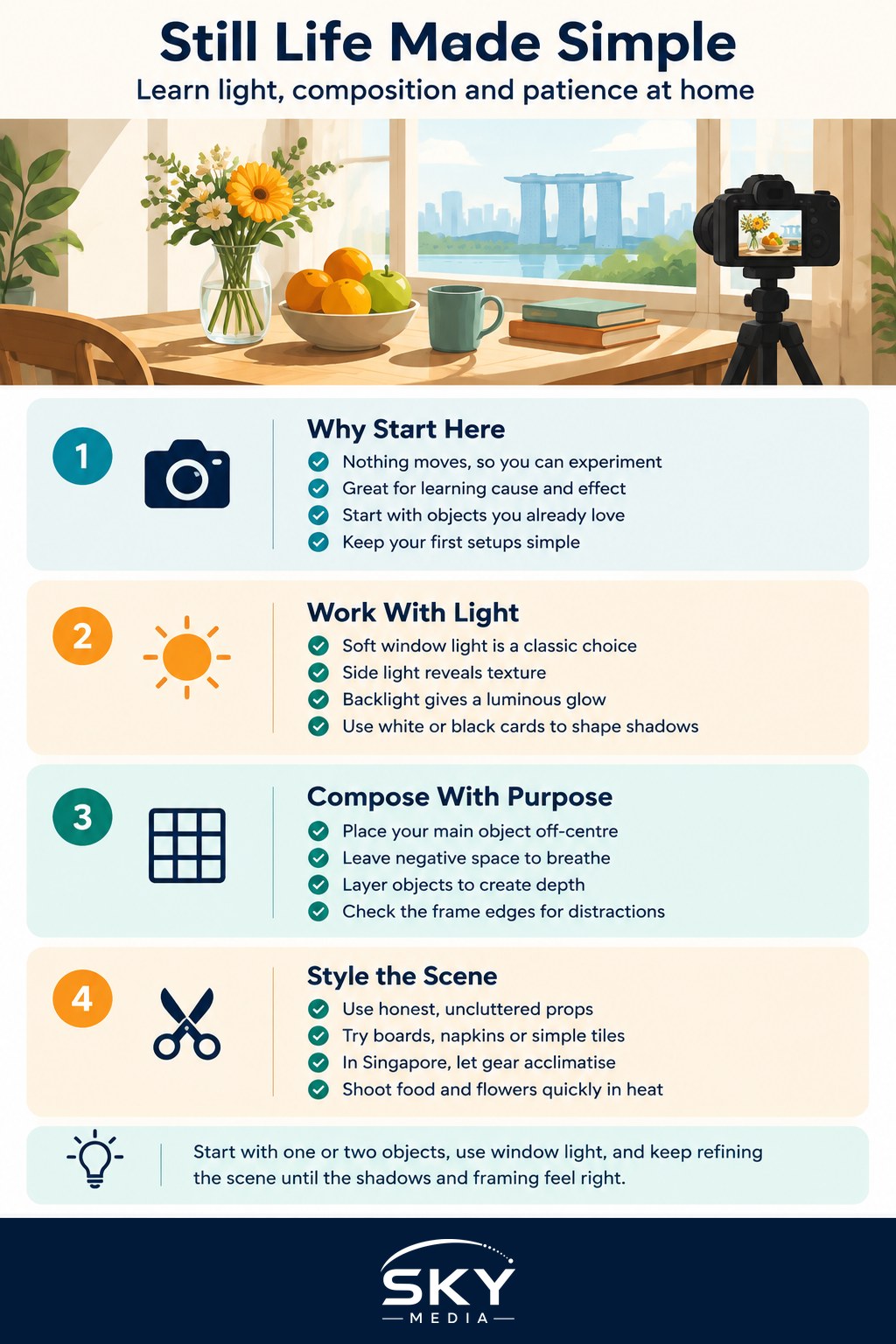
The greatest gift of still life is control. Nothing runs off, nobody gets impatient, and the light does exactly what you allow it to. That means you can move one object a centimetre, watch how the shadow shifts, and learn cause and effect in a way no fast-moving subject permits.
Start with objects you love or find interesting, because your enthusiasm shows. A single lemon on a wooden board, a stack of old books, a teapot catching the afternoon light. Keep your first setups simple, with one or two objects, so you can focus on getting the fundamentals right rather than wrangling clutter. As your eye sharpens, add complexity slowly.
A tripod helps enormously. It frees your hands to arrange props, lets you shoot at low ISO for clean files, and keeps your framing consistent while you tweak the scene. Once the camera is locked down, small refinements become obvious, and refining is where still life truly lives.
Light Is Everything
In still life, light is your main subject even more than the objects are. Learn to see it, shape it, and you are most of the way there.
Soft window light is the classic choice, and it is free. Place your subject beside a window, out of direct sun, and observe how the light falls across it. Side light rakes across surfaces to reveal texture, which suits rough bread, weathered wood, or a rugged ceramic pot. Backlight, coming from behind the subject, creates a luminous glow that flatters glass, drinks, and anything translucent. Front light is flatter and generally less interesting, so experiment with turning your setup relative to the window.
Shadows are not the enemy. They give depth and mood, and a dark, moody still life can be far more striking than an evenly lit one. To soften harsh shadows, bounce light back with a white card. To deepen them for drama, use a black card to subtract light. If you enjoy learning how directional light works, our guide to shooting backlit subjects applies directly to glowing still life scenes, and the fundamentals in lighting basics for video and photo will serve you across every genre.
You do not need studio lights to begin. A window, a couple of cards, and a willingness to move things around will teach you more than any expensive kit.
Compose With Intention
Composition is what separates a snapshot of some objects from a considered image.
- Use the rule of thirds to place your main object off-centre for a more dynamic feel, then break the rule once you know why it works. Our primer on the rule of thirds and composition basics is a solid foundation.
- Mind your negative space. Empty areas around a subject give it room to breathe and often make an image feel calmer and more premium.
- Create a sense of depth by layering objects at different distances and using a shallow depth of field so the background softens gently.
- Watch the edges of your frame for anything distracting poking in. Tidy composition looks effortless precisely because it is deliberate.
Colour choices matter too. A limited palette, say warm woods and creams, feels harmonious, while a single pop of contrasting colour draws the eye exactly where you want it.
Styling and a Singapore Note
Props and surfaces set the mood. A weathered chopping board, a linen napkin, or a simple tile can transform a scene, and you likely own plenty already. Hunt around your kitchen and drawers before buying anything. Keep styling honest and uncluttered, letting the hero object lead.
Our climate is worth a thought. Humidity can fog a cold lens brought out of air-conditioning, so let your gear acclimatise before shooting. Fresh flowers and food wilt fast in the heat, so shoot perishable subjects quickly and keep a spare on hand. Local markets are a treasure trove of colourful, characterful props, from tropical fruit to kopitiam crockery, so use what makes your setting feel personal.
Still life is the studio that never closes. Set up by a window this afternoon, arrange a single object, and chase the light until it sings. The lessons you learn here, about seeing light and composing with care, will lift every photograph you ever take. Start small, stay curious, and enjoy the quiet.
Further reading: How to Photograph Glassware and Drinks