

There is a quiet joy in capturing a plant at its best, whether you want to share a new leaf, track a plant’s progress, or simply remember how good your balcony looked one bright morning. Good plant photography singapore hobbyists can do entirely on a phone, no fancy camera needed. With a little thought about light, background, and angle, your photos can look far more polished than a quick, cluttered snap.
The best part is that our tropical light is generous. Long daylight hours and plenty of bright, diffused sky mean you rarely struggle for brightness. The trick is learning to shape that light rather than fight it, and to slow down for a few seconds before you tap the shutter.
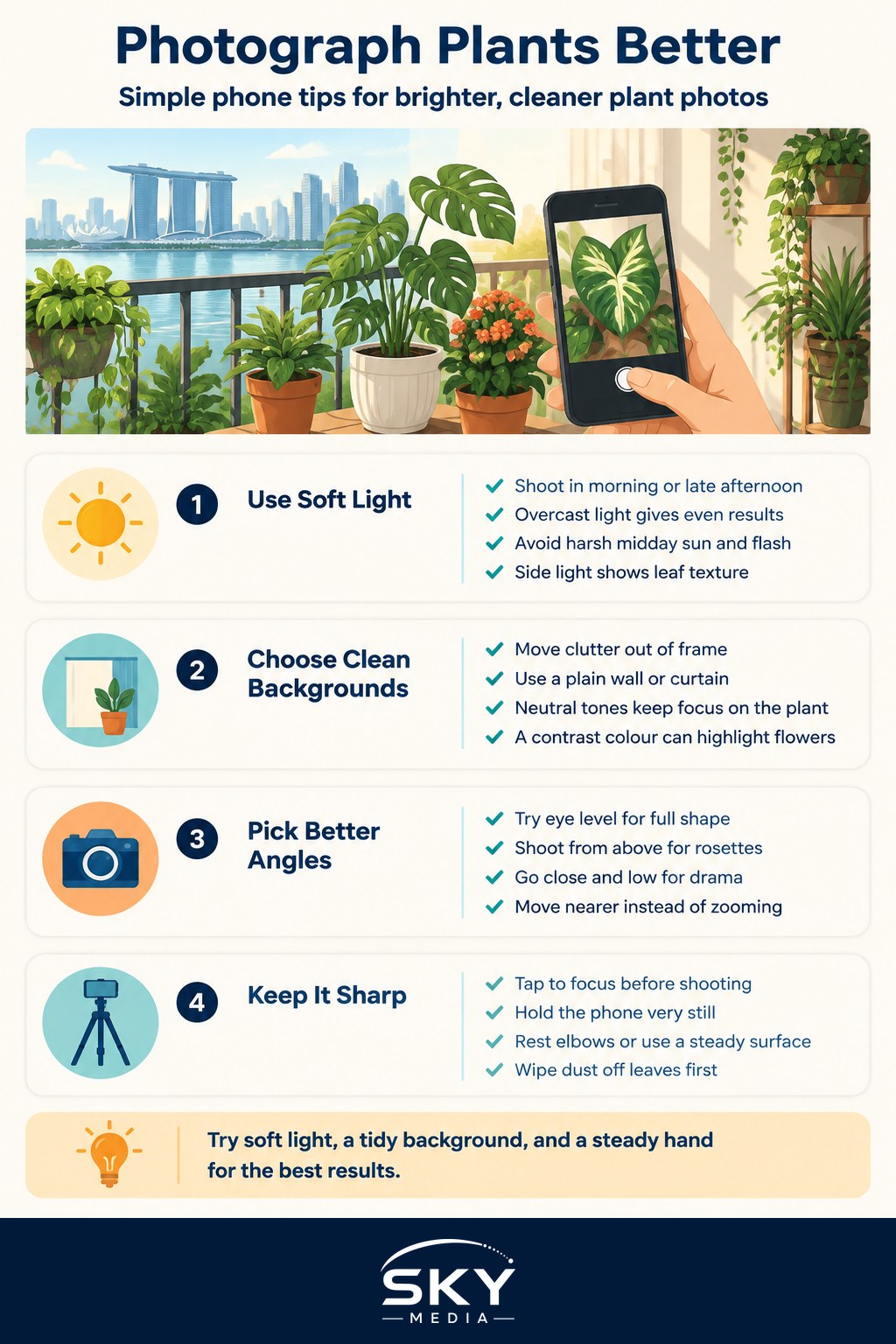
Light is everything
Soft, even light flatters leaves and flowers far more than harsh midday sun. In Singapore, the golden hours just after sunrise and before sunset give warm, gentle light that makes greens glow. Midday sun, especially on a west-facing ledge, creates hard shadows and blown-out highlights, so it is worth waiting for a softer moment or moving into shade.
An overcast, hazy, or lightly clouded day is secretly ideal. The cloud acts like a giant softbox, wrapping your plant in even light with no ugly shadows. If you only have a bright window indoors, place the plant beside it so the light comes from the side, not behind. Side light reveals the texture of veins, ridges, and fuzz that make foliage interesting.
Avoid using your phone’s built-in flash for plants. It flattens everything and throws a cold, unnatural glare on the leaves. Instead, tap the screen to set focus on your subject, then drag the little brightness slider down slightly. Slightly underexposed plant photos usually look richer, because deep greens stay saturated rather than washing out.
If you are photographing a plant you are proud of nursing back to health, natural window light really shows off the recovery. Our guide on how to revive a dying plant pairs nicely with a before-and-after photo series.
Backgrounds, angles, and steady hands
A clean background does most of the work. Cluttered scenes, a busy sink, a tangle of cables, pull the eye away from your plant. Move the pot in front of a plain wall, a curtain, or even a sheet of coloured card. Neutral tones like white, grey, or soft green let the plant be the star, while a contrasting colour can make a pale flower pop.
Angles change the whole mood of a shot. Try these three and see which suits your plant:
- Eye level, straight on, to show a plant’s full shape and height
- From above, looking down, which flatters rosettes, succulents, and round arrangements
- Close and low, to make a single leaf or bloom feel bold and dramatic
Get physically closer rather than zooming with your fingers. Digital zoom just crops and softens the image, while moving the phone keeps everything sharp. For tiny details like a water droplet or a new unfurling leaf, tap to lock focus first, hold very still, then shoot. Many phones have a portrait mode that gently blurs the background, which can look lovely for a single flower, though it sometimes struggles with fine, feathery foliage.
Steady hands make sharper photos. Tuck your elbows against your body, or rest the phone on a ledge, railing, or stack of books. In dimmer indoor light your phone slows the shutter, so the smallest wobble causes blur. A cheap mini tripod helps, but a steady surface works just as well.
A few finishing habits lift your results further:
- Wipe dust off the leaves first, since clean foliage always photographs better. Our tips on cleaning and dusting plant leaves will help.
- Turn the pot so the fullest, healthiest side faces the camera.
- Take several frames, then delete all but the best later.
- Edit lightly, nudging brightness and contrast, but resist heavy filters that turn greens unnatural.
If photography is becoming part of how you enjoy the hobby, consider pairing it with a simple record. A dated photo alongside notes in a garden journal turns scattered snaps into a satisfying growth diary you will love flipping through.
You do not need studio gear to take beautiful plant photos in Singapore. Chase soft light, tidy the background, get close, and hold steady. Do those four things and your everyday phone shots will start looking like something worth framing, or at least worth sharing with fellow plant lovers.
Frequently Asked Questions
How do I photograph plants indoors without good sunlight? Place the plant close to the brightest window and let the light fall from the side. If the room is dim, a plain lamp placed to one side can help, but avoid the phone’s flash. Hold steady, as dim light slows the shutter and causes blur.
Which phone camera mode works best for flowers? Portrait mode can look lovely on a single bloom by softening the background, though it may struggle with fine, feathery foliage. Standard mode with tap-to-focus is often safer for detailed leaves. Try both and compare the results.
How can I photograph a plant’s growth over time? Take a photo from the same spot, angle and distance on the same day each week. Put the pot on a marked position and keep the background the same, so changes are easy to compare. A dated album makes the progress obvious.
How do I make green leaves look natural, not oversaturated? Shoot in soft light and lower the brightness slightly rather than adding heavy filters. Light edits to brightness and contrast are usually enough. Strong saturation makes greens look artificial, and wiping dust from the leaves first helps.
Is it worth buying a clip-on macro lens for a phone? Only if you often photograph tiny details such as flower centres, seeds or small pests. Many phones already focus quite close without extra gear. Try your phone’s own close-up ability first, then decide if you need one.