

We all have a running commentary in our heads, and it is not always kind. “I always mess this up.” “They must think I’m useless.” “This is going to go badly.” When you learn to reframe negative thoughts in Singapore’s fast, comparison-heavy environment, you give yourself a quieter, steadier mind to work with. Reframing does not mean forcing fake positivity or pretending everything is fine. It means noticing an unhelpful thought, questioning it gently, and choosing a more balanced way of seeing the same situation.
Think of it as adjusting the lens, not lying to yourself. The facts stay the same. The story you tell about them can change.
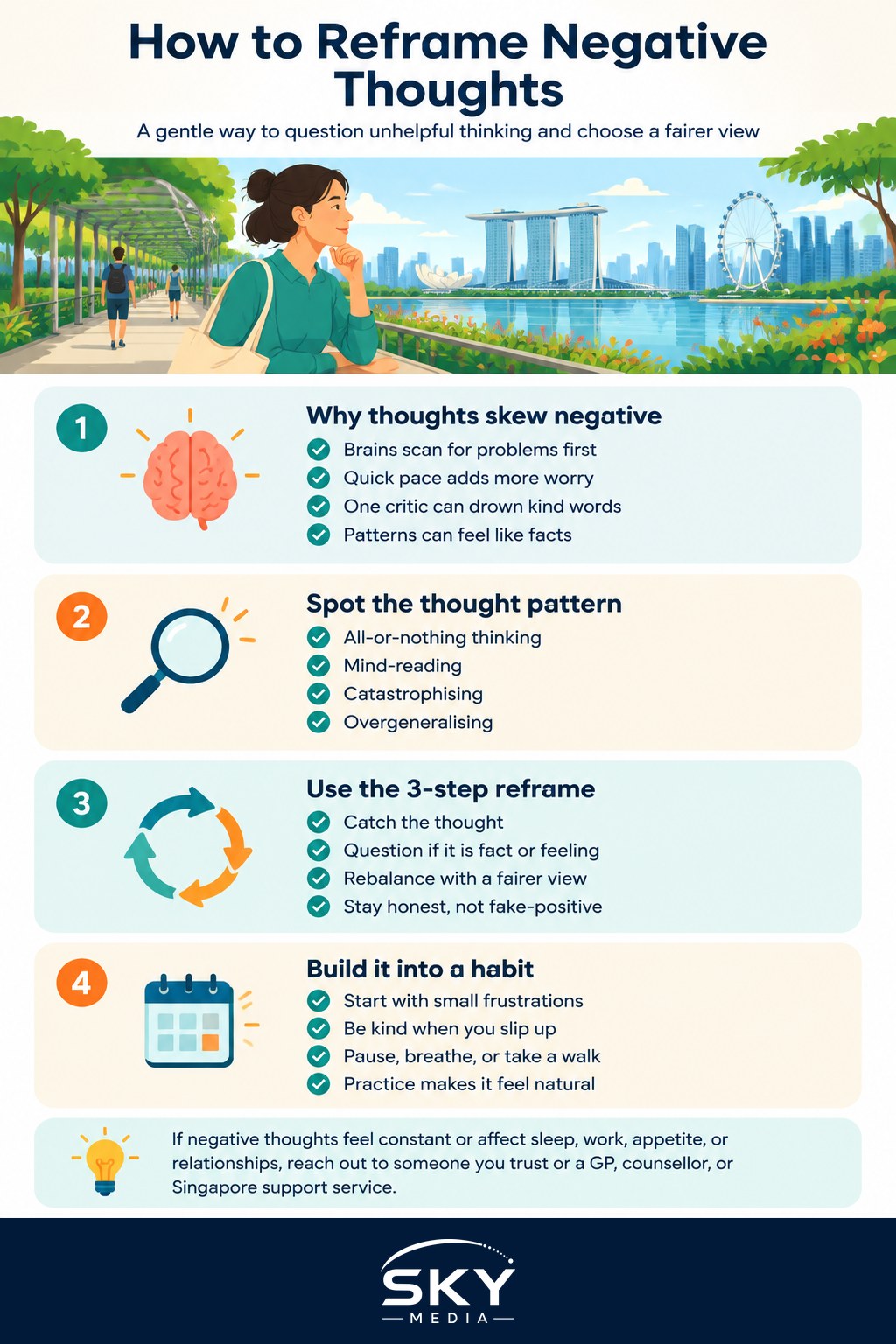
Why Our Thoughts Lean Negative
It is not a personal flaw. Our brains are wired to scan for problems, because for our ancestors, spotting danger mattered more than noticing what was going well. That instinct is still with us, which is why one critical comment can drown out ten kind ones.
Modern life adds fuel. In a place where the pace is quick and it is easy to feel you are falling behind, the mind finds plenty to worry about. Tight deadlines, exam pressure, the endless scroll of other people’s wins. Over time, certain thought patterns become automatic, so familiar that we mistake them for facts.
Some common ones to watch for:
- All-or-nothing thinking: “If it’s not perfect, it’s a failure.”
- Mind-reading: assuming you know what others think of you.
- Catastrophising: jumping straight to the worst-case ending.
- Overgeneralising: treating one setback as proof of “always” or “never”.
Simply naming the pattern already loosens its grip. If overthinking is a regular visitor, our guide on how to stop overthinking pairs well with what follows.
A Simple Way to Reframe
Reframing works best as a small, repeatable habit rather than a big mental battle. Try this gentle three-step approach.
- Catch it. Notice when you feel a dip in mood and ask, “What just went through my mind?” You cannot reframe a thought you have not spotted.
- Question it. Treat the thought as one possibility, not the truth. Ask: Is this a fact or a feeling? What would I say to a friend who thought this? Is there another way to read this situation?
- Rebalance it. Swap the harsh version for something fairer and still honest. “I always mess this up” might become “I made a mistake here, and I’ve handled similar things before.”
Notice that the reframe is not relentlessly cheerful. “Everything is amazing” would not feel true, so your mind rejects it. A believable, balanced thought is what actually helps.
Writing this out can make it easier to see clearly. Many people find the benefits of journaling show up strongest here, on the page, thoughts lose some of their power. Reframing is also close cousin to how to improve your self-talk, which is worth a read if the inner critic is loud.
Make It a Steady Habit
You will not rewire years of thinking in a week, and that is completely fine. Reframing is a practice, not a switch you flip. A few things help it stick:
- Start with low-stakes moments. Practise on small frustrations, a delayed train, a clumsy reply, before the big ones.
- Be kind about slip-ups. Catching yourself thinking negatively is progress, not failure.
- Add a pause. A slow breath or a short walk creates just enough space to choose a better thought instead of reacting on autopilot.
Over time, the balanced view starts to come more naturally, and the harsh automatic story loses its monopoly.
When to Reach for More Support
Reframing is a helpful everyday tool, but it has limits, and it is not a replacement for proper care. If negative thoughts feel constant, overwhelming, or impossible to shift, if you have felt persistently low, anxious, or hopeless for weeks, or if it is affecting your sleep, work, appetite, or relationships, please treat that as a signal to reach out.
Start with people you trust, and consider speaking to a GP, a counsellor, or a Singapore support service such as the Institute of Mental Health or the Samaritans of Singapore. Look up their current official channels for how to make contact. There is real strength in asking for help, and you do not have to sort everything out on your own.
A Gentle Wrap-Up
Your thoughts are not always telling you the truth, and you are allowed to question them. Catch the unhelpful ones, ask whether they are fair, and choose a version that is both kinder and honest. Do this often, gently, and without expecting perfection, and you will slowly build a calmer inner voice. You cannot stop difficult thoughts from turning up, but you can learn to hold them more lightly, and that changes everything.
Frequently Asked Questions
Is reframing the same as positive thinking? No. Positive thinking can mean pushing aside problems, while reframing means checking whether a thought is fair and finding a more balanced version. A reframe stays honest and may still acknowledge that something is difficult.
What if my negative thought is actually true? Then acknowledge it without exaggeration, and move to what you can do about it. A true setback does not prove you are hopeless. Separate the facts from the harsh meaning your mind adds, and think of one practical next step.
How do I reframe thoughts in the middle of an anxious moment? Pause with a slow breath, then name the thought and ask whether it is a fact or a feeling. Think of what you would tell a friend. If your mind is racing, step away briefly first. Practise on mild worries to build the skill.
Can reframing help with exam or work stress? It can help you replace catastrophic thoughts with realistic ones, like I have prepared and can handle the next step. It works alongside practical steps such as planning and rest. Seek support if stress affects your health.
Is cognitive behavioural therapy the same as reframing? Reframing is one technique used within cognitive behavioural therapy, which also covers behaviours and coping skills. A trained therapist can guide you through a structured approach. A GP can advise about options if thoughts feel overwhelming.
Further reading: How to Practise Negative Visualisation