
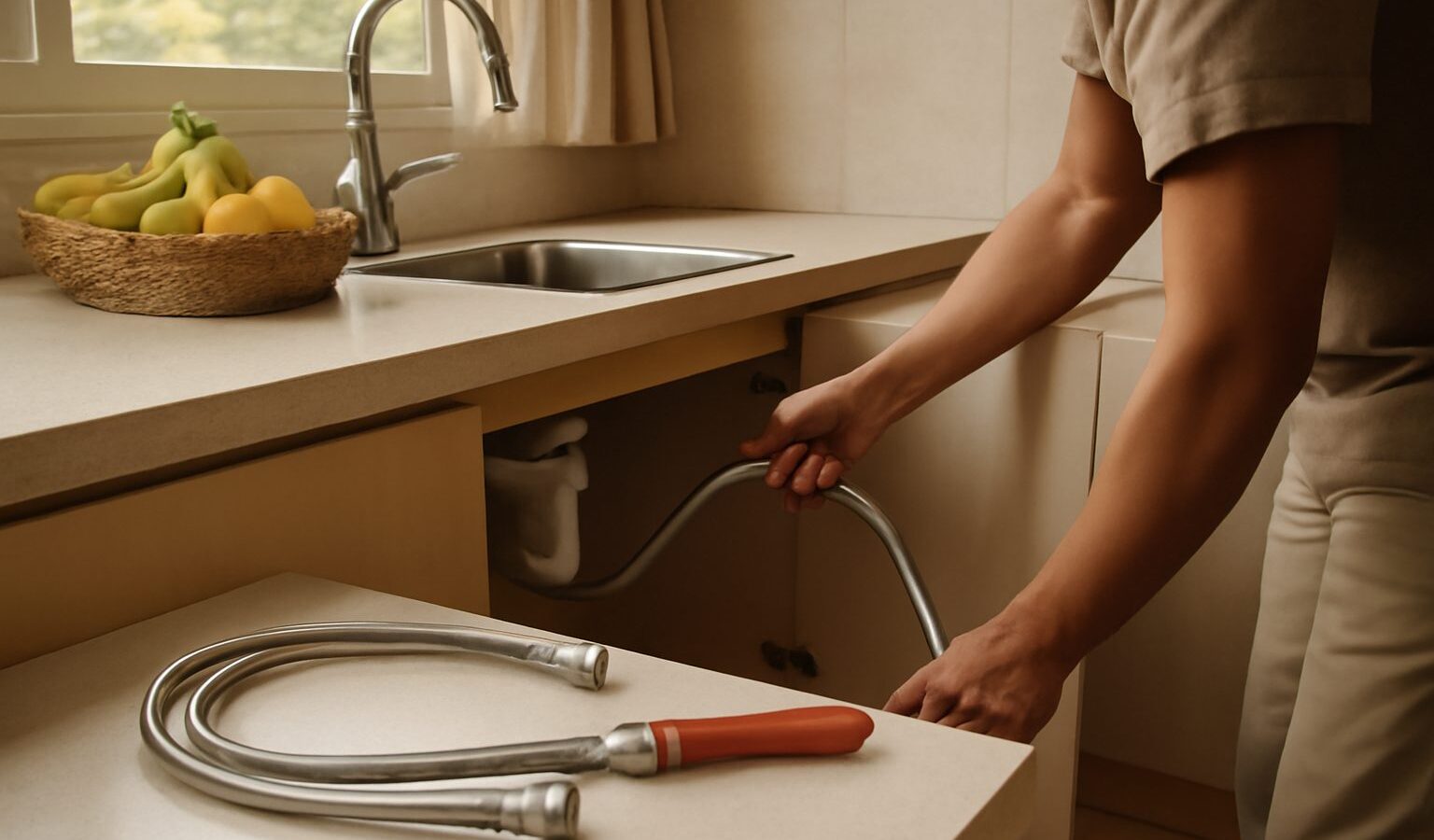
The flexible braided hose that connects your tap to the water supply is a small part that does a big job. Over time these hoses can weep, corrode at the fittings, or in the worst case burst, and a failed hose under a sink can flood a kitchen or bathroom surprisingly fast. In our humid climate the metal braiding and connectors also age quicker than you might expect. The reassuring news is that swapping a flexible hose sink singapore homes use is a straightforward task, provided you follow the golden rule first: shut off the water before you touch anything.
This guide covers the safe, simple version of the job. It also tells you plainly when to put down the spanner and call a licensed plumber, because water works are one area where knowing your limits saves you from an expensive mess.
Before You Start: Shut Off The Water
This is the most important step, so read it twice. Look under your sink and find the small angle valve, also called an isolating or stop valve, where the hose connects to the wall supply pipe. Turn it clockwise until it stops. This shuts off the water to that tap only.
Then open the tap above to release any pressure and let the remaining water drain out. Keep a bucket, a basin, and a few old towels ready, because there is always a little water left in the line that will drip when you disconnect.
If there is no isolating valve under your sink, or if the hose connects directly to the mains without a way to shut it off locally, stop here. Do not attempt the job. You will need to isolate the water elsewhere, and that is a task for a licensed plumber who can do it safely without flooding your home.
Tools You Will Need
- An adjustable spanner or a set of spanners
- A bucket and old towels
- The correct replacement hose, matched for length and fitting size
- A torch
Take the old hose to buy the replacement, or note the length and the thread sizes at each end. Flexible hoses come in different lengths and connector types, and a mismatch will leak. Buy a good quality braided hose rather than the cheapest option, since this part is holding back pressurised water.
Removing The Old Hose
With the water off and the tap opened to relieve pressure, position your bucket under the connections. Using the spanner, loosen the nut at the bottom of the hose where it meets the angle valve. Turn it anticlockwise. Water will drip, so let it run into the bucket and mop up as needed.
Next, loosen the nut at the top where the hose connects to the tap tail underneath the basin. This can be tight and awkward to reach, so take your time and get a torch on it. Once both ends are free, remove the old hose completely.
Inspect the threads on the valve and the tap tail. If they look clean and undamaged, you are good to fit the new hose. If they are badly corroded or stripped, that changes things, as noted below.
Fitting The New Hose
Hand tighten the new hose onto the tap tail first, then onto the angle valve. Most modern flexible hoses have rubber washers built into the connectors, so you usually do not need extra sealing tape on these fittings. Do not overtighten, because crushing the washer or cross threading the nut causes leaks rather than preventing them. Firm and snug is the target, then a gentle final nudge with the spanner.
Now the moment of truth. Slowly turn the angle valve anticlockwise to restore the water, and watch both connections closely with your torch. Look and feel for any weeping at the nuts. If you spot a drip, turn the water off again and tighten that connection a fraction more. Once it is dry, run the tap normally and check again after a few minutes, then look under the sink once more an hour later to be certain.
While you are under there, it is a good moment to check for other slow leaks. Our guides on how to fix a leaky tap and the broader water heater and plumbing guide for Singapore cover the neighbouring jobs.
When To Call A Licensed Plumber
Stop and call a licensed plumber if there is no isolating valve to shut off the water, if the connection is to the mains, if the threads on the valve or tap tail are corroded or stripped, if the angle valve itself is seized or leaking, or if you cannot stop a connection from weeping after refitting. In Singapore, certain water works must be carried out by a licensed plumber, and pressurised supply pipes are not something to gamble with.
For general guidance on drawing that line, read basic home repairs and DIY in Singapore and when to DIY and when to hire a professional. A confident do it yourself hose swap is fine, but knowing when to hand over is what keeps a small job from becoming a flooded kitchen.