

Most advice arrives with total confidence: wake at 5am, cut coffee, journal daily, and your life will change. But what works for someone else may not fit your body, your schedule, or your season of life. This is where personal experiments singapore readers can quietly borrow a scientist’s mindset. Instead of committing forever or judging yourself for “failing”, you simply test a small change for a short window and see what actually happens.
A personal experiment is low-stakes and honest. You are not promising to become a new person. You are gathering evidence about what suits you, in real life, with all its commutes, caregiving, and late-night deadlines.
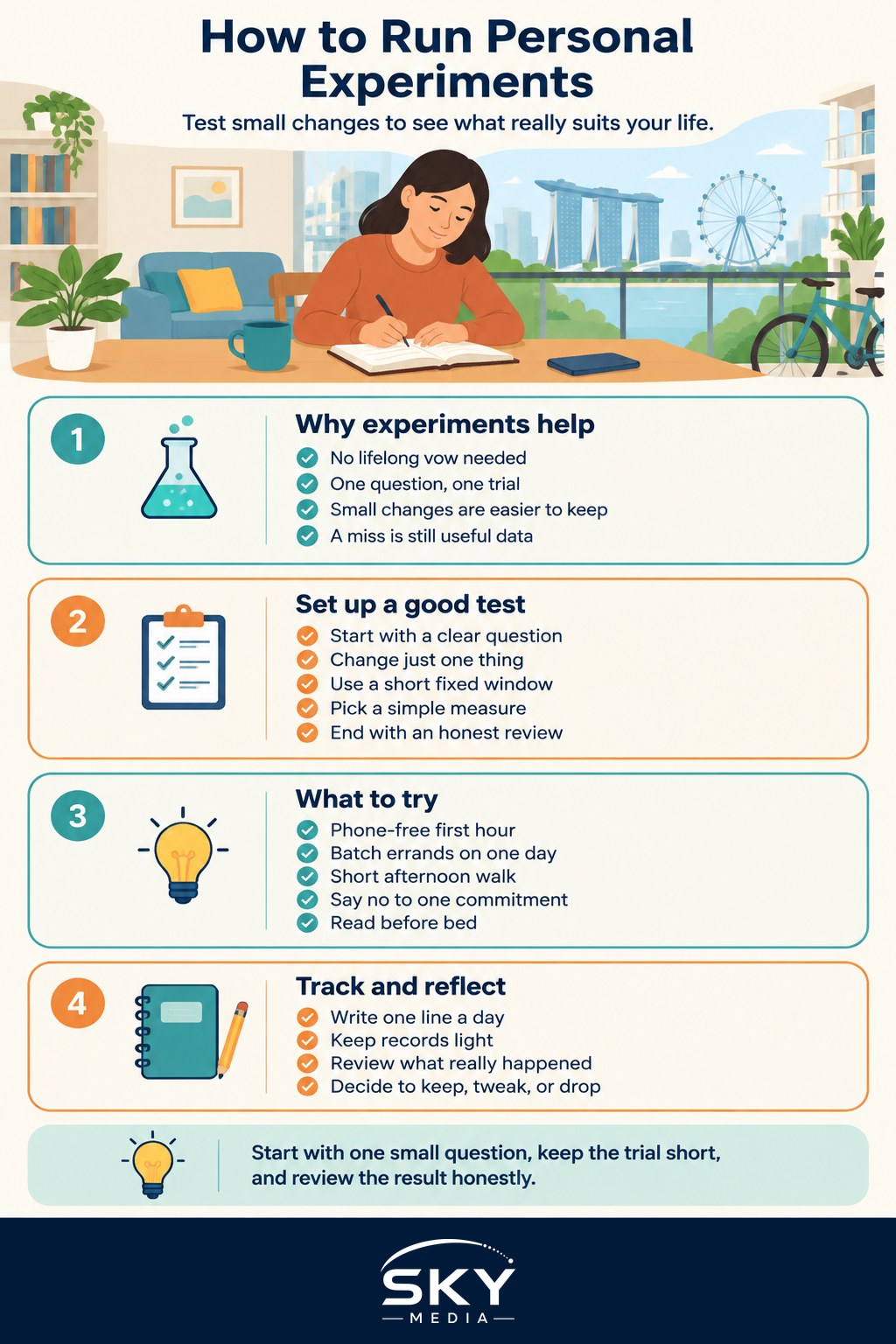
Why experiments beat willpower
When you decide to “change forever”, every wobble feels like proof you have failed. That pressure often makes us give up entirely. An experiment removes the drama. There is no lifelong vow, just a question and a trial period. You are allowed to conclude that something did not work, and that is a successful experiment, not a personal defeat.
Experiments also fit how change really happens. Small, sustainable adjustments tend to outlast dramatic overhauls. Testing one thing at a time keeps it manageable and makes it clear what caused what. In a busy Singapore week, that simplicity is a feature, not a compromise.
The simple structure of a good experiment
You do not need a spreadsheet or an app. A good personal experiment has just a few parts.
1. A clear question. Start with something specific. Not “be healthier” but “does walking after dinner help me sleep better?” A sharp question gives you a clear answer.
2. One change at a time. Change a single variable so you know what is responsible for the result. If you overhaul five habits at once and feel better, you will never know which one mattered.
3. A short, fixed window. Two weeks is often enough. Long enough to see a pattern, short enough that you will actually finish. Put an end date on it.
4. A simple way to measure. Decide in advance how you will judge it. That might be a number, like hours slept, or just a daily one-line note on how you felt. Keep it light.
5. An honest review. At the end, look back without spin. Did it help, hurt, or make no difference? Then decide whether to keep it, tweak it, or drop it.
Choosing what to experiment with
The best experiments target something you genuinely wonder about. A few gentle ideas:
- Does a phone-free first hour make your mornings calmer?
- Does batching errands on one day free up your week?
- Does a short afternoon walk lift your energy?
- Does saying no to one commitment reduce your stress?
- Does reading before bed help you wind down more than scrolling?
Start with something that feels easy and a little exciting, not the hardest change you can imagine. Early, pleasant wins make you more likely to keep experimenting. If you tend to overthink which one to pick, remember you can only ever run one experiment at a time, so just choose the nearest useful question and begin.
Keeping track without making it a chore
The lightest possible tracking is best. A single line in a notebook or notes app each day. If you already enjoy writing things down, this pairs naturally with the benefits of journaling, where a few honest sentences reveal patterns you would otherwise forget.
Some people prefer to note the decision and the reasoning behind it, so they can review it later with clear eyes. If that appeals to you, learning to keep a decision journal gives your experiments a memory, so past you can teach future you.
The point is not perfect data. It is enough of a record that, at the end, you are reviewing what really happened rather than a fuzzy feeling.
Reading your results honestly
When your window ends, resist two temptations. The first is to declare instant success because you want the change to work. The second is to call it a failure because you missed a day or two. Real life is messy, and a couple of slips do not ruin the evidence.
Ask yourself simple questions. Did I feel better, worse, or the same? Was it sustainable, or did it quietly drain me? Would I miss it if I stopped? A change that helps but feels impossible to keep is useful information too. It might mean you need a smaller version of it.
Some experiments will surprise you. Things you were sure you would love turn out flat, and small tweaks you almost dismissed make a real difference. That is the whole value of testing rather than assuming. Over time this habit strengthens your judgment and helps you learn from your mistakes instead of repeating them.
Making experimenting a way of life
Once you have run a few, experimenting starts to feel natural. Instead of asking “what should I do?” you begin asking “what could I test?” That shift is quietly powerful. It turns your life into a series of gentle, curious trials rather than a set of rules you must obey.
You do not need to experiment constantly. One small trial at a time, whenever you are curious or stuck, is plenty. The goal is not a perfectly optimised life. It is a life that fits you better because you took the time to find out what actually works, on your own terms, at your own pace. Start with one small question this week, give it a fortnight, and see what you learn.
Frequently Asked Questions
How long should a personal experiment last? Two weeks is often enough to see a pattern and short enough to finish, though some changes, such as sleep or mood, may need a little longer. Set an end date in advance so you review it rather than drift. If the result is unclear, run another round.
Can I test more than one habit change at the same time? It is better to test one at a time, because then you can tell what caused any difference. If several things change together, you will not know which one mattered. Finish one experiment, then start the next.
What if my experiment fails or I miss several days? That still gives you useful information. Ask what got in the way and whether a smaller version would fit your life better. A couple of missed days do not ruin the results, so carry on or adjust and restart.
Is it safe to experiment with diet, fasting or sleep changes? Keep experiments gentle and sensible, and avoid extreme changes. If you have a health condition, take medication or are pregnant, speak to a doctor or dietitian first. Stop if you feel unwell.
How do I know if a result is down to my change or something else? You can never be fully certain, but changing one thing at a time and keeping notes helps. Look out for other factors such as stressful weeks, illness or holidays. Repeating the test later gives a clearer picture.
Further reading: Kaizen Explained: Small Continuous Improvements in Everyday Life