

OKRs, short for Objectives and Key Results, are a goal setting method borrowed from the workplace that works surprisingly well for personal life. Using OKRs for personal goals gives you one clear direction and a small set of measurable checkpoints, so you always know whether you are actually making progress or just staying busy. This guide explains the method plainly and shows you how to apply it.
What OKRs actually are
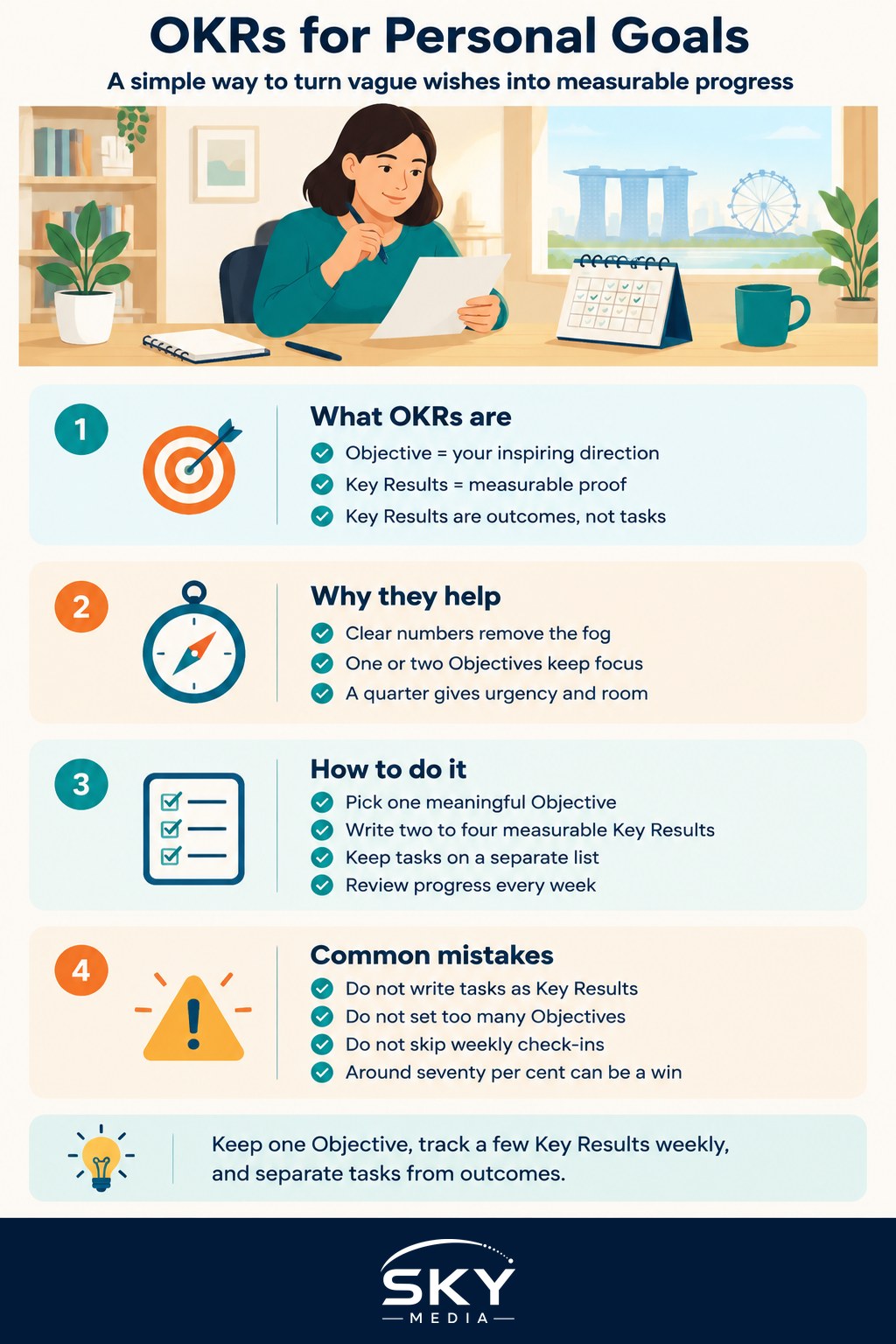
An OKR has two parts.
The Objective is a short, inspiring statement of what you want to achieve. It is qualitative and slightly ambitious. It answers, “Where do I want to be?” A good Objective is memorable and meaningful to you, such as “Feel strong and healthy again”.
The Key Results are the two to four measurable outcomes that prove you reached the Objective. They are numbers, not tasks. They answer, “How will I know I got there?” For the health Objective, a Key Result might be “Run five kilometres without stopping” or “Sleep at least seven hours on twenty five nights this quarter”.
The important distinction is that Key Results measure outcomes, not activity. “Go to the gym” is a task. “Do twelve full press ups in one set” is a Key Result, because it measures a result you can verify.
Why the method works
OKRs work because they separate the dream from the evidence. Many people set fuzzy goals like “get healthier” and then feel unsure whether they are succeeding. By forcing you to name measurable Key Results, OKRs remove the fog. At any point you can look at the numbers and know your true position.
They also create focus. You are meant to hold only one or two Objectives at a time, each with a handful of Key Results. This limit stops you from scattering your energy across a dozen half hearted intentions.
Finally, OKRs are set for a defined period, usually a quarter of about three months. That window is long enough to achieve something real and short enough to stay urgent.
Step by step
Step 1: Pick one Objective for the quarter. Choose an area that genuinely matters to you now. Write it as a short, motivating phrase.
Step 2: Write two to four Key Results. Each must be a number you can measure. If you cannot tell whether it is done by looking at a figure, rewrite it.
Step 3: Make them a stretch, but not a fantasy. OKRs are meant to be ambitious. Aim for a level where reaching about seventy per cent would still feel like a real win.
Step 4: List the tasks separately. Tasks are how you move the Key Results. Keep them on a different list so you never confuse “being busy” with “making progress”.
Step 5: Check in weekly. Once a week, update the current figure for each Key Result. This short review keeps the goal alive and tells you where to push.
Step 6: Score at the end of the quarter. Give each Key Result a simple score, such as the fraction achieved. Reflect on what worked, then set fresh OKRs for the next quarter.
A worked example
Take Mei, who wants to change careers into design but feels stuck. Vague wishes have got her nowhere, so she sets a personal OKR for the quarter.
Objective: Become a credible junior designer ready to apply for roles.
Key Results:
1. Complete three full portfolio projects.
2. Get feedback from five working designers.
3. Apply to ten suitable positions.
Notice these are outcomes, not activities. “Learn design” is not there; it is too vague to measure. Her tasks, kept on a separate list, include watching tutorials, joining a local design community, and redrawing an old project. Those tasks serve the Key Results but are not the Key Results themselves.
Each week Mei updates her numbers. Halfway through she has two projects done, feedback from three designers, and four applications sent. The figures show she is behind on projects, so she shifts a weekend to focus there. At quarter end she has completed all three projects, gathered feedback from four designers, and applied to eight roles. She scores herself strongly, learns that networking was slower than expected, and adjusts her next OKR accordingly.
OKRs versus a simple to do list
People sometimes ask why they cannot just keep a to do list. The two tools serve different purposes and are strongest together.
| Aspect | To do list | OKRs for personal goals |
|---|---|---|
| Measures | Tasks completed | Outcomes achieved |
| Time frame | Day to day | A whole quarter |
| Tells you | What is next | Whether you are winning |
| Risk | Staying busy, not progressing | Needs honest tracking |
| Best for | Daily execution | Direction and focus |
A to do list keeps today moving. OKRs make sure all that motion is heading somewhere that matters. Use the list to feed the Key Results.
Common mistakes
- Writing tasks as Key Results. If it starts with a verb like “do”, “attend” or “read”, it is probably a task. A Key Result names a measurable state, such as a number reached or a level cleared.
- Setting too many Objectives. One is often enough for personal life. Two is the sensible ceiling. More than that and each one starves.
- Never checking in. OKRs set and forgotten are useless. The weekly glance is what turns them into progress.
- Punishing yourself for scoring below full marks. Because good OKRs stretch you, hitting everything perfectly may mean you aimed too low. Around seventy per cent is a healthy landing.
Choosing the right Objective
Before you write Key Results, make sure the Objective is one you actually care about. An OKR pointed at someone else’s expectation will feel hollow by week three. Ask whether achieving this Objective would genuinely improve your life. If yes, commit. If you hesitate, it may belong to a different quarter, or to nobody at all.
Getting started this quarter
You do not need special software. A single page in a notebook works: the Objective at the top, the Key Results beneath, the current figure next to each, and a short task list below. Update it once a week and score it once a quarter.
The real value of using OKRs for personal goals is honesty. The numbers do not care how busy you felt; they only show where you are. Set one meaningful Objective, name a few measurable Key Results, and check in every week. Over a single quarter you will move further, and with far more clarity, than a year of vague intentions ever delivered.
Explore more: How to Set Quarterly Goals in Singapore · Using SMART Goals in Real Life · How to Break Big Goals into Steps in Singapore
Further reading: Kaizen Explained: Small Continuous Improvements in Everyday Life