

We make dozens of choices a day and remember almost none of the thinking behind them. That is a problem, because the only way to get better at deciding is to look back at how we decided and check whether it worked. Memory is a poor record. It quietly edits the past so that our good outcomes look wise and our bad ones look unlucky. A decision journal fixes this. Keeping a decision journal in Singapore, where life moves quickly and choices pile up, is one of the simplest and most useful habits you can build for clearer thinking.
The idea is plain. Before you make a decision that matters, you write down what you are choosing, why, and what you expect to happen. Later, you come back and see how it turned out. That is the whole method. What makes it powerful is that it freezes your reasoning in place so your future self cannot rewrite it.
Why a Decision Journal Works
The core benefit is honesty. When a choice goes well, we assume we were right. When it goes badly, we blame circumstances. Both stories protect our ego and teach us nothing. A written record separates the decision from the outcome. Sometimes you will find you reasoned well but got an unlucky result. Sometimes you will find you got a good result from sloppy thinking. Only by seeing both can you improve the thinking itself, which is the part you actually control.
There is a second benefit. The simple act of writing before you decide slows you down at the right moment. You cannot capture your reasoning without first noticing that you have some. Many rushed, regretted choices would never survive being written out honestly first. In a busy, always-on setting, that small pause is worth a lot. It works alongside learning how to make better decisions in general, giving you a place to practise the skill on real choices.
What to Write Down
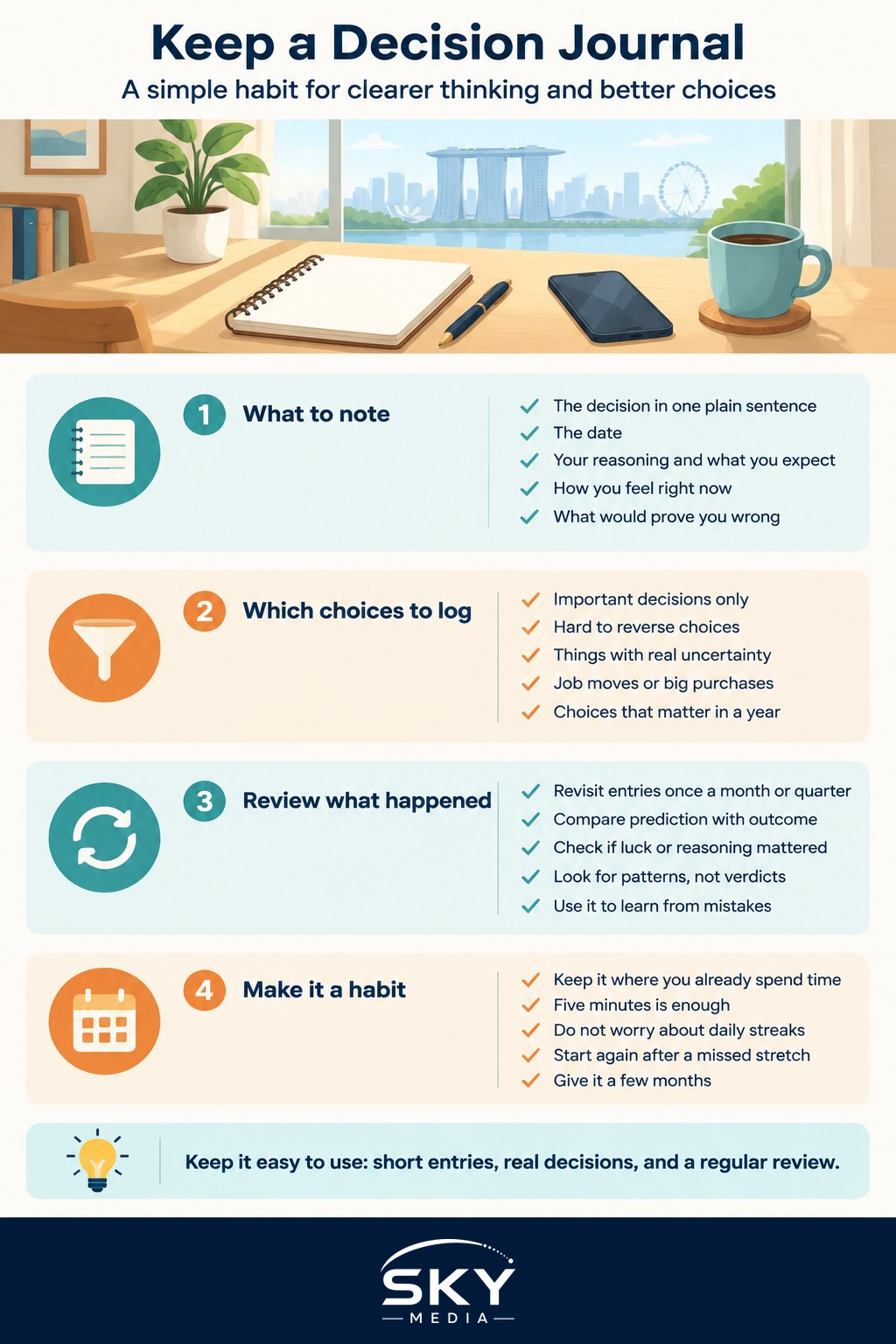
You do not need a fancy template. A notebook, a notes app, or a simple document all work. For each decision worth recording, capture a handful of things while the choice is still fresh.
- The decision. What are you actually choosing, in one plain sentence.
- The date. So you can find the outcome later.
- Your reasoning. Why this option over the others. What you are hoping for.
- What you expect to happen. Your honest prediction, ideally with rough odds. “I think there is a good chance this works out” is fine.
- How you feel. Rushed, calm, pressured, excited. Emotions shape choices, and noting them reveals patterns later.
- What could prove you wrong. The signs that would tell you this was a mistake.
That last point matters more than it looks. Naming what would change your mind, before you are attached to being right, keeps you open to updating later. It sits close to the habit of questioning your assumptions, which is exactly the muscle a journal trains.
Keep entries short. Five minutes is plenty. A journal you actually use beats a perfect one you abandon after a week.
Which Decisions Are Worth Recording
Not everything deserves an entry. What to eat for lunch does not need documenting. Reserve your journal for decisions that are important, hard to reverse, or genuinely uncertain. Think about job moves, big purchases, whether to take on a commitment, how to handle a difficult relationship, or where to put your savings.
A rough test: if getting this wrong would matter in a year, write it down. If you will have forgotten it by next week, let it go. Over time you will develop a feel for the line. The aim is a journal full of the choices that shaped your life, not a diary of trivia. This naturally supports learning how to think long term, because the entries that reward review are usually the ones with long tails.
Reviewing Your Entries
The journal only pays off when you go back to it. Set a gentle rhythm, perhaps once a month or once a quarter, to revisit past entries whose outcomes are now clear. Read what you predicted, then compare it with what happened. Ask a few honest questions. Did the outcome match my reasoning, or did luck decide it? Was I overconfident or too cautious? Did I let a mood push me? What kept showing up?
Do not use these reviews to beat yourself up. The point is learning, not judging. You are looking for patterns, not verdicts. Perhaps you notice you decide badly when rushed, or that you consistently underestimate how long things take, or that your fears rarely come true. Each pattern is a small gift, because now you can watch for it. This is really just a structured way of practising how to learn from your mistakes, with a record that stops you fooling yourself.
Making It a Habit
Like any habit, a decision journal survives on being easy, not on being impressive. Keep it wherever you already spend time, so it takes no effort to reach. Do not aim for daily entries; aim for capturing the choices that count. If you miss a stretch, simply start again with the next real decision. There is no streak to protect.
Give it a few months before you judge the value. The early entries feel unremarkable because you have nothing to compare them with. It is only when outcomes arrive and you read your old reasoning that the habit earns its keep. That is when you start catching your own patterns in the act, and quietly deciding a little better than you used to.
You will not become flawless, and that was never the goal. What you will build is a steadier, more honest relationship with your own choices. That alone is worth five minutes and a notebook.
Further reading: The Bullet Journal Method Explained · How to Keep a Stoic Journal