

Few products have proven their staying power in Singapore like bubble tea. Queues form outside popular outlets, new flavours trend on social feeds, and demand holds across malls, heartland corners, and campuses. That popularity is exactly why a bubble tea business Singapore-side is both tempting and crowded. Getting in is not hard. Standing out and staying profitable is the real challenge. This guide covers the model, the licences, the money, and the daily grind so you can decide with clear eyes.
The Opportunity and Who It Suits
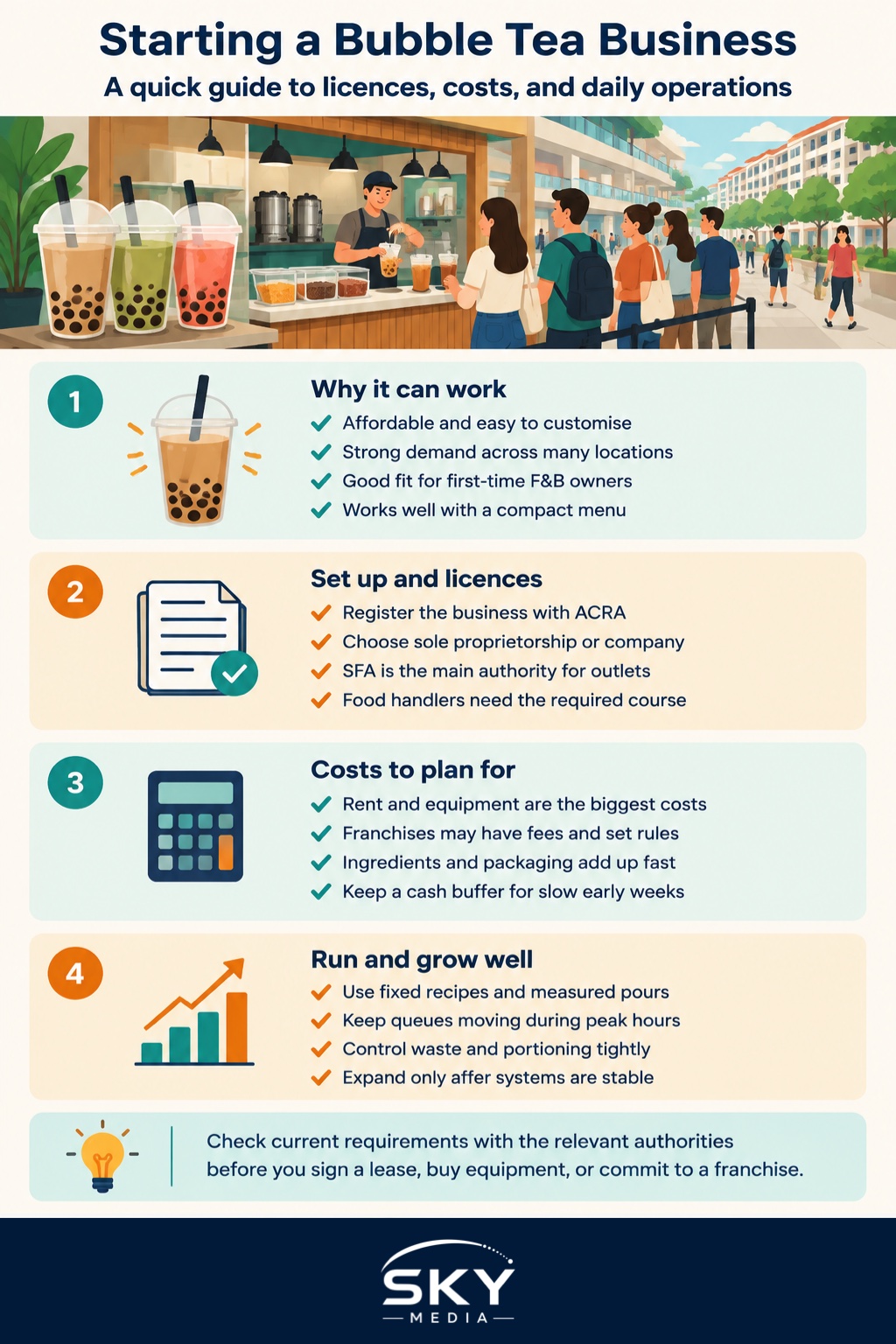
Bubble tea sells well because it is affordable, repeatable, and endlessly customisable. A single store can serve a steady stream of customers with a compact menu, and the ingredients travel and store better than fresh food. That makes the format attractive to first time food and beverage owners.
You broadly have three routes in. Buying into an established franchise gives you a proven recipe, supply chain, and brand, in exchange for fees and tight rules on how you operate. Building your own independent brand gives you full creative and financial control, but you carry all the risk of recipe development, sourcing, and marketing. A kiosk or small counter inside a mall or coworking space lowers your space needs but often sits in a fixed rent structure.
This business suits people who thrive on speed, consistency, and service under pressure. The peak hour rush is intense, quality has to stay identical from the first cup to the two hundredth, and margins depend on tight control of waste and portioning. If you enjoy systems and hospitality in equal measure, it fits.
Licences, ACRA, and the SFA
Register the business first with ACRA. A sole proprietorship is simple to start, while a private limited company offers limited liability and a cleaner base if you plan multiple outlets or a franchise partnership. An accountant or corporate secretary can help you choose, and you should confirm current requirements rather than assume.
Because you are selling drinks made and served on site, the Singapore Food Agency (SFA) is your key authority. A drinks outlet generally needs an SFA food shop licence, and your premises must meet the agency’s hygiene and design standards. Everyone preparing drinks will typically need to complete the required food safety course and register as a food handler. NEA hygiene rules govern cleaning, storage, and pest control, and shape your unit’s grading. If you plan to market as halal, that certification is a separate process through MUIS. Rules and fees change, so check the SFA site directly or ask them before you sign anything.
If you buy a franchise, the franchisor may guide you through parts of this, but the legal responsibility for compliance still sits with you as the licensee. Read your franchise agreement closely and, ideally, have a lawyer review it.
Costs and Getting Started
There is no single honest startup figure, because it depends on your format, location, and whether you franchise or go independent. Focus on the cost drivers instead.
| Cost driver | Independent kiosk | Franchise store |
|---|---|---|
| Upfront fees | None beyond setup | Franchise and licence fees apply |
| Rent | High in malls, varies by area | Often prime, high footfall sites |
| Equipment | Sealing machines, blenders, chillers, boilers | Often specified by franchisor |
| Ingredients and supply | You source and negotiate | Usually a set supply chain |
| Brand and marketing | You build from scratch | Provided, with rules attached |
The heaviest drivers are rent and equipment. A high traffic mall unit commands premium rent, while a heartland shop or kiosk costs less but may draw fewer impulse buyers. Sealing machines, blenders, tea brewers, water boilers, and chillers are core purchases, and quality used equipment can lower your entry cost. Ingredients, cups, straws, and packaging are a constant running cost, so negotiate supply and watch portioning to protect margin.
Keep a cash buffer for the slow early weeks and for the reality that a nearby competitor can open at any time. Explore Enterprise Singapore capability schemes, but treat any amounts and eligibility as things to verify, since they change. Register for GST with IRAS when required or beneficial, and keep clean records from day one.
Running and Growing the Business
Once open, success comes down to a handful of disciplines repeated flawlessly.
- Standardise every drink. Fixed recipes, measured pours, and timed brews keep taste identical across shifts and staff.
- Manage queue speed. During peaks, throughput is revenue. Smart layout, prep ahead, and a simple ordering flow matter as much as flavour.
- Control waste. Brewed tea, cooked pearls, and prepped toppings have short windows, so batch to demand.
- Refresh the menu. Seasonal and limited flavours give regulars a reason to return and give you social media moments.
- Own your online presence. Delivery platforms extend reach, and clear photos plus quick replies keep you visible, though platform commissions eat into margin.
Growth usually means opening more outlets, offering delivery, or building catering and bulk order channels for offices and events. Multi outlet growth multiplies your manpower and supply challenges, so systemise recipes, training, and stock control before you expand, not after.
Common Pitfalls to Avoid
The most common mistake is treating a trendy product as a guaranteed win. Bubble tea is competitive, and a location that looks busy may already be saturated. Others overpay for a prime lease that a modest menu cannot support, or franchise into a brand without reading the fees and obligations carefully. Many underestimate manpower, since peak hours need enough hands and Singapore’s tight labour market and foreign worker rules make staffing a real planning exercise. And inconsistent drinks quietly lose the regulars who make the numbers work.
Avoid these by testing demand in your chosen area, pricing for a genuine margin rather than just to fill the shop, and building tight operational systems before you scale. A bubble tea business Singapore-wide can absolutely thrive, but only for the operator who runs it with discipline, not just enthusiasm.
This article is general information, not legal, financial, or tax advice. Rules and figures change, so confirm current requirements with the SFA, ACRA, NEA, and IRAS, or consult a qualified professional before committing.
Explore more
Weighing your food and beverage options? Compare a bakes led model in our guide to starting a bakery, look at a lower rent, mobile path with running a food truck or stall, or consider the heartland route in starting a hawker stall.
Official sources: Singapore Food Agency (SFA)