

Most beginners think of flash as something you use only in the dark. In truth, one of its most useful jobs happens in broad daylight. Fill flash is a small, controlled burst of light that lifts the harsh shadows the sun carves onto your subject. In our part of the world, learning to use fill flash in Singapore is close to essential, because the sun sits high overhead and the light near the equator can be brutally hard for much of the day. That midday sun creates deep shadows under eyes, noses and chins, and a touch of fill flash softens them beautifully.
The idea is not to light the whole scene as flash normally would. Instead, you let the sun remain the main light and add just enough flash to open up the shadows. Done well, nobody can even tell you used flash. The photo simply looks more even and flattering.
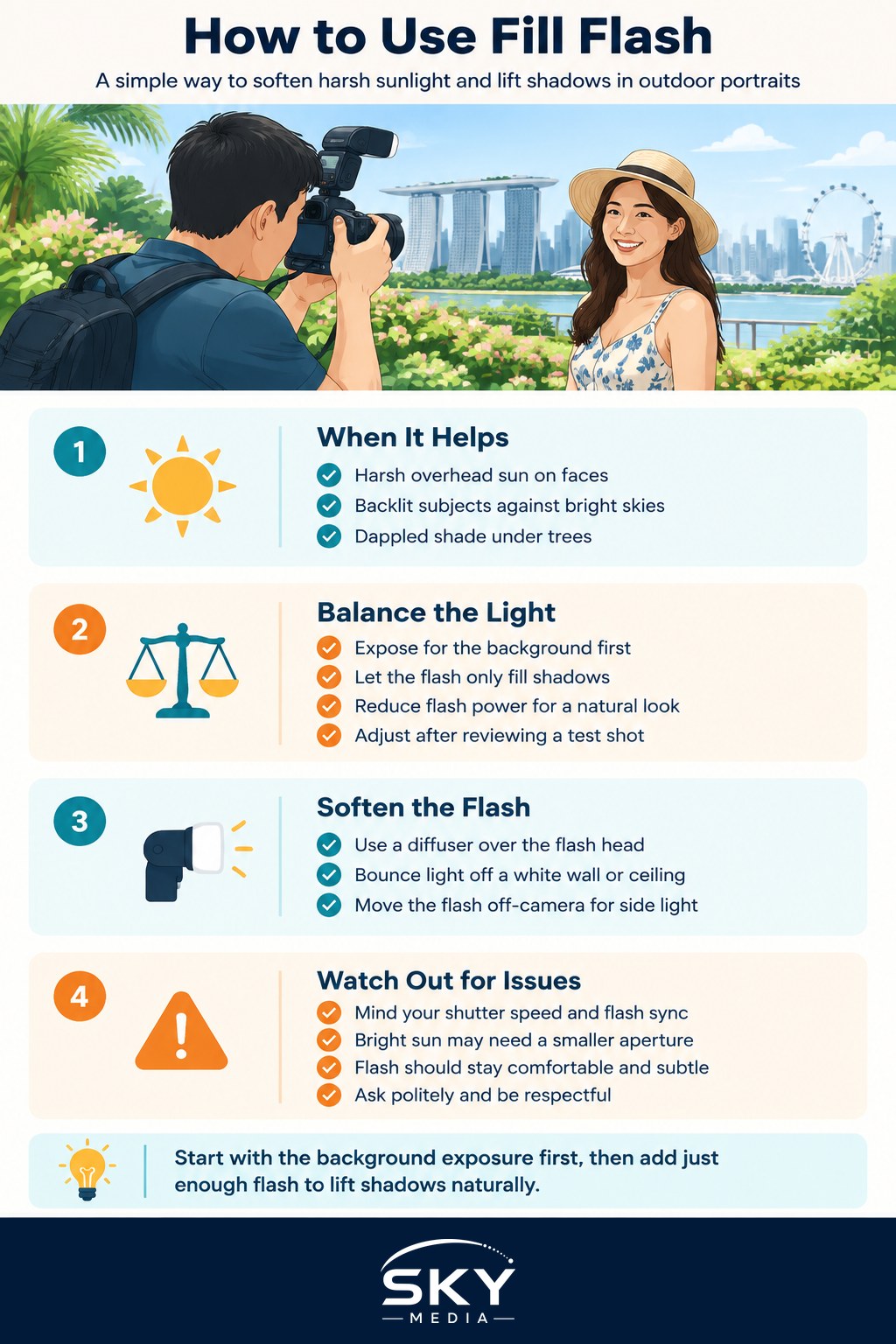
When Fill Flash Helps Most
There are a few classic situations where fill flash rescues a photo.
The first is harsh overhead sun. When the sun is high, it casts ugly shadows across faces, often called raccoon eyes. A little fill light brightens those shadows so features read clearly. If you cannot use flash, our guide to shooting in harsh midday sun covers other tactics, but flash is the most direct fix.
The second is backlighting. When your subject stands in front of a bright background such as a sunset, the sea or a bright sky, the camera exposes for the background and turns your subject into a dark shape. You can either embrace that and shoot silhouettes, or add fill flash to bring your subject back to life while keeping that glowing background. This is a wonderful technique for portraits by the water at Marina Bay or East Coast Park.
The third is dappled light, such as shade under trees where patches of sun fall unevenly across a face. Fill flash evens out those hot and cold spots.
Getting the Balance Right
The whole art of fill flash is balance. Too much and your subject looks lit like a deer in headlights, flat and artificial against a darker background. Too little and it does nothing. You want the flash to whisper, not shout.
Start by exposing for the background as you normally would, ideally in aperture priority or manual so you control the look. Get the sky, sea or scenery looking right first, even if your subject is a little dark. Then turn on the flash to fill in the subject.
Most cameras and speedlights let you dial in flash exposure compensation, usually marked with a lightning bolt and a plus or minus scale. This is your most important control. Begin by reducing the flash power, often to minus one or minus two thirds of a stop. That gentle reduction is what keeps the effect natural. Take a shot, review it, and adjust. If the shadows are still too dark, add a little power. If your subject looks unnaturally bright, pull it back further.
A Quick Starting Recipe
For an outdoor portrait in bright sun, try setting your camera to aperture priority at around f/4, let it meter the background, then switch the flash on with flash compensation at minus one stop. Check the result and fine tune from there. These are starting points, not fixed rules, so trust your eyes over any single setting.
Softening and Positioning the Light
Even a small pop of flash can look hard if it fires straight at your subject. There are simple ways to soften it.
A diffuser over the flash head spreads the light and makes it gentler. Many speedlights come with a small clip-on dome, and even a folded tissue or a proper reflector and diffuser helps. Bouncing the flash off a nearby white wall or ceiling also softens it, though outdoors you rarely have a surface to bounce from.
For more control still, moving the flash off the camera lets you angle the fill light from the side rather than head on, which looks far more natural. If you want to explore that route, our guide to flash and speedlights goes deeper. Off camera is not necessary for simple fill work, but it opens up creative options once you are comfortable.
A Few Honest Cautions
Fill flash is forgiving, but a couple of things trip people up. Watch your shutter speed. Every camera has a maximum flash sync speed, often around 1/200 of a second. Go faster than that with normal flash and you get a dark band across your frame. In very bright sun this can force you to use a smaller aperture or a neutral density filter, unless your flash supports high speed sync.
Be mindful of your subjects too. A flash firing repeatedly can be uncomfortable, especially for children or in quiet settings. Photograph people respectfully, ask when appropriate, and get parental consent when photographing minors. Indoors at events, a single subtle fill can flatter faces without turning your evening into a light show.
Fill flash is one of those techniques that quietly transforms your outdoor portraits once it clicks. Practise on a willing friend at a park during the harsh part of the day, dial the flash down until the effect looks invisible, and you will wonder how you ever shot backlit portraits without it. Give it a try on your next sunny outing.
Further reading: How to Use Off Camera Flash