
Moving your flash off the hotshoe is the single biggest jump in portrait quality most photographers ever make. Off camera flash lets you place light to the side, above or behind your subject, creating shape and depth that on camera flash simply cannot. This guide covers the triggers that fire it, the modifiers that soften it, and where to stand it for flattering results.
Why take the flash off the camera
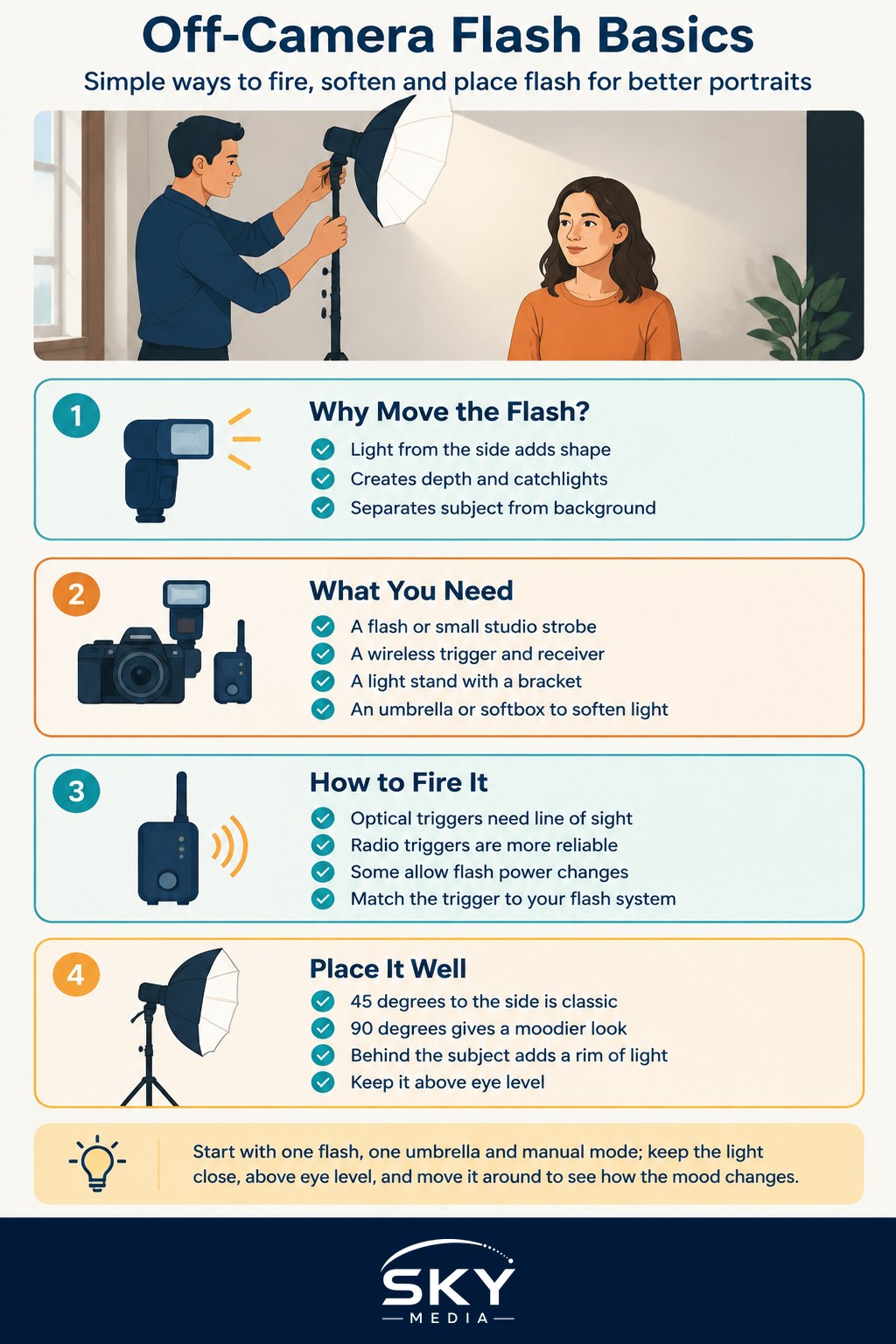
Light that comes from beside the lens looks three dimensional. It carves out cheekbones, adds a catchlight to the eyes and separates your subject from the background. On camera flash, sitting right next to the lens, flattens all of that away. Once the flash moves even a metre to one side, ordinary snapshots start to look like proper portraits. That is the whole reason this technique is worth the small extra effort.
Gear you need to start
You need three things beyond your camera: a flash, a way to fire it remotely, and a stand to hold it.
- A speedlight or a small studio strobe. Godox is popular locally because one trigger system works across many of its lights.
- A wireless trigger and receiver. The trigger sits on your hotshoe and tells the flash when to fire. Many modern flashes have a receiver built in.
- A light stand and a bracket that holds the flash and lets you attach a modifier.
A folding umbrella is the cheapest way to soften light, so many people begin there before buying a softbox.
Triggers: getting the flash to fire
Older methods relied on an optical signal, where one flash sees another fire and joins in. It works but struggles in bright daylight and needs line of sight. Modern radio triggers are far more reliable. They fire the flash by radio signal from up to many metres away, through walls, and often let you change flash power from the trigger on your camera without walking over to the light. That last feature alone saves enormous time on a shoot.
Match the trigger to your flash brand or system. A radio trigger and a matching receiver, or a flash with a receiver already inside, is the setup most people settle on.
Light modifiers: shaping the burst
A bare flash is a small, hard light that casts sharp shadows. Modifiers make the light source physically larger, and a larger source relative to your subject means softer, gentler shadows.
| Modifier | Light quality | Best for | Notes |
|---|---|---|---|
| Shoot through umbrella | Soft, spreads widely | Quick portraits, groups | Cheap, but light goes everywhere |
| Softbox | Soft, more controlled | Portraits, product | Directional, less spill |
| Bare flash | Hard, defined shadows | Drama, rim light | Small and punchy |
| Bounce off wall | Very soft, broad | Natural indoor look | Needs a white surface |
The bigger the modifier and the closer it sits to your subject, the softer the light. Pull it back and the shadows harden. This single relationship, size and distance, controls most of the mood in your images.
Positioning: where to put the light
Think of the flash as the sun and imagine walking it around your subject on a clock face, with the camera at six o’clock.
- 45 degrees to the side and slightly above is the classic portrait position. It lights the face while keeping natural shadows that add shape.
- 90 degrees to the side creates dramatic, moody light with one bright side and one dark side.
- Behind the subject gives a rim of light along the hair and shoulders, separating them from a dark background.
Height matters too. Raise the light a little above eye level and angle it down so shadows fall naturally under the chin, the way outdoor light does. Watch the catchlight in the eyes as your guide.
Settings to start from
Off camera flash usually works best in manual so results stay consistent. Try these as launch points:
- One light portrait: camera in manual, ISO 100, f/4, shutter 1/160. Flash at one quarter power in a softbox, placed 45 degrees to the side, about a metre from your subject.
- Balancing with a window: expose for the ambient room first, then add flash at low power for a clean, lit look that still feels natural.
- Outdoor at dusk: ISO 200, f/4, shutter at sync speed, flash power raised to overpower the fading sky.
Adjust flash power up or down to control your subject’s brightness, and use aperture and ISO to control how bright the background looks. Keeping the two separate in your head is the key skill. If manual mode still feels unfamiliar, it is worth practising the fundamentals of shooting in manual first.
Common mistakes to avoid
- Light too far away. Distant flash becomes hard and weak. Bring the modifier in close.
- Light too low. Lighting from below looks unnatural. Keep it above eye level.
- Forgetting the background. Your shutter and ISO decide how dark or bright the room behind the subject is. Change them deliberately.
- One flat setup forever. Move the light around a still subject and photograph each angle. You will learn more in ten minutes than in a week of reading.
- Line of sight issues with optical triggers. If firing is unreliable outdoors, switch to a radio trigger.
Bringing it together
Off camera flash sounds technical but rests on a few simple ideas: fire it reliably with a radio trigger, soften it with a modifier placed close, and position it to the side and slightly above. Start with one light and one umbrella, keep the flash in manual, and walk it around a patient friend until the shape of the light makes sense. From there, adding a second light is a small step rather than a leap.
Explore more: How to use flash and speedlights · Lighting basics for video and photo · How to shoot in manual mode
Frequently Asked Questions
What is the cheapest way to start with off camera flash? You need a flash, a wireless trigger and a light stand with a bracket. A folding umbrella is the cheapest way to soften the light, so many people begin there before buying a softbox. Many modern flashes have a receiver built in.
Why are radio triggers better than optical ones? Optical triggers rely on one flash seeing another fire, so they struggle in bright daylight and need line of sight. Radio triggers fire reliably from many metres away, through walls, and often let you change flash power from the camera.
How far should the flash be from my subject? Bring the modifier in close, since a bigger source nearer the subject gives softer light. A distant flash becomes hard and weak. As a starting point, the article suggests about a metre away, at 45 degrees to the side and slightly above.
Which modifier should I choose, an umbrella or a softbox? A shoot-through umbrella is cheap and spreads soft light widely, good for quick portraits and groups. A softbox is more directional with less spill, good for portraits and product work. Bare flash gives hard, punchy light for drama.
How do I stop the background going too dark with flash? Flash power controls your subject’s brightness, while shutter speed and ISO control how bright the room behind looks. Slow the shutter a little to bring back ambience, and balance with a window by exposing for the room first.
Further reading: How to Use Fill Flash