

A bit of worry is part of being human. It is your mind trying to protect you, running ahead to spot what might go wrong. But when worry becomes a constant background hum, playing out worst-case scenarios that rarely happen, it drains your energy and steals your peace. Learning how to worry less in Singapore’s high-pressure, always-on environment is not about switching off your concerns. It is about worrying more wisely, so anxious thoughts take up less of your day and less of you.
This is gentle, everyday self-help, not therapy. The aim is to give you some practical handles for the ordinary worries that most of us carry.
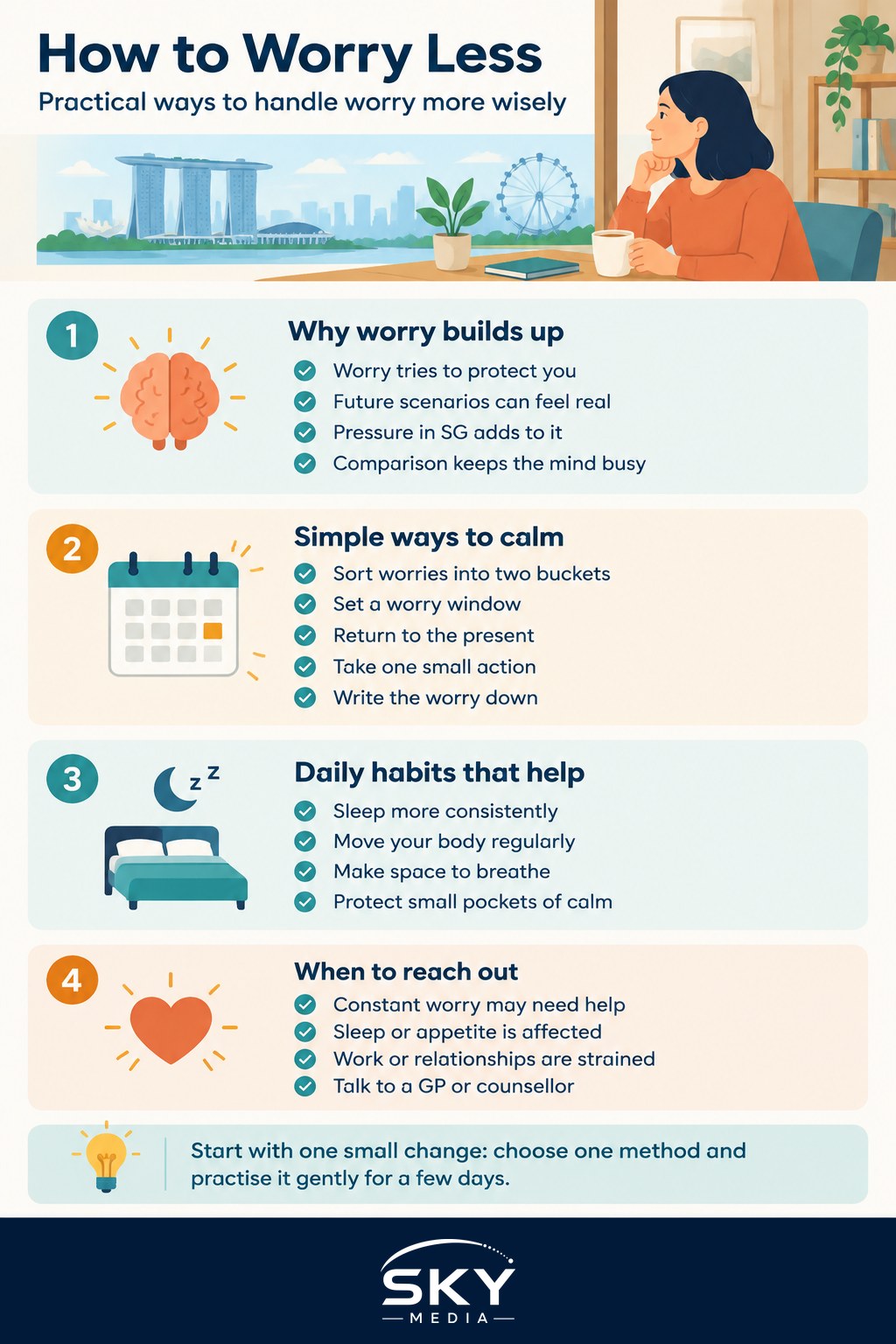
Why We Worry So Much
Worry often feels productive, as though turning a problem over enough times will somehow solve it or keep us safe. Usually it does neither. It just keeps the fear alive without changing anything.
Local life does not help. There is real pressure here around grades, careers, money, housing, and keeping up. Add a culture of comparison and a habit of always looking to the next milestone, and the mind finds no shortage of things to fret about. Much of it is future-focused, “what if” scenarios that may never arrive.
Two patterns are worth spotting:
- Worrying about things you cannot control. The economy, other people’s opinions, what might happen next year.
- Worrying instead of acting. Circling a problem endlessly rather than taking one small step.
Naming which kind you are doing is the first move toward loosening its hold. If your mind tends to spin, how to stop overthinking is a helpful partner to this piece.
Practical Ways to Worry Less
None of these are magic, but used regularly they genuinely lighten the load.
- Sort worries into two buckets. Can I do something about this or not? For the first, decide one small action. For the second, practise letting it go, again and again if needed. Our guide on how to let go of what you cannot control goes deeper here.
- Set a worry window. Give worry a time and place, say fifteen minutes in the early evening. When anxious thoughts pop up outside it, tell yourself you will attend to them then. Oddly, most feel smaller by the time the window arrives.
- Come back to now. Worry lives in the future. Anchor yourself in the present with a slow breath, your feet on the floor, or the sounds around you. Learning how to be more present makes this easier over time.
- Take one small action. Doing something, however tiny, breaks the loop far better than more thinking. Send the email. Book the appointment. Ask the question.
- Write it down. Getting a worry out of your head and onto paper often shrinks it to a manageable size.
Pick one or two to try rather than all at once. Small, steady practice beats a big overhaul.
Build Habits That Steady the Mind
Worrying less is partly about how you handle worries in the moment and partly about the state you keep your mind in day to day. A frazzled, exhausted mind worries more, so the basics matter.
Sleep, movement, and a little breathing space all lower the background level of anxiety. When your days are packed with no room to rest, everything feels more threatening. Protecting even small pockets of calm makes a real difference. If your stress runs high generally, how to manage everyday stress offers a fuller toolkit. Being kind to yourself matters too, since worry often comes wrapped in self-criticism.
When Worry Needs More Than Self-Help
These tools help with the everyday worries most of us live with. But worry is not always something you can simply manage on your own, and it is important to know the difference.
If anxiety feels constant and hard to control, if it is disrupting your sleep, appetite, work, or relationships, if you feel persistently on edge or low, or if worry has tipped into fear that will not lift, please treat that as a sign to reach out. Talk to people you trust, and consider speaking to a GP, a counsellor, or a Singapore support service such as the Institute of Mental Health or the Samaritans of Singapore. Do check their current official channels for how to get in touch. Reaching out is not a weakness. It is a sensible, brave step, and support really does help.
A Gentle Wrap-Up
You will never stop worrying entirely, and you do not need to. The goal is to keep worry in its place: useful when it points you toward action, gently set aside when it is only spinning. Sort what you can control from what you cannot, take small steps, come back to the present, and look after the basics. Be patient with yourself as you practise. A calmer mind is not one with no worries. It is one that has learned to hold them a little more lightly.
Frequently Asked Questions
What is the difference between normal worry and an anxiety disorder? Normal worry is tied to real situations and eases when they pass. An anxiety disorder involves excessive, hard-to-control fear that disrupts sleep, work or relationships for weeks. Only a doctor or qualified professional can diagnose it.
How can I stop worrying at night so I can sleep? Write your worries and one next step on paper before bed, then tell yourself you will deal with them tomorrow. Keep a regular wind-down routine and avoid screens late. If sleep is poor for weeks, see a doctor.
How do I worry less about my children’s future? Separate what you can influence, like support, routines and open conversation, from what you cannot. Focus on the child in front of you rather than imagined scenarios. Avoid comparing them with others, and talk to the school if concerns are specific.
Does exercise help reduce worry? Many people find regular movement eases tension and improves sleep, which lowers background worry. A walk or light activity works. It will not remove genuine problems, but it helps you cope. Check with a doctor if you have health conditions.
How do I worry less about money and the cost of living? Turn the vague fear into numbers: list income, regular expenses and one small saving step. Planning cuts uncertainty. For personal advice, speak to a licensed financial adviser, and check official schemes from government agencies for support you may qualify for.
Further reading: The Spotlight Effect: Why People Notice You Less Than You Think