

Most mornings begin with a cluttered mind. Half remembered worries, the day’s to-do list, a replay of yesterday’s awkward conversation, all jostling for attention before you have even had your kopi. Morning pages are a simple practice for clearing that clutter. The idea is to write a few pages, by hand, first thing in the morning, without stopping, editing, or trying to be clever. You just let whatever is in your head spill onto the page. Writing morning pages is one of the most accessible journaling habits around, and for many people it becomes a quiet daily reset they come to rely on.
The practice was popularised through well-known writing on creativity, as a tool to unblock artists and clear mental static. But you do not need to be a writer or an artist to benefit. Anyone with a busy, noisy mind, which is to say almost everyone in a fast city, can use it.
What Morning Pages Actually Are
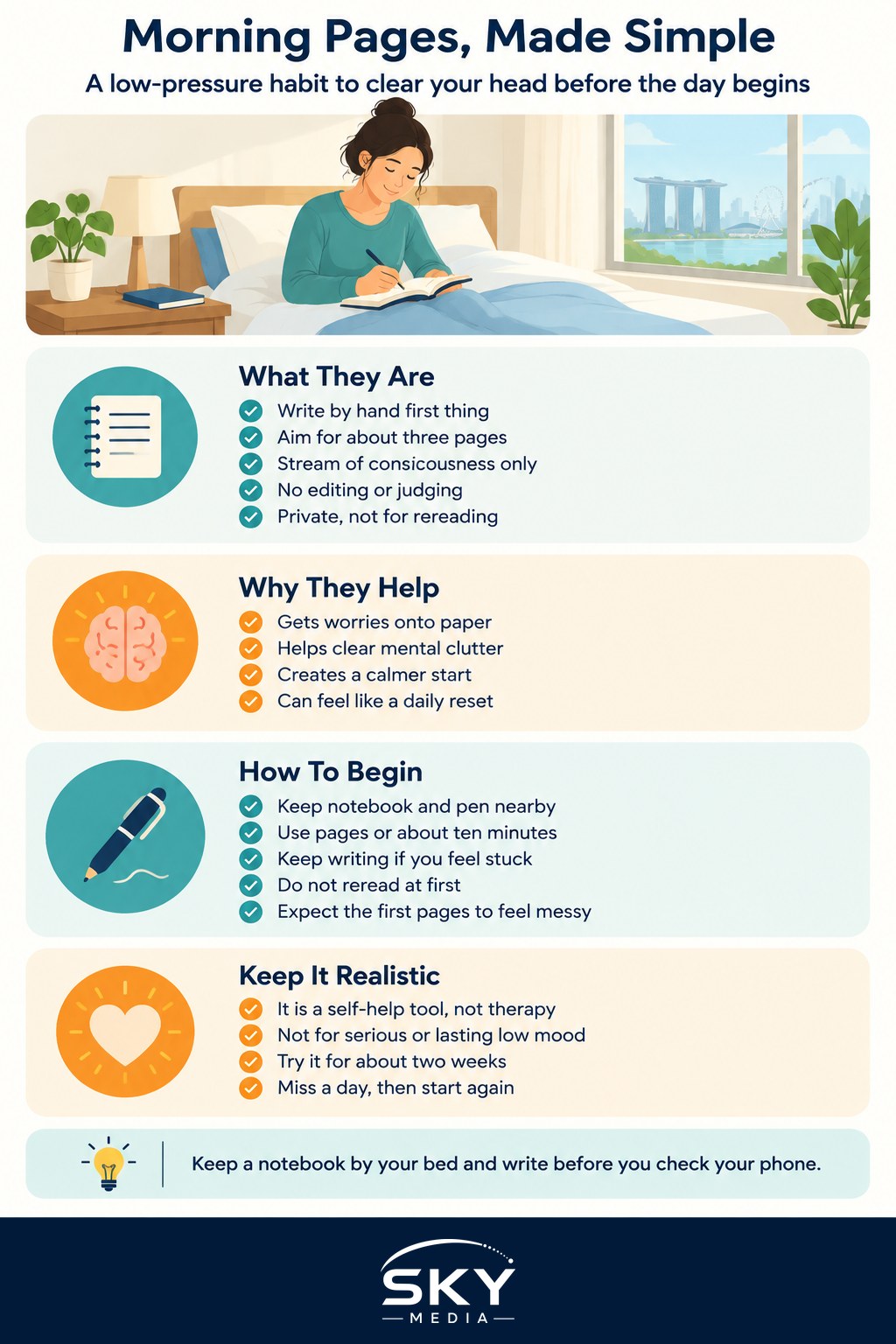
The core instructions are refreshingly simple. Each morning, soon after waking, you write about three pages of longhand, stream of consciousness. Whatever is in your head goes down. Grumbles, plans, worries, random thoughts, boredom, the fact that you cannot think of anything to write. There is no wrong content and no quality standard at all.
Three things make morning pages distinct from ordinary journaling. They happen first thing, before the day floods in. They are done by hand, which slows you down and keeps you honest. And they are strictly private, written for no one, never meant to be reread or judged. That privacy is the whole point. Because no one will ever see them, including a future you looking for something profound, you can be completely unfiltered. If you already enjoy the benefits of journaling, think of morning pages as its loosest, most no-pressure cousin.
Why They Work
It seems almost too basic to do anything, yet many people find morning pages genuinely steadying. The reason is not mysterious. A worried mind loops. The same anxieties circle round and round because they have nowhere to go. Getting them onto paper gives them somewhere to land, and once they are out, they lose some of their grip. It is a bit like emptying a cluttered drawer so you can finally see what is in it.
The morning timing matters too. Doing this before the emails and the group chats start pulling at you means you meet the day from a slightly clearer place, rather than reacting all the way through it. In this sense morning pages are close to how to do a brain dump, the practice of unloading everything in your head so it stops rattling around. Done daily and early, the effect compounds into a calmer baseline.
How to Start Writing Morning Pages
Getting going is easy, and the barrier to entry is deliberately low. A few practical notes to make it stick:
- Keep a notebook and pen by the bed, so the first thing you reach for is not your phone.
- Write about three pages, or set a rough limit like ten minutes if pages feel daunting. Consistency matters more than length.
- Do not stop to think or fix. If you are stuck, write “I do not know what to write” until something else comes. It always does.
- Do not reread them, at least not at first. These are for clearing your head, not for producing anything.
- Expect the first pages to feel like nonsense. That is normal and even the point. The clutter has to come out before the useful stuff surfaces.
The main challenge in Singapore life is the early start. If your mornings are already a rush to beat the MRT crowd, waking fifteen minutes earlier can feel impossible. Attaching the habit to something you already do, like your first cup of coffee, makes it far easier, which is the essence of habit stacking. If mornings truly will not work, a version at another quiet time still helps, even if it loses the first thing advantage.
Keeping It Realistic and Kind
A few honest caveats. Morning pages are a reflective, self help tool, not therapy. They are wonderful for everyday mental clutter and mild stress, but they are not a treatment for serious or persistent low mood. If writing keeps surfacing something heavy that does not ease, that is a sign to talk to someone you trust, or a GP or counsellor, not to write harder. Be gentle with yourself here.
It is also fine if this practice is not for you. Some people love the handwritten ritual, others find it a chore, and both are valid. Give it a fair try, perhaps two weeks, before deciding. And do not turn it into another stick to beat yourself with. Miss a day, miss a week, just start again without guilt. Building any morning habit takes patience, and it can help to first look at building a morning routine that works so the pages have a natural home.
Start tomorrow. Put a notebook by your bed tonight, and when you wake, write whatever comes for a few minutes before you touch your phone. Do not aim for insight. Aim only to empty your head onto the page. Writing morning pages asks very little, and for a great many people, it turns the chaotic start of the day into something quieter and more their own.
Further reading: How to Become a Morning Person If You Are Not One · How to Write a Year-End Reflection You Will Revisit