

Getting married changes a lot of paperwork, and many couples assume their tax return changes too. The good news is that income tax after marriage in Singapore is simpler than most people expect. You do not merge your returns, you do not lose your own reliefs, and your rates are still worked out on your own income. What does change is a short list of spouse and family reliefs, and the need to agree with your partner on who claims what.
If you are filing for the first time as a married person this tax season, this guide walks you through what to check. It is general information, not tax advice. Reliefs and conditions are reviewed in Singapore’s annual Budget, so always confirm the current rules on the IRAS (Inland Revenue Authority of Singapore) website before you submit.
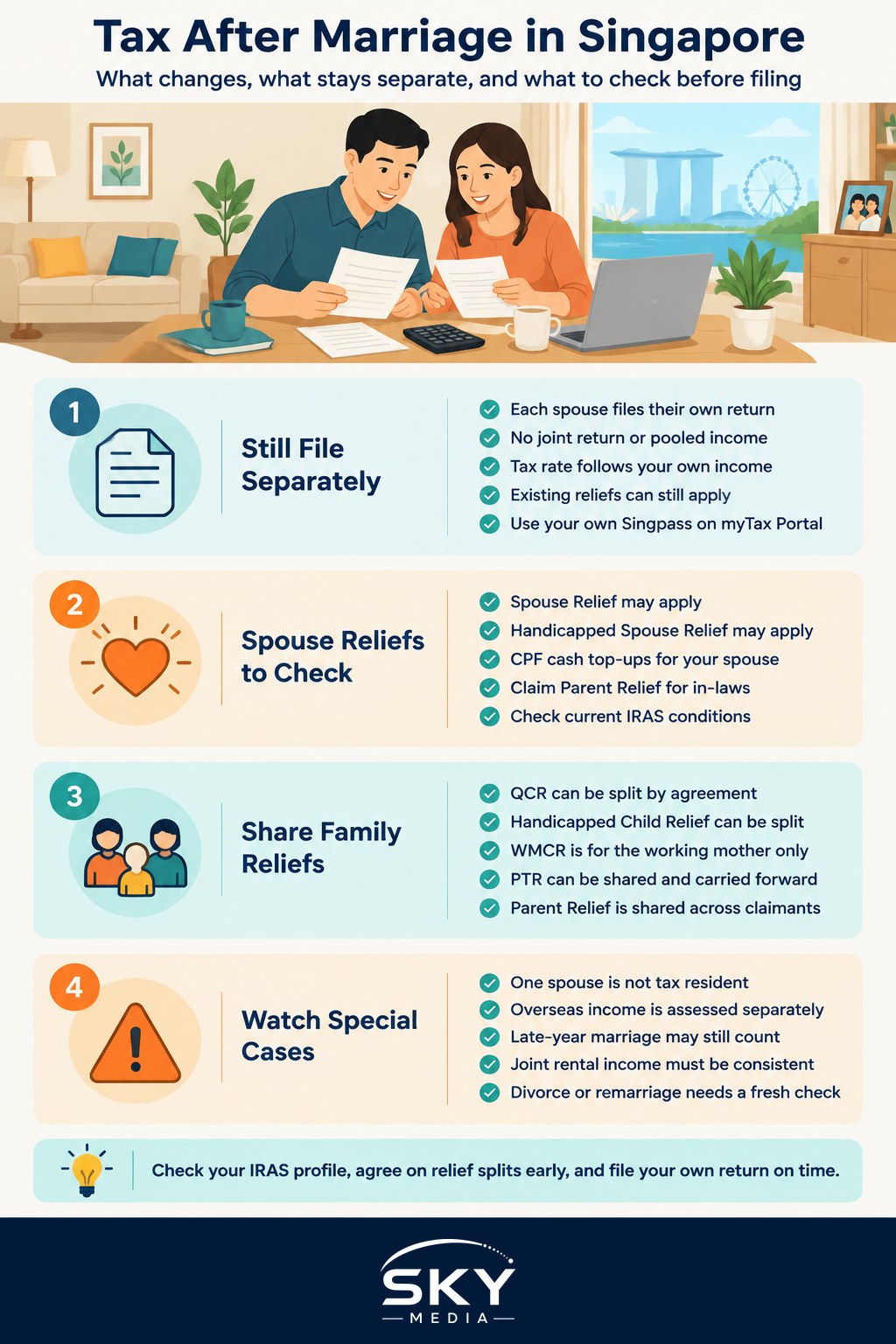
You Still File Separately as a Married Couple
Singapore uses separate assessment for husbands and wives. Each spouse has their own tax account, files their own return through myTax Portal using their own Singpass, and receives their own Notice of Assessment. There is no joint return and no option to pool your incomes.
This has a few practical consequences for newlyweds:
- Your tax rate depends only on your income. Marriage does not push either of you into a higher or lower bracket. If you want a refresher on how the brackets work, see Singapore Income Tax Rates Explained.
- Your existing reliefs stay with you. Earned income relief, CPF relief, and any reliefs you already claim for your own parents continue as before, as long as you still meet the conditions.
- Each of you is responsible for your own return. Even if one partner handles the household finances, the other still needs to log in, check the pre-filled figures and submit, unless they are on IRAS’s No-Filing Service and nothing needs changing.
- Your marital status should be updated. IRAS generally picks up your marriage from government records, but check that your profile on myTax Portal reflects it, because some reliefs depend on it.
Spouse-Related Reliefs Newlyweds Should Know
Marriage opens up a small set of reliefs that relate to your spouse. Whether you can claim them depends on your spouse’s circumstances, not just the fact that you are married.
- Spouse Relief. Historically available to a taxpayer whose spouse had little or no income in the previous year. The income limit and the amount are set by IRAS, and personal reliefs have been reviewed in recent Budgets, so check whether it still applies and what the conditions are for the year you are filing.
- Handicapped Spouse Relief. A higher relief for supporting a spouse with a physical or mental disability. Again, check the current conditions on IRAS.
- CPF Cash Top-up Relief for your spouse. If you top up your spouse’s CPF retirement account in cash, you may be able to claim relief, subject to your spouse’s income being below the limit IRAS sets and the overall annual cap for top-up relief. CPF Board and IRAS both explain how this works.
- Parent Relief for your in-laws. Once married, you can claim Parent Relief for your spouse’s parents, not just your own, if the in-laws meet the age, residence, income and support conditions. This is where couples and their siblings most often need to coordinate, because the relief for each parent can only be claimed up to the total limit across all claimants.
A common newlywed situation is one spouse pausing work for further studies, a career break or to care for a baby. That is the year to look closely at the spouse-related reliefs and the CPF top-up option, since they are designed for exactly this kind of income gap.
Who Claims What: Splitting Reliefs as a Couple
Once children arrive, the list of family reliefs grows, and several of them can be shared between husband and wife. The key is that you agree on the split before you both file, so the total does not exceed what the rules allow.
| Relief or rebate | Who can claim | Can it be split between spouses? |
|---|---|---|
| Qualifying Child Relief (QCR) | Either parent | Yes, by agreement, up to the total amount per child |
| Handicapped Child Relief | Either parent | Yes, by agreement, up to the total amount per child |
| Working Mother’s Child Relief (WMCR) | The working mother | No, it is for the mother only |
| Parenthood Tax Rebate (PTR) | Either parent | Yes, by agreement, and unused amounts carry forward |
| Parent Relief for each parent or in-law | Any child supporting that parent | Shared among all claimants, including siblings |
| Grandparent Caregiver Relief | The working mother | No, and only one claimant per caregiver |
A few practical tips for splitting:
- Put the higher earner first, but check the numbers. Reliefs reduce chargeable income, so they save more tax for the spouse in a higher bracket. That said, if the higher earner is already close to the overall personal relief cap of $80,000, shifting reliefs to the other spouse may be more useful.
- Use the Parenthood Tax Rebate wisely. A rebate reduces tax payable directly, and unused amounts carry forward to future years. Couples often let the spouse with the higher tax bill use it first, but you can share it in any proportion you agree on.
- Write your agreement down. A simple note in a shared document of who is claiming what percentage of each relief saves a lot of confusion next April.
For a full list of reliefs and their general conditions, see A Full Guide to Income Tax Reliefs in Singapore.
Situations That Need Extra Care
Not every couple fits the standard picture. A few situations deserve a closer look:
- One spouse is not a tax resident. If your spouse is a foreigner who has not yet lived or worked in Singapore long enough to be a tax resident, your own return is unaffected, but some spouse reliefs have residence or income conditions. Check them on IRAS.
- One spouse has overseas income. Your spouse’s foreign income is assessed separately from yours. For how foreign income is generally treated, read Tax on Foreign Income in Singapore.
- You married late in the year. Reliefs depend on your status and circumstances in the year before the Year of Assessment. If you married in December, you may already be able to claim married-person reliefs for that year, subject to the conditions.
- Joint property or joint rental income. If you co-own a property that you rent out, each owner declares their share of the rental income in their own return, usually in line with ownership. Both returns must be consistent.
- Divorce, separation or remarriage. Some child reliefs and rebates have specific rules for these situations. Check IRAS rather than assuming last year’s split still applies.
A Newlywed Tax Checklist for Filing Season
Use this before either of you clicks submit:
- Log in to myTax Portal with your own Singpass and confirm your marital status.
- Check that employment income and donations pre-filled by your employer and charities are correct.
- List every relief either of you could claim, including for your new in-laws.
- Agree on the split for any shared reliefs, and make sure the totals do not exceed the limits.
- Talk to your siblings and siblings-in-law about Parent Relief before anyone files.
- Keep receipts and records for at least the period IRAS requires, in case you are asked for them.
- Each file your own return before the deadline, which falls in mid-April each year. Check the exact date on IRAS.
If you get it wrong, you can usually correct it. IRAS allows you to object to or revise your assessment within a set period after your Notice of Assessment is issued, and its website explains how.
Marriage brings plenty of new conversations, and tax is one of the easier ones once you know what changes. Keep the split fair, keep records, and treat filing season as a quick annual check-in on your finances as a couple.
Explore more: Income Tax in Singapore: A Simple Guide
Frequently Asked Questions
Can I claim Parent Relief for my in-laws who live overseas? It depends on IRAS’s conditions on residence, age, income and support, so living overseas can disqualify a parent. Check the current Parent Relief rules on IRAS and keep proof of any support you give. Talk to your spouse’s siblings first, since the relief is shared among all claimants.
What happens if my spouse and I both claim the same relief by mistake? IRAS may notice that the total claimed exceeds what the rules allow and adjust one or both assessments. If you spot the error yourself, amend your return or raise it with IRAS promptly. Agreeing in writing who claims what before filing avoids this.
Do we pay tax on interest from a joint savings account? Interest from Singapore savings accounts is generally not taxable for individuals, but other income, such as rental from jointly owned property, usually is. Conditions can change, so check IRAS for the current position on each type of income before you file.
Can I file my spouse’s tax return for them? Each spouse files their own return with their own Singpass. If your spouse needs help, sit beside them while they log in, or ask them to authorise you through myTax Portal’s third-party authorisation. Never use their Singpass, because it is a personal identity and cannot be shared.
Is it worth hiring a tax professional after getting married? For most salaried couples, probably not, since the return is pre-filled and the changes are modest. A tax professional may help if you have rental property, foreign income, a business, or an unusual family set-up. Check IRAS first and ask for a quote before deciding.
Official sources: IRAS
Further reading: Combining Finances When You Marry