

Most people in Singapore spend less than half an hour on their tax return, and that speed is exactly where errors creep in. Income tax filing mistakes are usually not dramatic. They are a forgotten side income, a relief claimed twice, or a pre-filled figure nobody checked. Each one can lead to a revised bill, a letter from IRAS (the Inland Revenue Authority of Singapore), or in more serious cases a penalty.
This is a last-minute checklist to run through before you click submit. It assumes you already know the basics of filing. It is general information, not tax advice, and IRAS’s website is the authority on current rules.
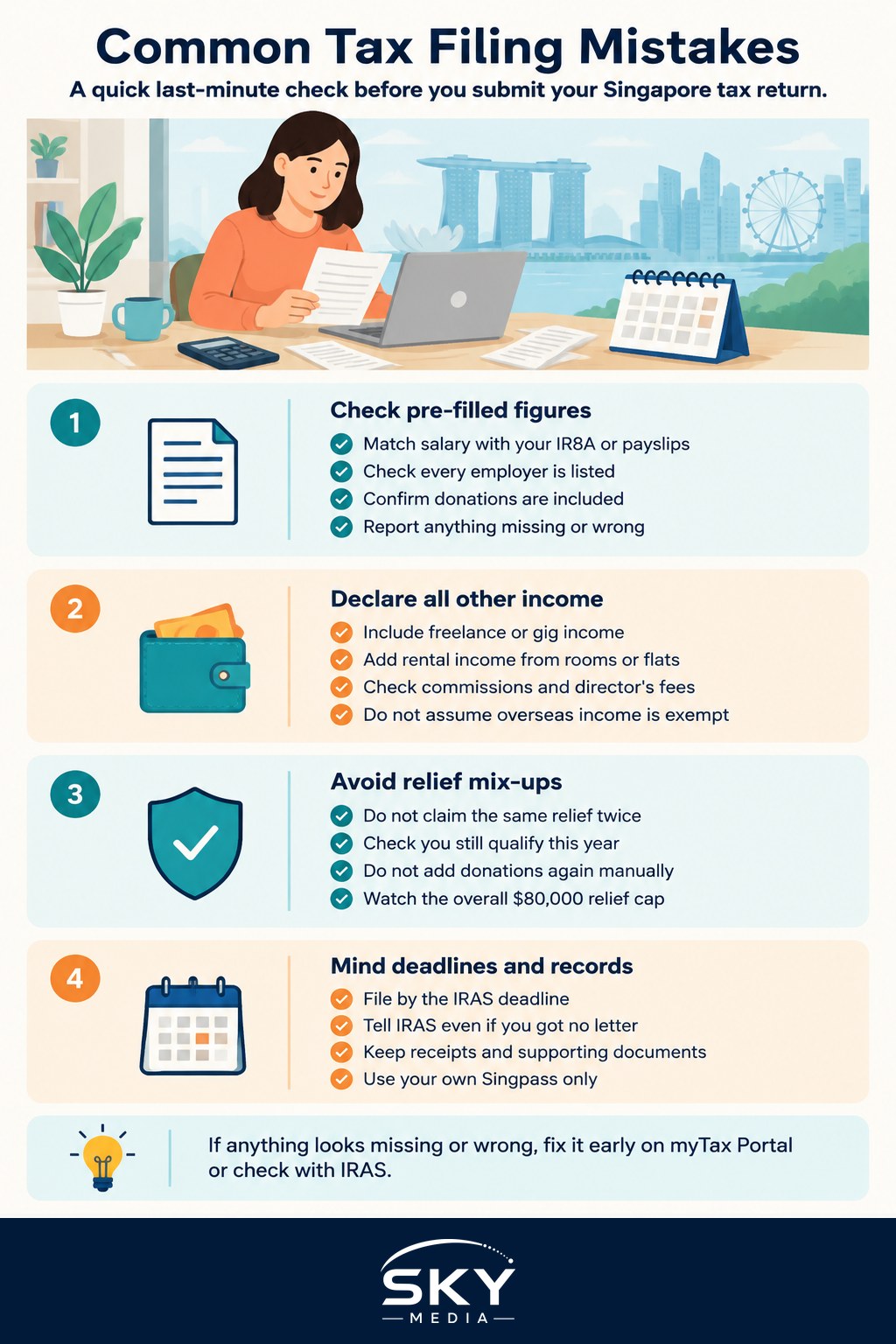
Mistake 1: Trusting the Pre-Filled Figures Without Checking
Many employers send salary details to IRAS automatically under the Auto-Inclusion Scheme (AIS), and approved charities send donation records too. That makes filing easy, but it also makes it tempting to skim.
- Compare employment income with your IR8A or payslips. Errors do happen, especially if you changed jobs, received a bonus late or left a company mid-year.
- Check every employer is listed. If one of your employers is not on the scheme, their income will not appear, and you must add it yourself.
- Check donations are there. If a donation is missing, it may be because your NRIC or FIN was not given when you donated. Contact the charity rather than adding it manually unless IRAS’s instructions say otherwise.
If you are on IRAS’s No-Filing Service (NFS), you still have a responsibility to tell IRAS if anything is missing or wrong.
Mistake 2: Forgetting Income That Is Not Pre-Filled
This is the most common source of trouble. Income that does not come through an employer’s payroll often has to be declared by you.
- Freelance, gig and side-hustle income. Earnings from private tuition, delivery or ride-hailing work, design or writing gigs, online selling and similar activities are generally taxable. Some platforms submit income data to IRAS, but you remain responsible for declaring it correctly, along with allowable expenses.
- Rental income. Renting out a room or your whole flat counts, even to a relative. See How Rental Income Is Taxed.
- Commissions and director’s fees. These may or may not be pre-filled depending on the payer.
- Overseas income. The treatment depends on the type of income and your residence status, so check rather than assume it is exempt.
Keep a running list through the year. A simple spreadsheet or a notes app is enough.
Mistake 3: Wrong or Double Relief Claims
Reliefs reduce your chargeable income, which is why errors here are taken seriously. Common slips include:
- Claiming the same relief as a sibling or spouse. Parent Relief, Qualifying Child Relief and the Parenthood Tax Rebate can be shared, but the total across everyone cannot exceed the limit. If you and your sibling each claim the full Parent Relief for the same mother, IRAS will pick it up.
- Claiming relief you no longer qualify for. Conditions change. A parent’s income may have gone up, a child may have started earning, or a relief may have been removed in a recent Budget. IRAS has phased out some reliefs in recent years, so check the list for the current Year of Assessment.
- Adding donations manually. Donations made with your NRIC are usually included automatically. Adding them again creates a double deduction.
- Claiming reliefs that are already automatic. Some reliefs, such as certain CPF-related reliefs, are often computed for you. Adding them again by hand can double-count.
- Ignoring the overall relief cap. There is an overall cap of $80,000 on total personal reliefs per Year of Assessment. Claims above that do not reduce your tax further.
For the full list and general conditions, see A Full Guide to Income Tax Reliefs in Singapore.
Quick Reference: Mistake, Risk and Fix
| Mistake | What can happen | How to fix it |
|---|---|---|
| Missing side or rental income | Revised assessment, possible penalties | Declare it in your return or contact IRAS to correct it |
| Two siblings claiming full Parent Relief | Claims reduced, follow-up letter from IRAS | Agree the split and file amended figures |
| Manually adding donations already pre-filled | Double deduction removed by IRAS | Check pre-filled donations before adding anything |
| Claiming a relief that no longer exists | Relief disallowed, tax bill revised | Check the current year’s relief list on IRAS |
| Filing late or not at all | Late filing penalties, summons in serious cases | File as soon as possible and contact IRAS |
| Ignoring the Notice of Assessment | Missing the window to object | Read it promptly and object within the stated time |
Mistake 4: Deadline and Admin Errors
Even a correct return causes problems if the admin side slips.
- Missing the deadline. The filing deadline falls in mid-April each year, with e-filing usually given a few extra days. Check the exact date on IRAS rather than relying on memory.
- Assuming no letter means no filing. If you have taxable income and did not receive a notice, you are generally still expected to tell IRAS. Newcomers often fall into this trap; see Income Tax Filing for Newcomers in Singapore.
- Outdated contact details. If IRAS cannot reach you, you may miss notices about your assessment or payments.
- Not keeping records. Receipts for expenses, rental agreements and supporting documents should be kept for the period IRAS requires, as you may be asked for them later.
- Using someone else’s Singpass. Each person must file using their own Singpass or a proper authorisation. Sharing logins is not allowed and causes confusion if questions arise.
What to Do If You Already Made a Mistake
Errors are fixable, and acting early is always better than waiting.
- Before the deadline: you can usually revise your return in myTax Portal, and the latest submission is used.
- After you receive your Notice of Assessment: if the assessment is wrong, you can file an objection within the time limit stated on the notice.
- If you discover undeclared income later: IRAS encourages voluntary disclosure of errors. It generally treats voluntary disclosure more favourably than errors it discovers itself, though the outcome depends on the case. Check IRAS’s guidance on voluntary disclosure.
- If your situation is complex: consider speaking to a registered tax professional.
A Five-Minute Pre-Submit Checklist
Before you click submit, run through this:
- Every employer and every income source is included.
- Pre-filled salary and donation figures match your own records.
- Each relief claimed still applies this year, and you meet its conditions.
- Shared reliefs have been agreed with your spouse or siblings.
- No donation or automatic relief has been entered twice.
- Your contact details are current.
- You have saved a copy of the acknowledgement page.
A careful five minutes now is far easier than a correction letter months later.
Official sources: IRAS
Further reading: How to Revise Your Income Tax Return After Filing · Missed the Income Tax Filing Deadline? What to Do Next · How to File Income Tax on Behalf of an Elderly Parent