

Moving from India to Singapore for work changes more than your address. It usually changes how Indian law treats you, and that has knock-on effects on your bank accounts, investments and taxes back home. Understanding your NRI status in Singapore early helps you avoid a common mistake: carrying on with your Indian resident savings account as if nothing has changed.
This guide explains the key ideas in plain terms. It is general information, not financial, tax or legal advice. Indian rules on residency, banking and tax are set by the Reserve Bank of India (RBI) and the Income Tax Department, and they do change. Confirm the details with your Indian bank, a qualified tax adviser, and the official sources before acting.
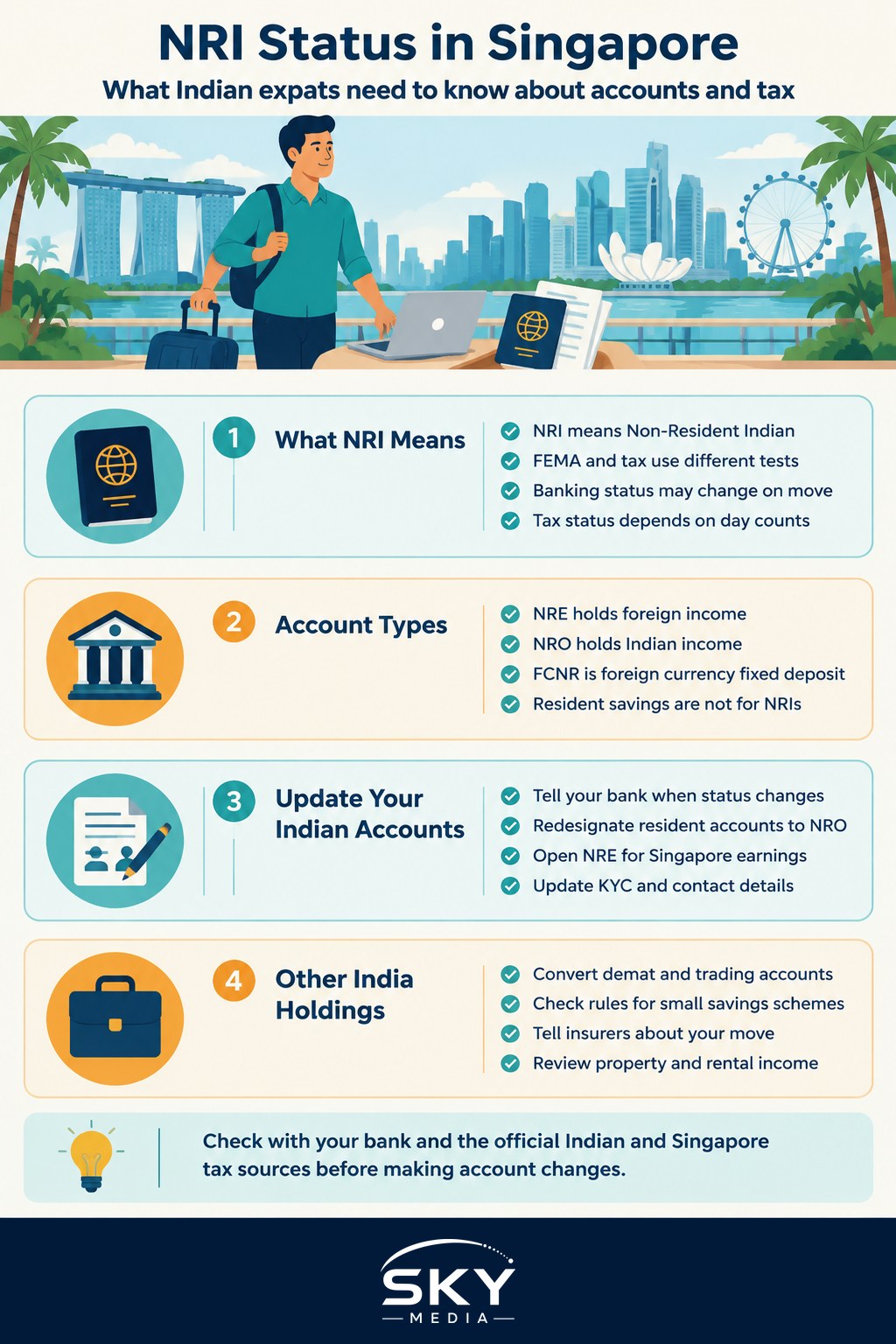
What NRI Status Means and Why It Changes When You Move
NRI stands for Non-Resident Indian. There are two separate tests that matter, and they do not always give the same answer.
- Under FEMA (the Foreign Exchange Management Act), which governs bank accounts and investments, your status generally depends on your purpose and intention. If you leave India to take up employment or a business abroad, or otherwise in circumstances showing you intend to stay outside India for an uncertain period, you are typically treated as a non-resident for banking and investment purposes from the time you leave.
- Under the Income Tax Act, residency is decided mainly by how many days you spend in India in a financial year, along with some additional conditions. You can be non-resident for FEMA but still resident for tax in your year of departure, or the other way round.
The practical point: your banking obligations usually change as soon as you move for work, while your Indian tax status depends on day counts and your income. Check both separately.
NRE, NRO and FCNR Accounts Explained
Once you are an NRI under FEMA, Indian banks expect you to hold accounts designed for non-residents rather than ordinary resident savings accounts.
| Account | What goes in | Repatriation to Singapore | Indian tax on interest |
|---|---|---|---|
| NRE (Non-Resident External) | Money earned abroad, such as your Singapore salary | Freely repatriable, principal and interest | Generally exempt under current rules |
| NRO (Non-Resident Ordinary) | Income earned in India, such as rent, dividends or pension | Allowed within annual limits and with paperwork | Generally taxable in India |
| FCNR(B) (Foreign Currency Non-Resident) | Foreign currency term deposits | Freely repatriable | Generally exempt under current rules |
| Resident savings account | Not meant for NRIs | Not applicable | Must usually be redesignated |
A few practical notes:
- NRE accounts are held in Indian rupees. You convert your Singapore dollars into rupees when you send money in, so exchange rate movements affect what you get back if you later bring money out.
- NRO accounts collect Indian income. If you keep a flat in India that you rent out, the rent usually goes here. Tax is often deducted at source by the bank.
- FCNR deposits avoid currency conversion because they are held in foreign currencies such as US dollars. They are fixed deposits, not everyday accounts.
Interest tax treatment, repatriation limits and the documents needed can change, so check the current rules with your bank and on the RBI and Income Tax Department websites.
What to Do With Your Existing Indian Accounts
The most important step is to tell your Indian bank that your residential status has changed. Under FEMA rules, resident savings accounts held by someone who has become an NRI are generally required to be redesignated as NRO accounts. Banks usually handle this through a form plus supporting documents, such as your passport with your Singapore pass details and proof of your overseas address.
A sensible order of tasks:
- Contact each Indian bank where you hold an account and ask for its NRI conversion process.
- Redesignate resident savings accounts to NRO. Ask whether joint accounts with resident family members need special treatment.
- Open an NRE account if you plan to send Singapore earnings home or invest in India.
- Update your KYC details, including your Singapore address, contact number and email. Keep your Indian mobile number active if your bank sends one-time passwords to it, or register an alternative method.
- Review fixed deposits with your bank, as they may also need redesignation.
Many Indian banks and some Singapore banks with Indian operations can open NRE and NRO accounts for customers based abroad. Compare service, fees and transfer options before choosing.
Investments, Insurance and Other Holdings in India
Your change of status affects more than savings accounts.
- Shares and mutual funds. Your demat and trading accounts generally need to be converted to their NRI versions, usually linked to an NRE or NRO account. Some fund houses limit investments from residents of certain countries, so check with each one.
- Small savings schemes. Rules on whether NRIs can continue or open certain government savings schemes differ by scheme. Check with the bank or post office that holds them.
- Property. NRIs can generally hold residential property in India, and rental income usually flows into an NRO account. Ask a tax adviser about tax on rent and any later sale.
- Insurance. Tell your Indian insurers about your move. Some health policies may not cover treatment abroad, so you may also need cover in Singapore. Our guide to insurance for expats explains the local options.
How Singapore Fits Into the Tax Picture
Singapore taxes individuals mainly on income earned in Singapore. For most individual employees, foreign-sourced income received in Singapore is generally not taxed, though there are exceptions, such as income received through partnerships. Singapore tax residency for individuals depends on factors including how long you stay or work here in a year. IRAS (the Inland Revenue Authority of Singapore) sets out the current rules on its website.
India and Singapore have a Double Taxation Avoidance Agreement, which helps decide which country can tax certain types of income and how to claim relief if both do. Interest on an NRO account, Indian rental income and capital gains in India can all raise questions under this agreement, so it is worth speaking to an adviser who understands both systems, especially in your year of moving.
Common Mistakes Indian Newcomers Make
- Leaving resident accounts unchanged for years after moving.
- Depositing Singapore salary into an NRO account when an NRE account would usually be more suitable for repatriation.
- Forgetting about Indian tax filings when there is Indian income such as rent or interest.
- Letting KYC lapse, which can freeze accounts at an inconvenient time.
- Not planning for a return. If you move back to India later, your accounts will need converting again, and there are rules for that too.
Settling in well also means building a life here, not just managing accounts back home. Our tips for new expats and guide to the expat community in Singapore are good next reads, and if you are planning long term, see retirement planning for expats.