

One of the first practical things you will want after landing is a local bank account. It is what your salary gets paid into, how you settle rent and bills, and how you tap and pay for almost everything through PayNow and contactless cards. The good news is that Singapore’s banking system is modern, fast and heavily digital, so once you have the right documents the process is usually quick. This guide walks through who can open an account, what you need, and the small hurdles newcomers sometimes hit.
A note up front: this is a general overview, not financial advice. Banks set their own rules, and eligibility, fees and features change. Always confirm the current requirements directly with the bank and check the Monetary Authority of Singapore (MAS) for the wider regulatory picture.
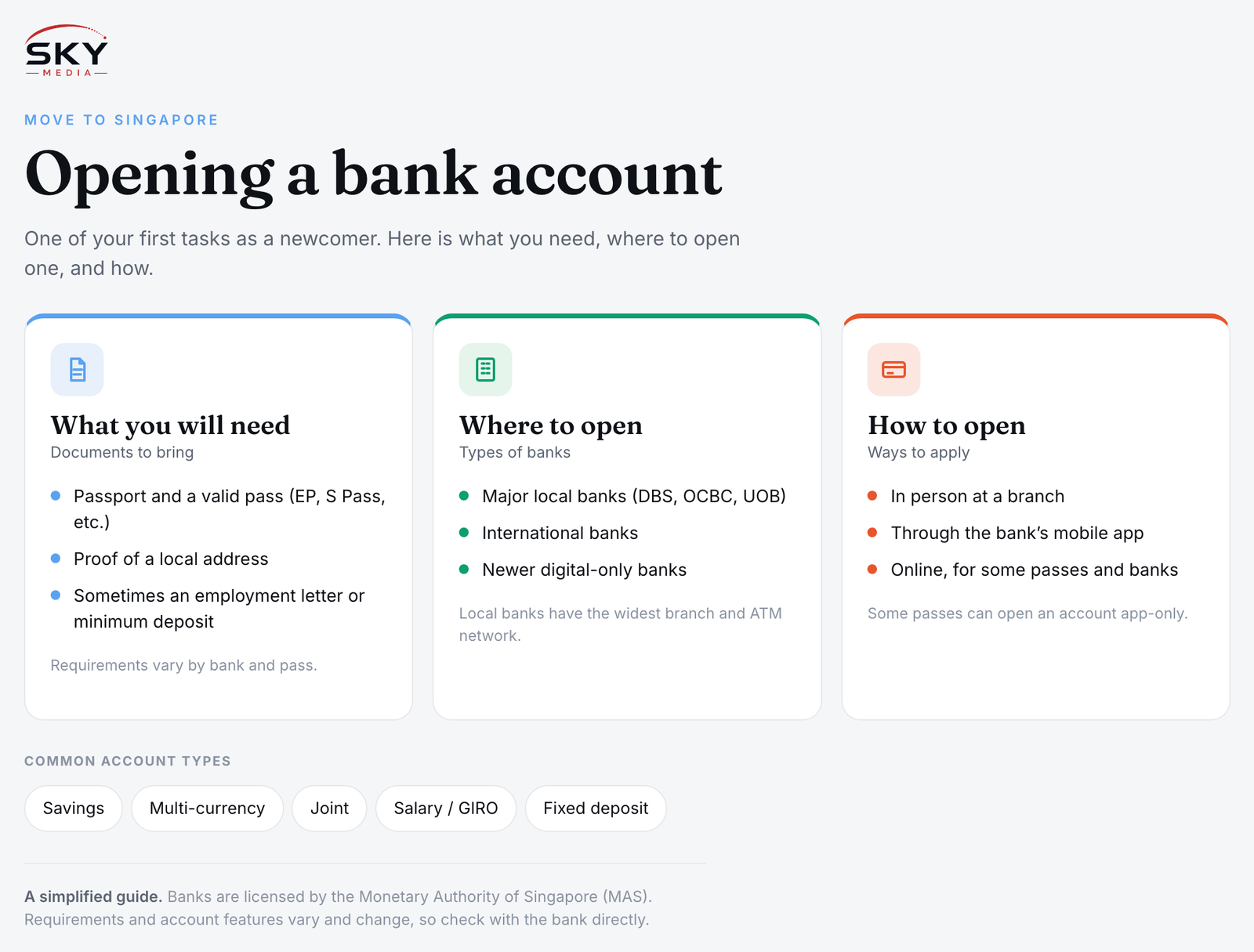
Who can open an account
Your situation determines how smooth the process is.
- Citizens and Permanent Residents have the easiest time and the widest choice of accounts.
- Employment Pass, S Pass and other long-term pass holders can open accounts with most banks once their pass is issued, using the pass as proof of legal stay.
- Newcomers who have not yet collected a pass card can sometimes open an account using the In-Principle Approval (IPA) letter plus a passport, though this varies by bank. It is worth asking before you arrive.
- Before you even move, some banks let you pre-open certain accounts online or through their international or priority banking arms, which can be handy for parking relocation funds.
Documents you will typically need
Requirements differ slightly between banks, but you should be ready with:
- Your passport.
- Your pass card (Employment Pass, S Pass, Dependant’s Pass, Student’s Pass) or, in some cases, the IPA letter.
- Proof of local residential address, such as a tenancy agreement or a utility bill. This is the step that trips up the newly arrived, since you may not have an address on day one.
- Sometimes an employment letter or proof of income, especially for certain account tiers.
If you are still in a hotel or serviced apartment, ask the bank what they accept as proof of address. Some will use the accommodation booking, and some digital banks are more flexible.
The main types of account
| Account type | Best for | Good to know |
|---|---|---|
| Basic savings account | Everyday spending, receiving salary | The default first account, comes with a debit card and app |
| Multi-currency account | People paid or spending in several currencies | Hold and convert currencies, useful for regular overseas transfers |
| Joint account | Couples and families sharing expenses | Both parties usually need to be present or verified |
| Salary or bundled account | Those who want fee waivers | Often waives fall-below fees if salary is credited |
| Foreign currency account | Saving in a home currency | Handy if you are still tied to income abroad |
Most newcomers start with a straightforward savings account and add others later.
Traditional banks versus digital banks
Singapore has long-established local banks with dense branch and ATM networks, alongside newer digital banks that operate entirely through an app. Each has its place.
- Traditional banks offer branches for in-person help, wide ATM access, and the full range of products from mortgages to investments. If you expect to need a home loan or want face-to-face service, they are a natural home base.
- Digital banks often shine on quick onboarding, clean apps and low or no minimum balances, which can suit a newcomer who wants to get set up fast without worrying about fall-below fees.
Many residents keep one of each: a main account with a large bank and a digital account for day-to-day convenience.
Minimum balances and fees
Many accounts carry a minimum average balance, and dropping below it can trigger a fall-below fee. The exact figures vary by bank and account, so treat any number you read online as indicative and confirm the current terms. Salary crediting or bundled accounts frequently waive this fee, which is why so many people route their pay into one of those. Watch also for card fees, early account closure fees, and charges on international transfers.
PayNow and everyday transfers
PayNow is the feature you will use constantly. It lets you send money instantly to another person using just their mobile number or, for businesses, a registered identifier, without needing account numbers. Once your account is open, link it to PayNow through your bank’s app. Splitting a hawker bill, paying a landlord, or settling up with a friend all happen in seconds. For anything more formal, local bank transfers through FAST are also near-instant.
Tips for newcomers without a local address
The address requirement is the most common sticking point. A few ways around it:
- Ask whether your bank accepts a tenancy agreement, an offer letter listing a company address, or your temporary accommodation booking.
- Consider a digital bank with a lighter onboarding process while you settle your permanent address.
- If your employer has a relationship with a particular bank, they may be able to smooth introductions for new staff.
- Update your address with the bank as soon as you sign a lease, since your cards and statements will be sent there.
After your account is open
Once you are set up, take a few minutes to:
- Activate your debit card and set up the mobile app with secure login.
- Link PayNow to your mobile number.
- Set up any recurring payments such as rent, utilities and broadband via GIRO, the local direct debit system.
- Enable transaction alerts so you can spot anything unusual early.
With that done, you have the financial backbone of daily life in Singapore in place. Salary in, bills out, and instant transfers whenever you need them.
Common reasons applications get delayed, and how to avoid them
Most applications go through without a hitch, but a handful of recurring issues can hold yours up. Knowing them in advance can save you a second trip to the branch.
- Name mismatches. If the spelling or order of your name differs across your passport, pass and application form, the bank may pause to verify it. Enter your name exactly as it appears in your passport.
- Documents that are expired or not yet active. A pass that has only just been approved may not show as valid in official records for a day or two. Give it a little time before you apply.
- Tax residency declarations. Under international reporting rules such as FATCA and CRS, banks ask for your tax residency and identification details. Have your foreign tax number ready to avoid back-and-forth.
- Questions about source of funds. For a larger opening deposit, the bank may ask where the money comes from. A payslip, employment letter or transfer record usually settles this quickly.
- Unclear address proof. Bring an original or a clean digital copy rather than a photo of a photo, since blurry documents are often bounced back.
If the bank queries something, respond promptly. Most holds clear the moment the missing piece is in hand.
Explore more: Moving to Singapore checklist · Cost of living in Singapore · Singapore work passes at a glance