

A missed premium rarely feels urgent. But an insurance policy lapse in Singapore can quietly remove protection you spent years paying for, and getting it back is not always as simple as paying what you owe.
This guide walks through what actually happens after a missed premium: the grace period, the point at which cover stops, the options some policies have built in to keep themselves alive, and how reinstatement works if the policy has already lapsed. It is general information, not financial advice. Your policy contract is the document that decides what applies to you, so keep it close as you read.
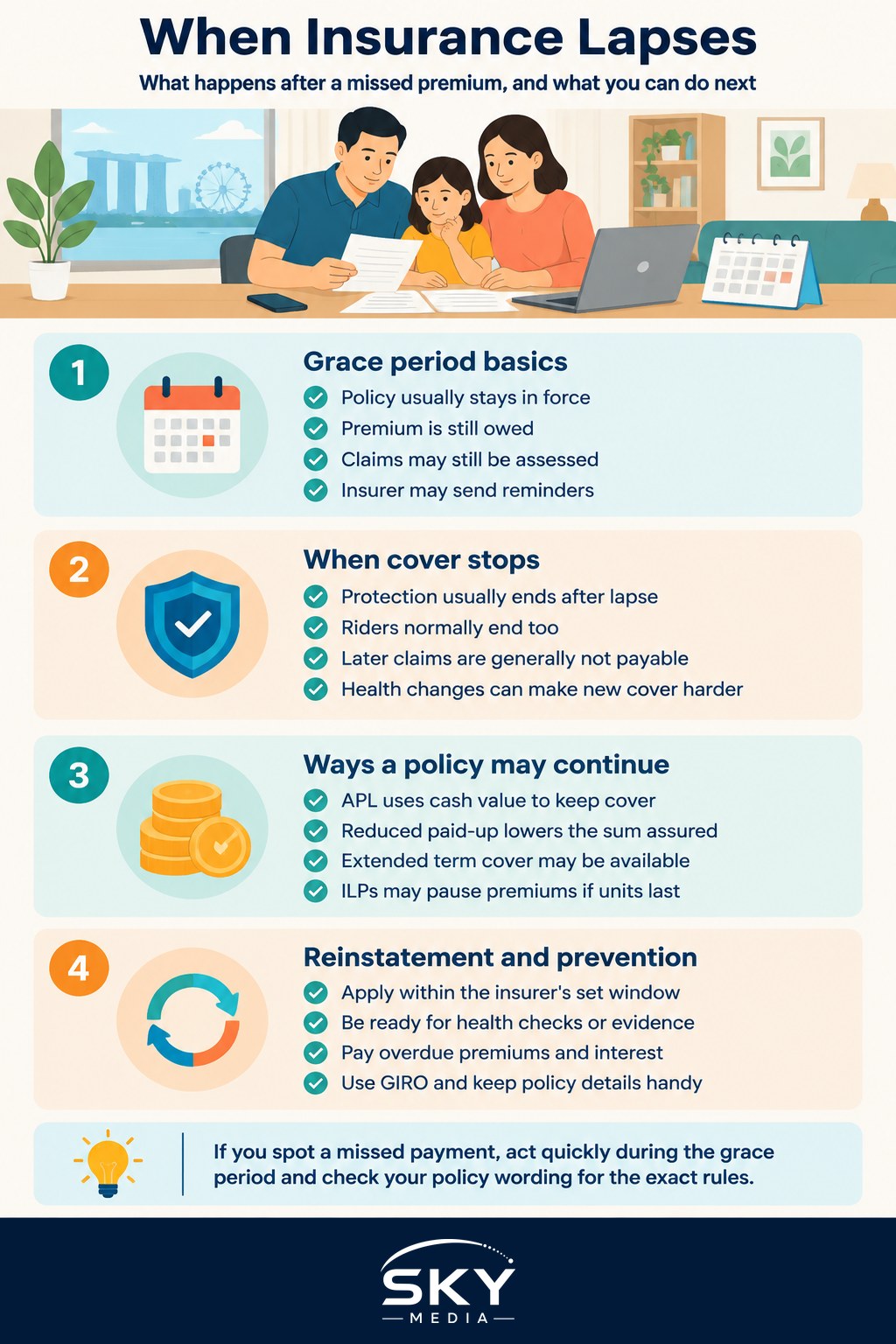
The Grace Period: Your First Safety Net
Most regular-premium policies come with a grace period, a short window after the premium due date during which the policy stays in force even though you have not paid yet. For many life policies in Singapore this window is commonly around 30 days, but the exact length is set in your policy wording and can differ for health, general and other types of cover. Check the “premium payment” or “grace period” clause in your contract rather than assuming.
What the grace period usually means in practice:
- Cover continues. If a claim event happens within the grace period, the insurer will typically still assess it, though it may deduct the unpaid premium from any payout.
- The insurer will chase you. Expect letters, emails or SMS reminders. Keep your contact details with the insurer current.
- It is not a free extension. The premium is still owed. The grace period simply gives you time to pay without losing cover.
If you know a payment failed, the simplest fix is to pay within the grace period through the insurer’s portal, app or customer service centre and confirm in writing that the policy remains in force.
What Changes Once a Policy Lapses
If the grace period ends with the premium still unpaid, and nothing else in the policy steps in, the policy lapses. From that point:
- Protection stops. Death, critical illness, disability, hospitalisation or accident claims for events after the lapse date are generally not payable.
- Riders usually fall away too. Add-on riders depend on the base policy, so a lapse normally ends them as well.
- Your health may have changed. This is the hidden cost. If you have developed a medical condition since you first bought the policy, a new policy may cost more, exclude that condition, or be declined altogether.
- You may lose accumulated value. For policies with a cash value, a lapse can mean surrendering on unfavourable terms, especially in the early years when surrender values are often low compared with premiums paid.
Pure term and hospitalisation plans typically have no cash value, so a lapse simply ends the cover. Whole life, endowment and investment-linked policies behave differently, as the next section explains.
Built-In Options That Can Keep a Policy Alive
Policies that build up cash value often include non-forfeiture options, provisions that use that value to keep some protection going when premiums stop. Whether your policy has them, and how they work, is spelled out in the contract.
Common examples include:
- Automatic premium loan (APL). The insurer lends you the premium from the policy’s cash value so cover continues. The loan accrues interest at a rate set by the insurer, and it reduces what your family would receive in a claim or what you would get on surrender. If the loan plus interest grows larger than the cash value, the policy can still end.
- Reduced paid-up policy. You stop paying premiums and the policy continues for a smaller sum assured, with no further premiums required.
- Extended term cover. Some policies convert the cash value into term protection for the original sum assured, lasting only as long as the value can fund it.
- Premium holiday for investment-linked policies. Some ILPs let you pause premiums, with charges deducted from the units. Cover continues only while there are enough units to pay those charges. Our guide to investment linked policies in Singapore explains how unit deductions work.
These options can be helpful in a short cash crunch, but they quietly erode value. If an APL has been running for months, ask the insurer for a statement showing the outstanding loan and how long the policy can last at that rate.
Comparing Your Options After a Missed Premium
| Situation or option | What happens to cover | What it costs you | Best suited to |
|---|---|---|---|
| Pay within the grace period | Cover continues as normal | Only the premium owed | A one-off missed payment |
| Automatic premium loan | Cover continues while cash value allows | Loan interest and a smaller payout | A brief cash shortfall |
| Reduced paid-up | Cover continues at a lower sum assured | No more premiums, but less protection | Long-term inability to pay |
| Reinstatement after lapse | Cover restored if insurer approves | Back premiums, possible interest, health checks | Recently lapsed policies worth keeping |
| Surrender | Cover ends permanently | Any loss between premiums paid and surrender value | Policies you no longer need |
How Reinstatement Works
Reinstatement is the process of reviving a lapsed policy on its original terms. Many insurers allow it within a set period after the lapse, and the length of that window is stated in the policy. Generally, the insurer may ask you to:
- Submit a reinstatement application, often with a health declaration confirming any changes since the policy started.
- Provide medical evidence if the lapse was long or the declaration raises questions. This can include a medical examination.
- Pay all overdue premiums, sometimes with interest at a rate the insurer sets.
- Repay any outstanding policy loans, or agree to carry them forward on the insurer’s terms.
The insurer is not obliged to approve every request. It can accept, accept with new exclusions or loadings, or decline. Reinstating an old policy is often worth the effort because it preserves your original entry age and underwriting, which may be far better than what you would get applying fresh today. Speak with the insurer or your adviser as soon as you notice the lapse, since the longer you wait, the more likely medical underwriting becomes.
Special Cases Worth Knowing
Hospitalisation cover. MediShield Life premiums can be paid from MediSave, so coverage under the national scheme is generally maintained as long as those premiums are covered. Integrated Shield Plan upgrades and private riders are separate commercial products and can lapse if their cash or MediSave payments fail. Check with the insurer and the CPF Board if a MediSave deduction did not go through.
Policies tied to loans. If a policy was bought to cover a home loan, letting it lapse can leave your family exposed if something happens to you. Our article on what happens if you default on your mortgage covers the wider picture when finances get tight.
Preventing a Lapse Before It Happens
A few habits go a long way:
- Pay by GIRO or a recurring card charge, and update the details when cards are replaced.
- Keep one list of every policy, its premium due date, insurer and adviser contact, and share it with a trusted family member.
- Read the insurer’s letters. Lapse warnings are usually sent well before the deadline.
- Ask before you stop paying. If premiums are becoming unaffordable, the insurer may be able to reduce the sum assured, change the payment frequency or switch to a paid-up policy, all of which are usually better than letting the policy lapse by default.
If you believe a lapse or reinstatement decision was handled unfairly, raise it with the insurer first. If it remains unresolved, the Financial Industry Disputes Resolution Centre (FIDReC) handles disputes between consumers and financial institutions, and MoneySense, the national financial literacy programme, has neutral guides on insurance basics. Requirements and processes can change, so confirm current details with your insurer and these bodies.
Official sources: MoneySense
Further reading: What Happens to Your Policies When Your Insurance Agent Quits · Borrowing Against Your Life Insurance: Policy Loans Explained · What to Declare When Buying Insurance: Non-Disclosure Explained