

If you hold a whole life or endowment plan, you may be able to borrow money from your insurer using the policy’s cash value as security. In Singapore this is called a policy loan, and it can look like an easy source of cash: no credit check, fast approval, and no fixed repayment schedule. This insurance policy loan Singapore guide explains how it actually works, what the interest does over time, and why an unpaid loan can quietly end your cover.
This is general information, not financial advice. Every insurer sets its own loan terms, and your policy contract is what governs your situation. Check with your insurer or financial adviser before borrowing.
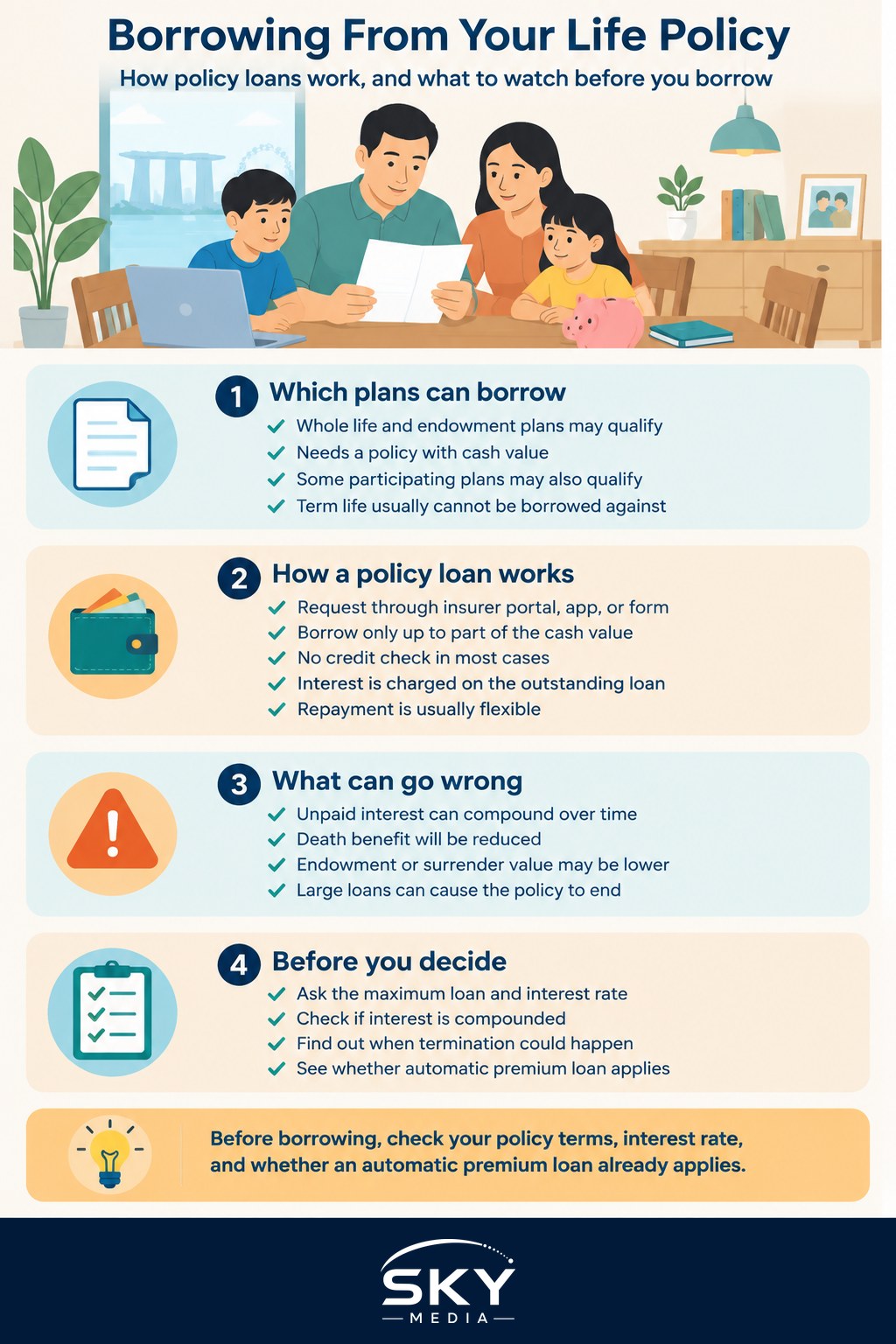
Which Policies Allow You to Borrow
Policy loans are only possible on plans that build up a cash value, the savings portion that grows as you pay premiums over the years. These are typically:
- Whole life policies, which cover you for life and accumulate cash value.
- Endowment policies, savings plans with a maturity date and a guaranteed or projected payout.
- Some other participating (with-profits) plans that build cash value.
Plans that usually do not allow policy loans include:
- Term life insurance, which has no cash value. If you are unsure what you hold, check your policy documents or ask your insurer.
- Most investment-linked policies (ILPs), where value sits in fund units rather than a cash value pool. Some insurers handle ILPs differently, so check your contract.
A new policy may have little or no cash value in its first few years, because early premiums go largely towards costs and commissions. In that case there may be nothing to borrow against yet.
How a Policy Loan Works
The mechanics are similar across insurers, though the details differ:
- You request a loan. This is usually done through the insurer’s customer portal, app or a form. Your financial adviser can also help.
- The insurer checks the loan value. You can usually borrow up to a percentage of the policy’s cash value, not the full amount. The percentage and any minimum loan size are set by the insurer.
- Money is paid out. Funds are typically credited to your bank account. There is normally no credit check, because the policy itself is the security.
- Interest starts to accrue. The insurer charges interest on the outstanding amount. The rate is set by the insurer and can usually be revised from time to time, so it is not fixed for the life of the loan.
- You repay when you choose. There is often no fixed repayment schedule. You can repay in full or in part at any time, subject to the insurer’s rules.
If you do not repay, unpaid interest is commonly added to the loan balance, so the debt grows by compounding: you end up paying interest on the interest.
Automatic Premium Loans
Many cash-value policies include an automatic premium loan (APL) feature. If you miss a premium and the grace period ends, the insurer may automatically use your cash value to pay the premium as a loan, so the policy stays in force.
This sounds helpful, and it can be in a short cash crunch. But it is still a loan with interest, and many policyholders do not notice it running in the background. Check your annual policy statement for any outstanding loan balance, and ask your insurer whether APL applies to your plan and whether you can switch it off.
The Real Risk: Lapse and Reduced Payouts
The biggest danger of a policy loan is that it eats into your protection in ways that are easy to overlook.
- Lower death benefit. If you pass away with a loan outstanding, the insurer deducts the loan and unpaid interest from the payout. Your family receives less than they expect.
- Lower maturity or surrender value. For endowments, the loan is deducted at maturity. If you surrender, the loan comes off the surrender value. Our guide on what happens if you surrender a whole life policy covers that path.
- Policy termination. If the loan plus accrued interest grows to exceed the policy’s cash value, the insurer can terminate the policy. Insurers usually send notices before this happens, but if you ignore them, you can lose your cover entirely, often at an age when buying new insurance is costly or difficult. See what happens when your insurance policy lapses for how lapse and reinstatement generally work.
- Bonuses may be affected. For participating policies, an outstanding loan does not usually stop bonuses, but the net benefit you receive is reduced by the debt. Check your policy terms.
The core point: a policy loan that is never repaid is not free money. It is slowly converting your insurance into debt.
Policy Loan vs Other Ways to Raise Cash
A policy loan is one option among several. The right choice depends on how much you need, for how long, and how much you value keeping your cover intact.
| Option | How it works | Main advantage | Main drawback |
|---|---|---|---|
| Policy loan | Borrow against your policy’s cash value | No credit check, flexible repayment, cover continues | Interest compounds; unpaid loan reduces payout or ends the policy |
| Surrendering the policy | Cancel the plan and take the surrender value | Immediate lump sum, no debt | Cover ends permanently; early surrender often returns less than premiums paid |
| Personal loan from a bank | Unsecured loan with fixed instalments | Fixed schedule, clear end date | Credit check, typically higher interest, missed payments affect your credit record |
| Using emergency savings | Draw down your own cash buffer | No interest, no paperwork | Leaves you exposed to the next emergency until rebuilt |
For a short-term gap you are confident of repaying within months, a policy loan can be reasonable. For long-term or open-ended borrowing, the compounding interest and lapse risk make it a weak choice.
Questions to Ask Before You Borrow
Before you take a policy loan, get clear answers from your insurer on:
- What is the maximum loan amount right now, and what percentage of cash value does that represent?
- What is the current interest rate, how often can it change, and how is interest charged (for example, compounded yearly)?
- What happens to unpaid interest each year?
- At what point would the loan balance trigger termination, and what notices will I receive?
- Can I repay partially, and is there any minimum repayment?
- Does an automatic premium loan already exist on my policy?
It also helps to look at your latest policy statement and, for a new purchase, the benefit illustration. Our guide on how to read a life insurance benefit illustration explains the guaranteed and non-guaranteed figures.
Using a Policy Loan Responsibly
If you decide to borrow, a few habits keep the risk under control:
- Borrow only what you need, not the maximum available.
- Set your own repayment plan, even though the insurer does not require one. Regular repayments stop the balance compounding.
- Pay the interest at least yearly if you cannot clear the principal.
- Track the balance on every annual statement.
- Tell your family. If they are your beneficiaries, they should know the payout may be reduced.
For broader context on why you hold life cover in the first place, revisit the protection needs you originally bought the policy for. If you are unsure whether a loan makes sense, speak to a licensed financial adviser, and remember that disputes with insurers can be raised with the Financial Industry Disputes Resolution Centre (FIDReC) if you cannot resolve them directly.
Frequently Asked Questions
How much can I borrow against my whole life policy? Usually only a percentage of the policy’s cash value, not the full amount. The percentage and any minimum loan size are set by each insurer, and a new policy may have little cash value in its early years. Ask your insurer for the maximum loan available right now.
Is there a credit check for an insurance policy loan? Normally there is not, because the policy itself is the security. That is why approval can be quick, but the interest still compounds if left unpaid, and the loan reduces what your family receives, so convenience should not decide whether to borrow.
Can I get a policy loan on term insurance or an investment-linked plan? Term insurance has no cash value, so a policy loan is not possible. Most investment-linked policies also do not offer one, as value sits in fund units, though some insurers differ. Check your policy documents or ask your insurer what yours allows.
What is an automatic premium loan and should I switch it off? It lets the insurer use your cash value as a loan to pay a missed premium after the grace period, keeping the policy in force. It carries interest and can run unnoticed, so ask your insurer whether it applies to you and whether you can turn it off.
What happens to my family’s payout if I die with a loan outstanding? The insurer deducts the loan and unpaid interest from the payout, so your beneficiaries receive less than the headline amount. Tell your family about any loan, and keep a repayment plan so the balance does not keep growing.
Official sources: MoneySense
Further reading: Borrowing From a Licensed Moneylender in Singapore Safely · Investment Linked Policy in Singapore: ILPs Explained