
Singapore has Japanese food at almost every level, from food court ramen stalls to quiet counters serving omakase. The variety is wonderful, but a Japanese restaurant menu can be confusing if you are new to it. Dishes are often listed in romanised Japanese, set meals bundle several items under one name, and the same fish can appear at very different prices depending on the cut.
This guide is not a tour of Japanese cuisine. It is a decoder: the words you will see most often, how set meals and rice bowls are structured, what the different sashimi cuts mean, and which add-ons are worth knowing about.
The Menu Words You Will See Most Often
Many menus in Singapore show English descriptions next to Japanese names, but not always. These terms come up constantly:
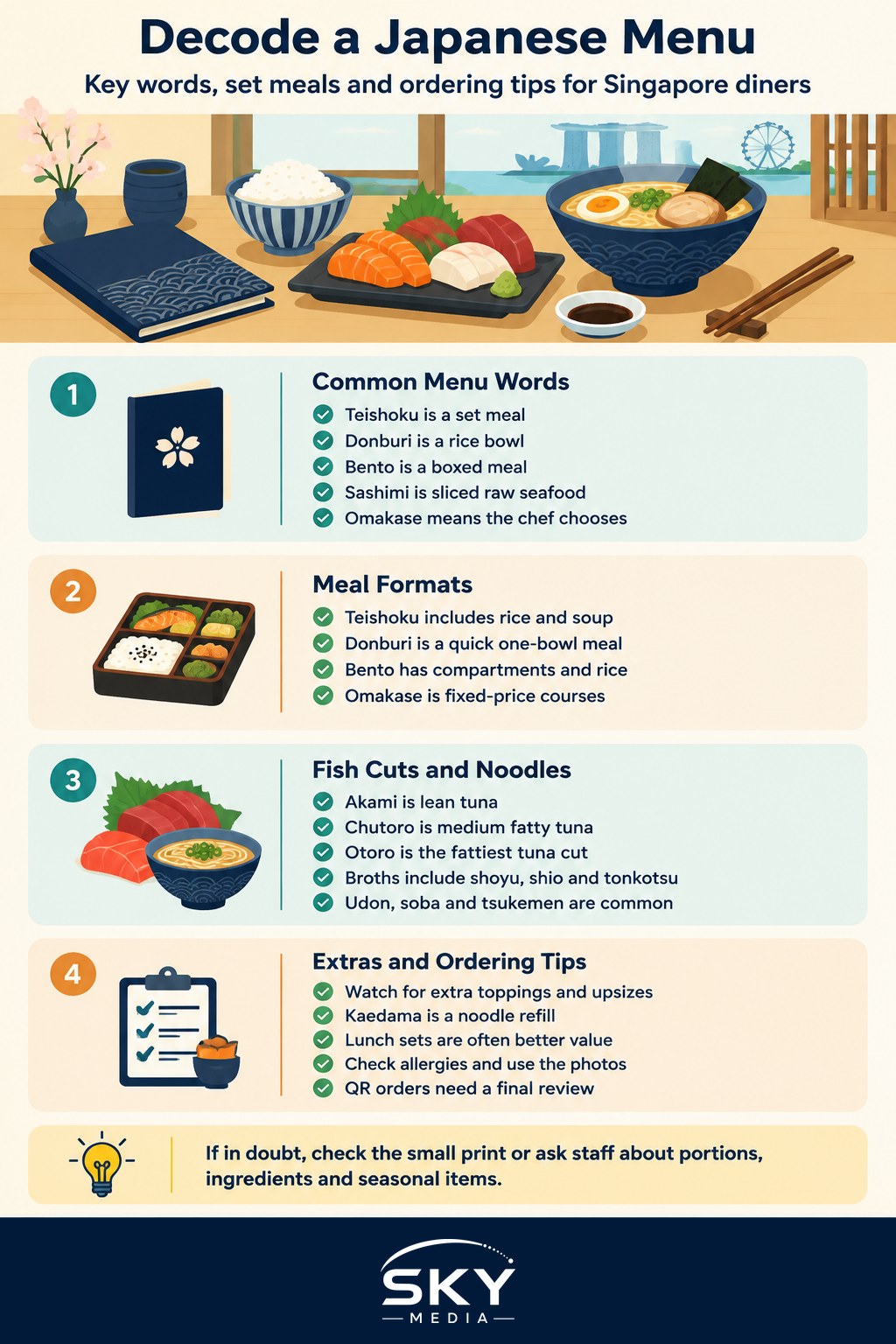
- Teishoku: a set meal. Usually a main dish with rice, miso soup, pickles and a small side or two.
- Donburi (or “don”): a bowl of rice with toppings. “Katsudon”, for example, is a breaded pork cutlet on rice with egg.
- Bento: a boxed meal with several compartments, common at lunch.
- Sashimi: sliced raw fish or seafood served without rice.
- Sushi: vinegared rice with toppings. “Nigiri” is a hand-pressed piece; “maki” is a roll.
- Agemono: deep-fried dishes, such as tempura or karaage (fried chicken).
- Yakimono: grilled dishes. Our yakitori guide explains skewer menus in detail.
- Nimono: simmered dishes in a light broth.
- Chawanmushi: a savoury steamed egg custard, often served as a side.
- Omakase: “I leave it to you”. The chef chooses a sequence of dishes for a set price.
A few cooking descriptors also help: “shio” means salt, “tare” is a sweet soy-based sauce, “aburi” means lightly seared with a torch, and “tataki” is seared on the outside and rare inside.
Set Meals, Donburi and Bento Compared
Lunch menus in particular are built around a few formats. Knowing the difference helps you judge value and portion size.
| Format | What usually comes with it | Good for |
|---|---|---|
| Teishoku (set meal) | Main dish, rice, miso soup, pickles, sometimes a small side or chawanmushi | A balanced, filling sit-down meal |
| Donburi (rice bowl) | Rice topped with the main item, often with miso soup on the side | A quick, hearty one-bowl meal |
| Bento | Several small dishes in compartments with rice | Sampling a variety, takeaway |
| Omakase | A chef-chosen sequence of courses at a fixed price | Special occasions, trying the chef’s best |
| A la carte | Individual dishes ordered separately | Sharing plates with a group |
What each set includes varies by restaurant, so read the small print under the dish name. Some places offer rice refills, others charge for them.
Understanding Sashimi and Sushi Cuts
The biggest price jumps on a Japanese restaurant menu usually sit in the sashimi and sushi section. For tuna (maguro), the cut matters:
- Akami: the lean, deep red meat. Clean flavour and usually the most affordable tuna cut.
- Chutoro: medium fatty tuna, from between the lean and the belly. Richer and softer.
- Otoro: the fattiest belly cut. Very rich, often the priciest item on the list.
Salmon (sake or “salmon” on most local menus) has a similar split, with belly cuts (harasu) richer than the leaner back. Other common names include hamachi or buri (yellowtail), hotate (scallop), ebi (prawn), amaebi (sweet prawn), ika (squid), tako (octopus), unagi (freshwater eel, usually grilled with sauce) and uni (sea urchin).
You may also see menus describe fish as “sashimi grade” or mention seasonal or air-flown fish. These are descriptions used by the restaurant or supplier rather than a single official grading standard, so if quality matters to you, it is fair to ask staff where the fish comes from and what is in season.
Ramen, Noodles and Hot Dishes
Noodle menus have their own vocabulary:
- Ramen broth types: shoyu (soy), shio (salt), miso, and tonkotsu (rich pork bone).
- Udon: thick wheat noodles. Soba: thinner buckwheat noodles, served hot or cold.
- Tsukemen: noodles served separately from a concentrated dipping broth.
- Toppings: chashu (braised pork), ajitama or ajitsuke tamago (marinated soft-boiled egg), negi (spring onion), menma (bamboo shoots) and nori (seaweed).
Many ramen shops let you choose noodle firmness and broth richness. If you are unsure, the default is a safe start.
Add-Ons, Extras and Drinks
Small extras can change the final bill, so look out for:
- Upsizes: larger rice or noodle portions, sometimes free, sometimes not.
- Extra toppings: additional egg, chashu or seaweed are often charged per item.
- Kaedama: a noodle refill at some ramen shops, so you can add more noodles to remaining broth.
- Sides: edamame, gyoza (pan-fried dumplings), agedashi tofu and salads.
- Drinks: green tea is sometimes complimentary or refillable. For the wider range of teas, our guide to matcha and Japanese drinks explains what you will find.
Also remember that many sit-down restaurants in Singapore add a service charge and GST to the listed prices, and the menu usually says so in small print. Ask if it is unclear.
Ordering Tips for Newcomers
- Ask about allergies and diet. Dashi (soup stock) often contains fish, and many sauces contain soy and wheat. Staff can usually advise, and some menus mark pork-free or vegetarian items.
- Use the pictures. Many local Japanese menus include photos, which help when names are unfamiliar.
- Check QR menus carefully. Ordering by phone is common, and items can be easy to tap twice. Review your cart before submitting.
- Go for a set at lunch. Teishoku and donburi are often better value at midday than similar dishes at dinner.
- Try omakase when you are ready. If you are curious, start with a lunch omakase, which is usually shorter. See our list of best-value tasting menus for how tasting formats work.
- Look for the specials board. Many restaurants list seasonal fish or limited dishes on a separate card, a whiteboard or a page at the back of the menu. These are often written only in Japanese, so ask staff to explain what is on it today.
- Halal and vegetarian needs. Some Japanese restaurants in Singapore are halal certified by MUIS (the Islamic Religious Council of Singapore), but many use mirin, sake or pork in their cooking. If this matters to you, look for the certificate or ask before ordering.
- Wasabi and ginger. At sushi counters, the chef may already have added wasabi. Pickled ginger (gari) is for clearing your palate between pieces.
Once you recognise a dozen or so core words, a Japanese restaurant menu becomes much less intimidating. You will spot the set that suits your appetite, know why the otoro costs more than the akami, and order the extras you actually want.
Frequently Asked Questions
What is the difference between sashimi and sushi on a Japanese menu? Sashimi is sliced raw fish or seafood served without rice, while sushi is vinegared rice with toppings. Nigiri is a hand-pressed piece and maki is a roll. Prices differ mainly by the cut of fish.
Why does otoro cost so much more than akami? Otoro is the fattiest belly cut of tuna, rich and soft, so it is often the priciest item, while akami is the lean red meat and usually the most affordable. Chutoro sits in between.
Do Japanese restaurants in Singapore charge service charge and GST on top of menu prices? Many sit-down restaurants add both to the listed prices, and the menu usually says so in small print. Ask staff if it is unclear before ordering.
Is Japanese food halal or vegetarian-friendly? Some restaurants are halal certified by MUIS, but many use mirin, sake or pork in cooking, and dashi often contains fish. Look for the certificate or ask before ordering, and check with staff about vegetarian options.
Is it worth trying lunch omakase before dinner omakase? It is a good way to start, since a lunch omakase is usually shorter, and you can see whether you enjoy the format. Check the restaurant’s menu for exact courses and prices, which vary by restaurant.
Further reading: Shopping at Don Don Donki and Japanese Supermarkets in Singapore