

In a small business, one or two people often hold everything together: the founder who brings in the clients, the technical lead who knows the systems, or the director whose name sits on the bank facilities. If that person died or became seriously disabled, the business could lose revenue, stall projects or face pressure from lenders. Key man insurance in Singapore, also called key person insurance, is designed to give the company a cash cushion in that situation.
This guide explains how it works, who to insure, how the tax treatment generally works and how to think about the amount of cover. It is general information only, not financial or tax advice. Policy features vary by insurer, and tax treatment depends on the facts of each case, so speak to a licensed financial adviser, your accountant and IRAS (the Inland Revenue Authority of Singapore) before you commit.
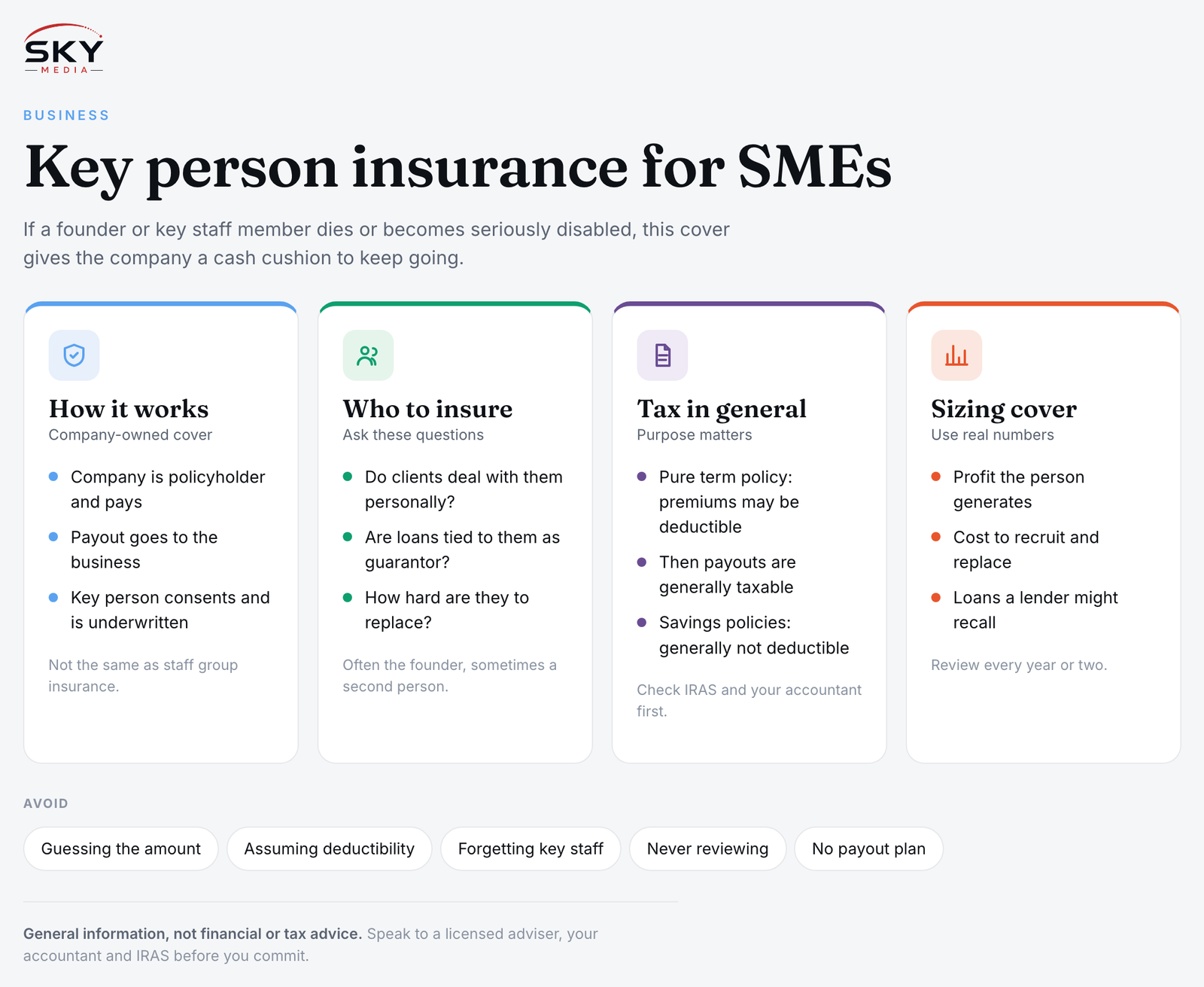
What Key Person Insurance Actually Is
Key person insurance is a life (and often disability or critical illness) policy that a company buys on the life of an important individual. The key features are:
- The company is the policyholder. It owns the policy and pays the premiums.
- The company is the beneficiary. Any payout goes to the business, not to the insured person’s family.
- The insured person is the key individual, such as a founder, director or senior employee, who must usually consent to being insured and go through underwriting.
The payout is meant to help the business survive the loss. Companies typically use it to cover lost profits while they recover, recruit and train a replacement, repay business loans that a lender might call in, reassure suppliers and customers, or fund an orderly wind-down if continuing is not realistic.
It is different from group insurance benefits for staff. Group term life, for example, pays out to the employee’s family as an employee benefit. If you are setting up staff cover, our guide to group insurance for SME employers: GHS, GTL and GPA explains those products.
Who Counts as a Key Person in Your Business
A key person is someone whose sudden absence would cause real financial damage. Ask these questions about each candidate:
- Would revenue drop significantly if they were gone, because clients deal with them personally?
- Do they hold critical knowledge, licences or technical skills that are hard to replace quickly?
- Are bank loans or credit lines tied to them as a director or guarantor?
- Would investors, partners or major customers lose confidence without them?
- How long and how costly would it be to find and train a replacement?
In many SMEs the honest answer points to the founder or managing director. In growing companies it may also include a head of sales, a chief engineer or the person who manages a key overseas relationship.
How Tax on Premiums and Payouts Generally Works
The tax treatment is where many business owners get confused, and it is worth getting right before you buy. Broadly, IRAS looks at the purpose and nature of the policy.
In general terms, premiums on a key person policy may be deductible as a business expense when the policy is taken out purely to protect the business against loss of profits from the death or disability of a key employee, and is a pure protection (term) policy without a savings or investment element. If the premiums are allowed as a deduction, a payout from the policy is generally treated as taxable income of the company.
Where a policy has a savings or investment element, such as a whole life or endowment policy with a cash value, the premiums are generally not deductible, and the tax treatment of any payout follows from that. There are also specific conditions IRAS applies, including around the relationship between the insured person and the company’s ownership.
Because the details matter and rules can be updated, check IRAS’s current guidance on key man insurance and confirm the position with your accountant for your specific policy and company structure. Plan for the possibility that a payout is taxable when you size your cover.
Comparing Common Policy Types
| Policy type | How it works | Points to consider |
|---|---|---|
| Term life | Pays out on death (often with disability cover) during a set term | Lower premiums, pure protection, no cash value |
| Term with critical illness rider | Adds a payout on diagnosis of covered illnesses | Check the definitions and exclusions carefully |
| Whole life | Covers for life with a cash value that builds over time | Higher premiums, ties up cash, different tax treatment |
| Universal life | Flexible premiums and cover with an investment component | Complex, returns not guaranteed, needs close review |
For most SMEs focused on protecting cash flow, plain term cover is the simplest starting point. A licensed adviser can explain whether any other structure fits your plans, for example linking cover to a shareholder buy-sell agreement.
How to Size the Amount of Cover
There is no single correct figure, but insurers and advisers commonly use one or more of these methods. Work through them with real numbers from your management accounts.
- Contribution to profit. Estimate how much gross profit the key person generates and how long it would take for the business to recover. Multiply accordingly.
- Replacement cost. Add up recruitment fees, a higher salary for an experienced hire, overlapping pay during handover and lost productivity while the new person settles in.
- Debt protection. List business loans, overdrafts and facilities that a lender might recall, or that the key person has personally guaranteed.
- Contractual exposure. Consider penalties or lost contracts if a major project cannot be completed on time.
Then reduce the figure for cash reserves the business already holds, and adjust for tax if payouts would be taxable. Insurers will also underwrite against the company’s financial position and the person’s health, so the cover you can get may be capped. Review the amount every year or two, especially after a fundraising round, a new loan or a big jump in revenue.
Practical Steps to Set Up a Policy
- Identify key people and document why. A short board or directors’ resolution recording the business reason for the policy is useful for tax and governance.
- Get the key person’s consent. They will need to complete forms and possibly a medical check.
- Compare quotes through a licensed adviser or directly from insurers. Compare premiums, exclusions, waiting periods, disability definitions and whether premiums are fixed.
- Confirm the tax position with your accountant before signing, based on the specific policy type.
- Record the policy in your accounts correctly and diarise renewal and review dates.
- Plan what happens if the person leaves. Policies can sometimes be cancelled or transferred. Check the terms before you need them.
Common Mistakes to Avoid
- Buying a savings-heavy policy and assuming premiums are deductible.
- Insuring the founder but forgetting the second person the business truly depends on.
- Picking a cover amount out of thin air rather than from the numbers.
- Leaving the policy untouched for years while the company grows.
- Not having a written plan for how the payout would actually be used.
Key person insurance will not replace a good succession plan, documented processes or cross-trained staff, but it buys time and options when the unexpected happens. Pair it with a clear contingency plan, and review both as your business grows. If you employ foreign staff, also make sure their mandatory cover is in order with our guide to medical insurance requirements for Work Permit and S Pass holders.
Further reading: bizSAFE Certification for Singapore SMEs: Levels, Steps and Costs