

A client emails months after a project ends: your advice, code or design has cost them money, and they want you to pay. This is the situation professional indemnity insurance in Singapore is built for.
This guide looks narrowly at professional indemnity (PI) cover: what it actually pays for, what shapes the premium you are quoted, and which kinds of clients will ask for a certificate before they sign. It is general information, not insurance or legal advice. Your policy wording and your insurer or broker are the final word on what is covered.
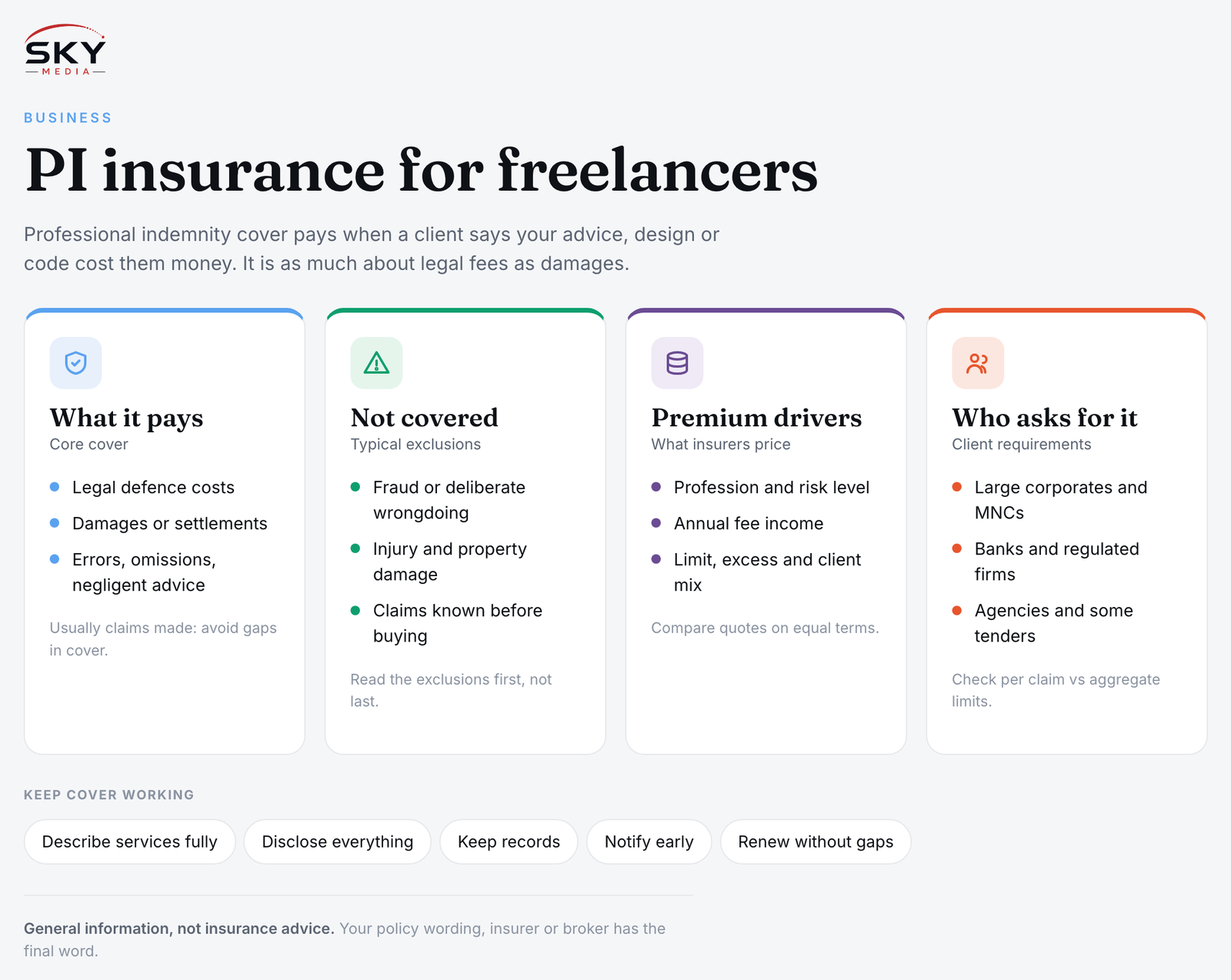
What Professional Indemnity Insurance Pays For
PI insurance (sometimes called errors and omissions cover) protects you when a client or third party alleges that your professional work caused them a financial loss. Even a claim with no merit can be expensive to defend, so PI is as much about paying lawyers as paying damages.
Most PI policies are built around a few core elements:
- Defence costs. Legal fees and related expenses to respond to a claim, often including costs incurred before anything reaches court.
- Damages or settlements. Sums you are legally liable to pay the claimant, up to your limit of indemnity.
- Common triggers. Negligent advice, errors or omissions in your work, missed deadlines that cause loss, and in many policies unintentional breach of confidentiality or copyright.
- Claims made basis. Most PI policies respond to claims made while the policy is active, not when the work was done. If you let cover lapse, a claim about old work may not be covered.
What PI usually does not cover matters just as much. Typical exclusions include deliberate wrongdoing or fraud, bodily injury and property damage (that is public liability territory), contractual promises that go beyond normal professional duty, fines and penalties, and claims you knew about before buying the policy. Read the exclusions section first, not last.
PI Compared With Other Business Covers
The table below shows where PI sits next to covers people often mix it up with.
| Cover | What it responds to | Example for a freelancer |
|---|---|---|
| Professional indemnity | Financial loss caused by your advice, design or service | A client loses revenue after a website you built fails at launch |
| Public liability | Injury to people or damage to property | A visitor trips over your equipment at a client’s office |
| Cyber insurance | Data breaches, hacking and related costs | Your laptop is compromised and client data leaks |
| Personal accident or health | Your own injury or illness | You are hospitalised and cannot work for a month |
You may need more than one; a broker can explain whether any can be bundled.
What Shapes Your PI Premium
Premiums vary widely, and any figure you see quoted online is only a rough snapshot for one profession at one point in time. Understand the factors insurers price on instead:
- Your profession and risk level. Advice that directly moves money, structures or health outcomes (finance, engineering, IT systems) usually costs more to insure than lower-stakes creative work.
- Annual fee income. Higher turnover generally means more exposure and a higher premium.
- Limit of indemnity. The maximum the insurer will pay. A higher limit raises the premium, though often not in direct proportion.
- Excess or deductible. Agreeing to pay a larger share of each claim yourself can lower the premium.
- Client mix and geography. Work for overseas clients, especially in jurisdictions known for high litigation costs, may be excluded or priced higher.
- Retroactive date. Cover for work done before the policy started (prior acts cover) can add cost but protects you if an old project goes wrong.
Compare at least two or three quotes on the same limit, excess and exclusions. A cheaper policy with a narrow definition of “professional services” may not cover the work you actually do.
Which Clients Ask for PI Cover
Many freelancers buy PI because a client contract demands it rather than out of their own risk assessment. Common sources of this requirement include:
- Large corporates and multinationals. Vendor onboarding often asks for proof of PI and public liability, sometimes with a minimum limit stated in the contract.
- Banks, insurers and regulated firms. These clients tend to pass their own compliance expectations down to suppliers and contractors.
- Government and public sector work. Some tenders and contracts list insurance requirements in their terms. Read the tender documents carefully, as requirements differ by agency and project.
- Agencies that subcontract. An agency hiring you for a client project may require you to carry your own cover.
- Regulated professions. In some fields, the regulator or professional body sets PI rules for its members. If you hold a professional licence, check your regulator’s current requirements rather than assuming.
When a contract names a required limit, ask whether it applies per claim or in the aggregate (the total for the policy year). Also check if the client wants to be named on the policy or simply wants a certificate of insurance.
For broader advice on structuring client relationships, see How to Work With Freelancers and Contractors, which covers contracts from the hiring side.
Do You Actually Need PI as a Freelancer?
Not every freelancer needs PI on day one. Ask yourself a few honest questions:
- If a client claimed my work cost them money, could I afford a lawyer to respond?
- Does my work feed directly into decisions, systems or money that belong to someone else?
- Are my contracts asking for it, or likely to as I take on bigger clients?
If you answered yes to two or more, PI is worth pricing. If your work is lower risk, a well-drafted contract with a clear scope and a sensible limitation of liability clause can do a lot of the work. Insurance does not replace a good contract; the two work together.
Budget for PI like any other business cost. Financial Planning for Freelancers explains how to build regular expenses like this into your pricing, and Tax for the Self-Employed and Freelancers covers how business expenses are treated. Check with IRAS on whether a particular premium is deductible for your situation.
How to Buy and Keep PI Cover Working for You
Once you decide to buy, a few habits make the policy more useful when it counts:
- Describe your services accurately. If the proposal form says “graphic design” but you also do brand strategy consulting, a claim about the strategy work may be disputed.
- Disclose everything material. Past complaints, disputes and overseas clients should go on the form. Non-disclosure can void cover.
- Keep records. Emails, signed scopes, change requests and sign-offs are your best defence. Store them for several years after a project ends.
- Notify early. Most policies require you to tell the insurer as soon as you are aware of a possible claim, even before a formal demand. Do not admit liability or promise compensation without the insurer’s agreement.
- Renew without gaps. Because PI is usually claims made, a lapse can leave you exposed for past work. If you stop freelancing, ask about run-off cover.
Licensed insurance brokers can compare policies across insurers, which is useful for niche professions. You can check whether an insurer or broker is licensed on the Monetary Authority of Singapore (MAS) Financial Institutions Directory.
Key Takeaways
Professional indemnity insurance in Singapore covers the legal defence and damages when a client claims your work caused them financial loss. Premiums depend on profession, income, limit, excess and client mix, so compare quotes on equal terms. Large corporates, regulated firms, agencies and some public sector contracts often require it, so read every contract’s insurance clause. Pair your policy with clear contracts and good records, and confirm specifics with your insurer, broker or professional body.
Explore more: Finding Clients as a Freelancer in Singapore