

For many small and medium enterprises (SMEs) in Singapore, group insurance is one of the first employee benefits to consider after salary, CPF and leave. It helps attract and keep staff, protects them when something goes wrong and can be simpler to manage than you might expect. This guide explains group insurance for employees from the SME employer’s side: the three core covers, GHS, GTL and GPA, what drives the cost per head and how to choose a plan.
It is general information, not financial, legal or insurance advice. Policy terms, prices and rules vary between insurers and change over time, so read the policy wording carefully and speak to a licensed insurance adviser or broker before you buy. For statutory obligations, check with the Ministry of Manpower (MOM).
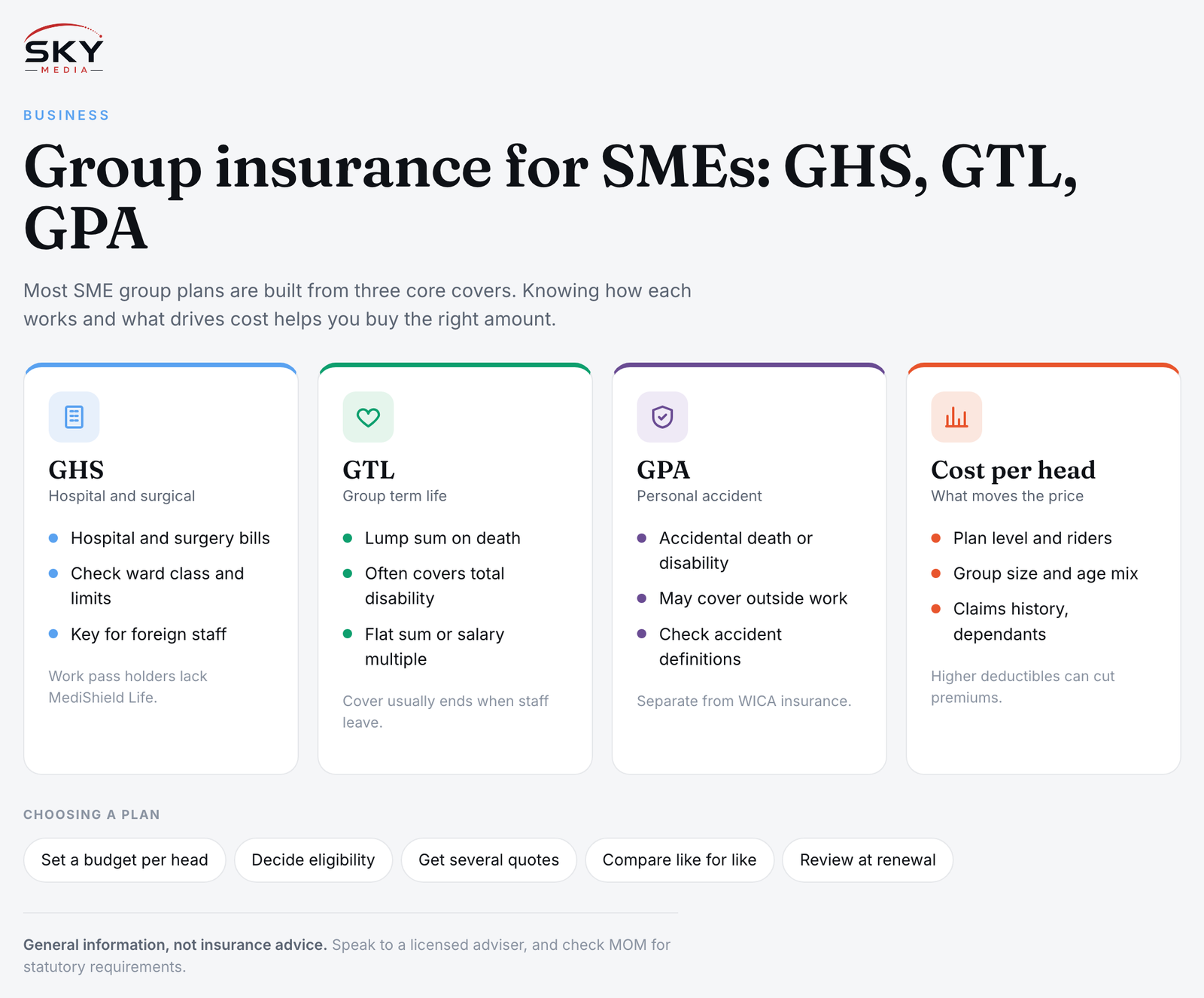
The Three Core Covers at a Glance
Most SME group insurance packages are built from three main building blocks. Insurers may bundle them or let you pick.
| Cover | What it pays for | Who usually benefits | Key things to check |
|---|---|---|---|
| Group Hospitalisation and Surgical (GHS) | Hospital stays, surgery and related bills, up to plan limits | The employee, sometimes dependants | Ward class, annual and per-item limits, pre-existing conditions |
| Group Term Life (GTL) | Lump sum if the employee dies, and often if they become totally and permanently disabled, while covered | The employee’s family or nominees | Sum assured basis, exclusions, conversion options when leaving |
| Group Personal Accident (GPA) | Payout for accidental death, disability or injury, and sometimes accident medical costs | The employee | What counts as an accident, coverage outside work hours, overseas cover |
Many plans also offer add-ons, called riders, such as outpatient GP and specialist cover, dental, maternity, or critical illness cover.
GHS: Group Hospitalisation and Surgical
GHS is usually the core of a group plan, because hospital bills are the costs employees worry about most.
How it works
GHS pays for eligible hospital and surgical costs up to the plan’s limits. Plans differ by the ward class they are designed around, such as a public hospital ward type or private hospital rooms, and by the limits set for room and board, surgery, intensive care and other items.
Interaction with MediShield Life and Integrated Shield Plans
Singapore citizens and permanent residents are covered by MediShield Life, the national basic health insurance, and many also hold private Integrated Shield Plans. Group GHS sits alongside these. How claims are coordinated between them depends on the insurers and policies involved, so check how your chosen plan handles this with your adviser. Foreign employees on work passes are generally not covered by MediShield Life, which makes GHS more significant for them.
Medical insurance obligations
MOM has requirements for employers of certain work pass holders, such as Work Permit and S Pass holders, including minimum medical insurance. These requirements are separate from voluntary benefits. Check MOM’s website for the current rules that apply to your workforce, and make sure any group policy you buy meets them where relevant.
GTL: Group Term Life
GTL pays a lump sum to the employee’s beneficiaries if the employee dies while covered. Many plans also cover total and permanent disability.
- Sum assured basis. Employers commonly set cover either as a flat amount per employee or as a multiple of annual salary. A flat amount is simpler; a salary multiple scales with seniority.
- Cover ends when employment ends. Employees often lose cover when they leave. Some policies allow them to convert to an individual policy without new health checks, within a set window. Explain this to staff; our article on group insurance gaps when leaving a job covers the employee side.
- Underwriting. For small groups, insurers may ask health questions or set limits above which individual evidence of health is needed.
GPA: Group Personal Accident
GPA covers accidental death, permanent disability and, depending on the plan, medical expenses from accidents.
- It is not the same as work injury compensation. Singapore employers have obligations under the Work Injury Compensation Act (WICA) for certain employees, administered by MOM. WICA insurance is a separate, specific requirement. GPA is a voluntary benefit and may cover accidents outside work too.
- Check the definitions. What counts as an accident, whether sports or overseas travel are covered and how disability is assessed all vary between policies.
What Drives the Cost Per Head
Insurers price group plans per employee, and premiums can vary widely. Rather than relying on a quoted “typical” figure, understand the factors that move the price:
- Plan level. Higher ward classes, bigger limits and more riders cost more.
- Group size. Very small groups may face tighter underwriting or limited plan choices.
- Workforce profile. Age mix, occupations and the share of staff in manual or higher-risk roles affect pricing.
- Claims history. On renewal, insurers often adjust premiums based on how much the group claimed.
- Dependants. Extending cover to spouses and children adds to cost, and employers may ask staff to co-pay.
- Deductibles and co-insurance. Higher out-of-pocket portions for employees can reduce premiums.
Group premiums paid by the employer for staff medical benefits may be deductible as a business expense, but tax treatment depends on the specifics. Check with the Inland Revenue Authority of Singapore (IRAS) or your accountant.
How SMEs Can Choose a Plan
A practical process helps you avoid buying too much or too little.
- Set a budget per head you can sustain year after year, not just in the first year.
- Decide eligibility. Common choices include all permanent staff after probation, with different tiers for management and staff. Keep tiers simple and fair.
- Identify must-haves. Most SMEs start with GHS, then add GTL and GPA. Outpatient cover is popular with staff because they use it often.
- Get several quotes. Approach a few insurers directly or go through a licensed broker who can compare options.
- Compare like for like. Line up ward class, limits, exclusions, waiting periods and pre-existing condition terms side by side.
- Check administration. Ask how claims are filed, whether there is a panel of clinics, how staff join or leave the plan, and what reports you will receive.
- Review at renewal. Look at claims experience and staff feedback, and adjust.
Communicating the Benefits to Staff
Insurance only adds value if employees understand it. Prepare a short benefits summary, explain how to claim, share the panel clinic list and tell staff what happens to their cover if they leave. Employees who know their benefits are more likely to value them. Our guide to claiming outpatient care from employer insurance is a useful link to share with staff.
For the wider picture of employer responsibilities, see hiring employees in Singapore and our guide to CPF for employers.
Frequently Asked Questions
Is group insurance mandatory for SME employers in Singapore? Group medical, life and accident cover are generally voluntary benefits, but MOM sets certain requirements for employers, such as minimum medical insurance for some work pass holders and work injury compensation insurance. Check the MOM website for what applies to your workforce.
How many employees do I need before an insurer will quote a group plan? Minimum headcounts differ by insurer and plan, and very small groups may face tighter underwriting or fewer choices. Ask a licensed broker or several insurers for quotes. If you are very small, they can tell you what is available.
Can part-time or contract staff be included in the group plan? It depends on the insurer’s eligibility rules and on how you define who qualifies. Many employers cover permanent staff after probation, but others extend cover differently. Ask the insurer what is allowed and set clear, fair criteria.
What happens to the plan when staff join or leave during the year? Insurers normally allow additions and removals during the policy period, with premiums adjusted according to their rules. Tell staff that cover usually ends when employment ends. Ask about conversion options and how quickly changes must be reported.
Can company directors or owners be covered under the same group plan? Often yes, although conditions vary by insurer and plan. Ask whether directors or owners can be included, on what terms and whether they need to provide health information. A licensed adviser can walk you through the options.
Further reading: Key Person Insurance for Singapore SMEs: How It Works · bizSAFE Certification for Singapore SMEs: Levels, Steps and Costs