

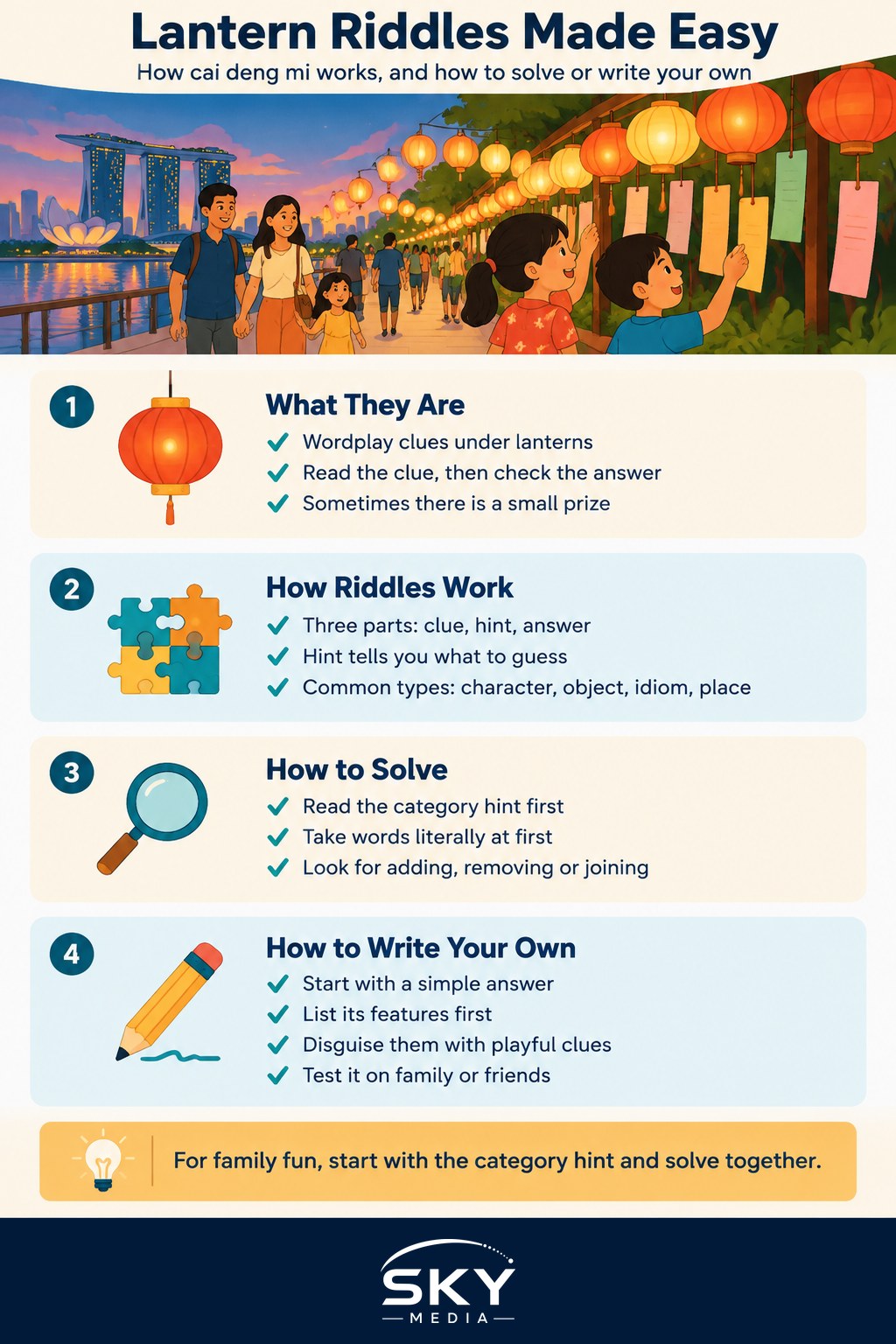
Walk past a festive lantern display in a Chinese community, and you may notice small slips of paper hanging beneath the lanterns. These are lantern riddles, known in Mandarin as cai deng mi (猜灯谜), literally “guessing lantern riddles”. Visitors read the clue, puzzle over it, and, in many traditional setups, take the slip to an organiser to check the answer and sometimes win a small prize.
Lantern riddles are a wordplay game rather than a quiz of facts. Once you understand how the clues are built, they become a fun family activity, whether you are fluent in Chinese or just starting out. This guide explains where the tradition comes from, how a riddle is structured, and how to solve and write your own.
Where the Tradition Comes From
Riddle games have a long history in Chinese literary culture, and over centuries they became linked with lanterns. The custom is most strongly associated with the Lantern Festival (元宵节) on the fifteenth day of the first lunar month, which in Singapore is often celebrated as Chap Goh Mei. Our guide to Chap Goh Mei and the Lantern Festival in Singapore covers that festival in more detail.
In Singapore and the wider region, riddle games also appear during the Mid-Autumn Festival, when lanterns are everywhere. Community centres, clan associations, schools and Chinese cultural groups often run riddle corners as part of their celebrations. Practices vary from event to event, so think of the rules below as common patterns rather than fixed regulations.
The appeal is simple: riddles reward patience, imagination and a playful feel for language. They are a gentle way for children to learn Chinese characters, and a social game that gets strangers chatting at a lantern display.
How a Lantern Riddle Is Built
Most traditional Chinese riddles have three parts.
- The riddle face (谜面, mí miàn). This is the clue itself, often a short phrase, a line of verse or a description.
- The category hint (谜目, mí mù). This tells you what kind of answer to look for. Common ones include 打一字 (guess one character), 打一物 (guess an object), 打一成语 (guess an idiom) or 打一地名 (guess a place name).
- The answer (谜底, mí dǐ). Literally “the bottom of the riddle”, this is the solution.
The category hint is your most important tool. A clue that seems impossible as an object riddle may be obvious once you realise it is asking for a single character.
The Main Types of Riddle Clues
Here is how the most common riddle types work, with an example of each.
| Riddle type | How the clue works | Example clue | Answer |
|---|---|---|---|
| Character riddle (打一字) | Break apart or combine character components | 千里相逢 (a thousand and a li meet) | 重 (千 on top of 里) |
| Character riddle (打一字) | Remove or add a stroke or part | 一口咬掉牛尾巴 (one mouth bites off the cow’s tail) | 告 |
| Object riddle (打一物) | Describe an object in a poetic or misleading way | 麻屋子,红帐子,里面住着白胖子 (a rough house, red curtains, a white chubby fellow inside) | 花生 (peanut) |
| Object riddle (打一物) | List features that seem contradictory | 有面没有口,有脚没有手 (has a face but no mouth, has legs but no hands) | 桌子 (table) |
| English-style riddle | A description with a twist, for non-Chinese speakers | I am round and bright, I come out at night, I change shape all month | The moon |
Character Riddles
Character riddles are the classic form. Chinese characters are built from smaller parts called components or radicals, so clues often describe how to assemble or take apart a character.
- 千里相逢 says that 千 (thousand) and 里 (a unit of distance) “meet”. Stack them and you get 重.
- 一口咬掉牛尾巴 asks you to take 牛 (cow), remove its “tail” (the bottom of the vertical stroke) and place 口 (mouth) under it. The result is 告.
- 半个月亮 (half a moon) is a playful one for Mid-Autumn: 半 (half) plus 月 (moon) makes 胖 (chubby). It is a favourite with children who have just eaten a lot of mooncake.
Object Riddles
Object riddles describe everyday things in an indirect, often rhyming way. The peanut riddle works because a peanut shell is rough (like hemp, 麻), the skin inside is red (like a curtain) and the nut itself is white and plump. These are the best type for younger children, because they rely on observation rather than knowledge of characters.
Idiom and Place-Name Riddles
More advanced riddles point to four-character idioms (成语) or place names. These usually depend on puns, double meanings and literary knowledge, so they tend to appear at adult-level riddle competitions.
How to Solve Lantern Riddles
A few habits make riddles far less intimidating.
- Read the category hint first. It narrows the possibilities dramatically.
- Take the words literally. Riddle writers love describing the shape of characters as if they were objects. “Head”, “tail”, “half” and “meet” often refer to parts of a character.
- Look for hidden actions. Words like “remove”, “lose”, “add” or “join” usually describe changes to strokes or components.
- Think of puns. Many Chinese words share sounds, so a clue may point to a homophone rather than the obvious meaning.
- Say it out loud. Rhythm and rhyme can reveal the answer, especially in object riddles.
- Work as a team. At a riddle corner, the fun is in discussing possible answers. A child who notices a shape and an adult who knows a character often crack a riddle together.
How to Write Your Own Riddles at Home
Writing riddles is as much fun as solving them, and it is a lovely activity for a Mid-Autumn evening.
- Start with the answer. Pick a simple character, an everyday object or something linked to the festival, such as the moon, a mooncake, a lantern or a rabbit.
- List its features. For objects, note shape, colour, texture and use. For characters, note which components it contains.
- Disguise the features. Describe them indirectly, using comparisons or playful contradictions.
- Add a category hint. Write 打一字, 打一物 or simply “guess an object” in English.
- Test it. Try your riddle on someone else. If no one gets it, add a clue; if everyone gets it instantly, make it a little trickier.
For a family riddle night, write each riddle on a slip of coloured paper and hang it from a lantern with string. Children can take turns choosing a slip, and the answers can go on the back or on a separate list held by a “riddle master”.
If you are making lanterns for the occasion, our guide to traditional lantern making in Singapore is a good starting point.
Easy Riddles to Try With Children
Here are a few gentle ones to start with, in English and Chinese.
- I am round like a coin, sweet inside, and shared under the full moon. What am I? (A mooncake)
- I have long ears and live on the moon, and in the story I keep Chang’e company. Who am I? (The Jade Rabbit)
- 有头没有颈,身上冷冰冰,有翅不能飞,无脚也能行 (has a head but no neck, is cold all over, has fins but cannot fly, has no feet but still moves). 打一动物 (guess an animal). Answer: 鱼 (fish).
- 远看山有色,近听水无声 (from afar the mountain has colour, up close the water makes no sound). 打一物 (guess an object). Answer: 画 (a painting).
Riddles connect children to Chinese language and festival customs without any pressure. After solving a few at home, take the family to a lantern display; our list of lantern walks and light displays covers the kinds of places that light up during the festive season.
Frequently Asked Questions
Can I join a lantern riddle game if I do not read Chinese? Yes. Many organisers include English-style riddles, and object riddles rely on observation rather than characters. Team up with someone who reads Chinese, since the fun is in discussing answers together. Start with simple riddles about everyday things or the moon.
Do lantern riddle games give prizes? At many traditional setups, you take the slip to an organiser to check your answer and sometimes win a small prize. Practices vary from event to event, so ask the organiser or check the event details before you go.
What does the category hint like 打一字 tell me? It tells you what kind of answer to look for. 打一字 means the answer is one character, 打一物 an object, 打一成语 an idiom and 打一地名 a place name. Reading it first narrows the possibilities and often makes a puzzling clue obvious.
Which riddles are best for young children? Object riddles suit them best, since they depend on shape, colour and everyday observation rather than knowledge of characters. Try the peanut or fish riddles, or ones about the moon and a mooncake. Older children can then move on to character riddles.
How can I run a riddle night at home? Write each riddle on a slip of coloured paper, mark the category hint, and hang the slips from lanterns with string. Children take turns choosing a slip. Put answers on the back or on a list kept by a riddle master, and add clues if nobody gets one.