
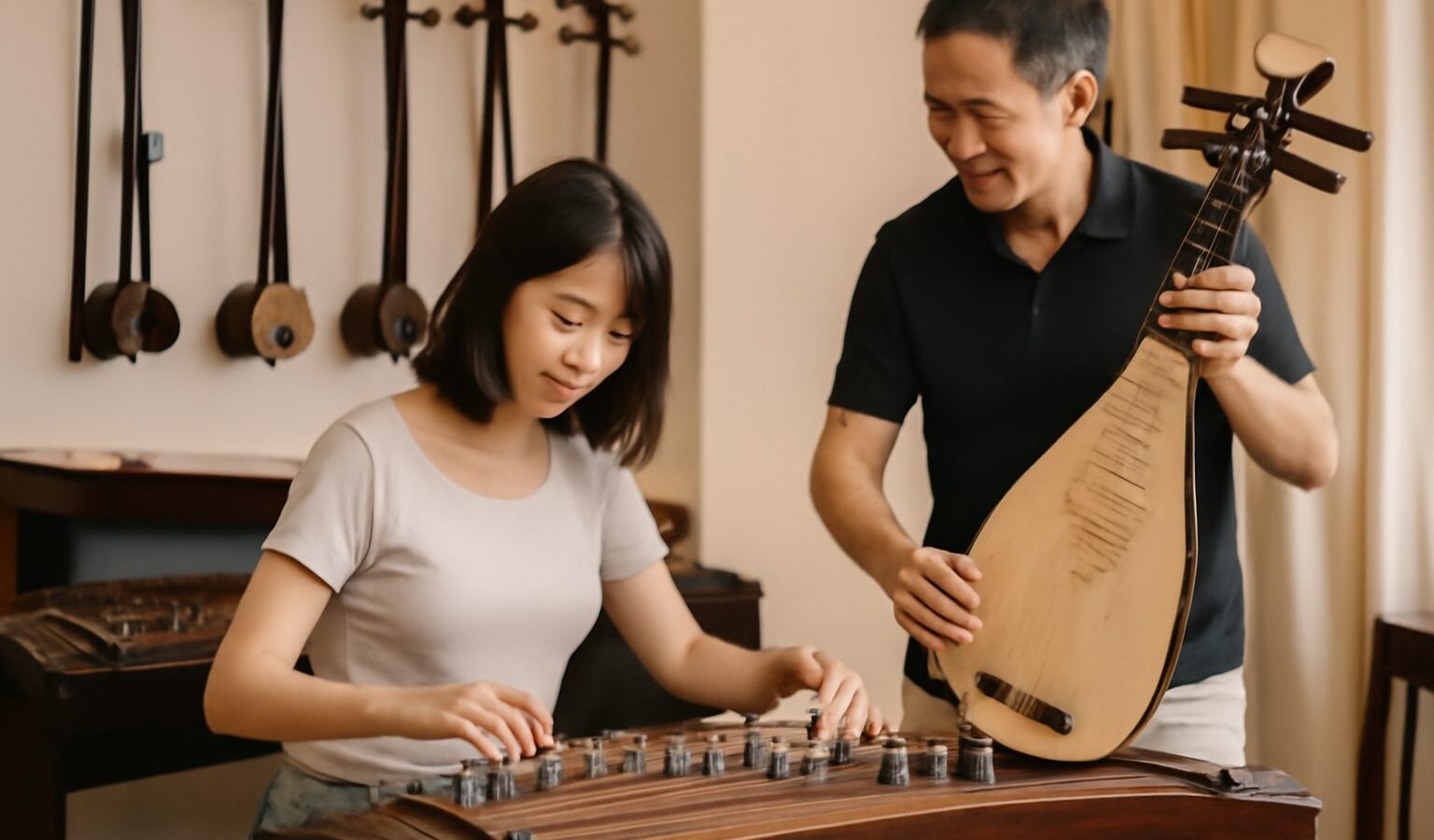
Singapore has a lively Chinese music scene. Many schools run Chinese orchestra as a co-curricular activity (CCA), community centres offer classes, and there is a full-time professional Chinese orchestra in the city. That means it is quite possible to buy Chinese instruments in Singapore, whether you want an erhu, a guzheng, a dizi or a pipa. For mainland Chinese newcomers who played back home, and for complete beginners who simply love the sound, the challenge is less about finding an instrument and more about choosing the right one for your level, budget and home.
This guide walks through the main instrument types, where to look, what to check before paying, and how to care for a wooden, silk-stringed instrument in Singapore’s humid climate.

Choosing Which Instrument to Start With
If you have not settled on an instrument yet, think about space, noise and how you like to learn. Our general guide on how to choose your first instrument covers motivation and learning style. For Chinese instruments specifically, here is how the common beginner options compare.
| Instrument | Size and portability | Noise level at home | Beginner points to note |
|---|---|---|---|
| Erhu (二胡) | Small, easy to carry | Moderate, can be piercing early on | Tricky to play in tune at first; a teacher helps a lot |
| Guzheng (古筝) | Large, usually around the length of a person | Moderate, warm tone | Needs floor space and a stand; finger picks and tape required |
| Dizi (笛子) | Very small and light | Loud, carries through walls | Needs a membrane (dimo) fitted correctly; several keys exist |
| Pipa (琵琶) | Medium, carried in a case | Moderate | Uses finger picks; technique takes time to build |
| Yangqin (扬琴) | Large and heavy | Moderate to loud | Hard to move; often played at a centre or school instead |
In HDB flats, where neighbours are close, a dizi or erhu can be noticed more than you expect. Practising at reasonable hours and using a practice mute where one exists keeps relations friendly.
Where to Buy Chinese Instruments in Singapore
There are several routes, each with trade-offs.
- Specialist Chinese instrument shops. Singapore has a handful of shops that focus on Chinese instruments, often found in older shopping centres in the city and in some heartland areas. The main advantage is that you can try instruments in person and get basic setup, strings and accessories in one place. Search online maps for “Chinese musical instruments” near you and read recent reviews.
- General music stores. Some larger music retailers carry a small range of Chinese instruments alongside Western ones, usually at the entry level.
- Teachers and orchestras. Many teachers source instruments for students or can point you to a trusted seller. If you join a community centre class or an amateur Chinese orchestra, ask fellow members for recommendations.
- Second-hand listings. Marketplace apps and community groups regularly list used guzheng and erhu, often from families whose children finished school CCA. Our guide on how to buy used musical instruments explains how to inspect a listing and meet sellers safely.
- Buying from China online. Some newcomers order directly from sellers in China. This can widen your choice, but large instruments like guzheng are costly and risky to ship, and you will not be able to try them first.
What to Check Before You Pay
Whether new or used, take a few minutes to inspect the instrument, ideally with a teacher or an experienced player beside you.
For an erhu:
– Check the snakeskin or alternative membrane for tears, looseness or bubbling.
– Turn the tuning pegs; they should hold without slipping.
– Make sure the bow hair is intact and the bow is not warped.
For a guzheng:
– Look along the soundboard for cracks or lifting, especially near the ends.
– Check that the bridges (码子) are all present and not cracked.
– Ask whether strings were replaced recently, as a full restring adds cost.
For a dizi:
– Hold it up to the light and look for cracks along the bamboo.
– Check that the membrane hole and finger holes are clean and round.
– Play a few notes, or ask the seller to, and listen for buzzing or air leaks.
For a pipa:
– Look for cracks in the soundboard and check the frets are firm.
– Make sure the tuning pegs turn smoothly.
In every case, ask what is included. A case, spare strings, finger picks, a tuner and a stand can add up if bought separately.
Snakeskin Erhu and Bringing Instruments Into Singapore
Many traditional erhu use python skin for the soundbox membrane. Python species are covered by CITES, the international agreement on trade in endangered species, and Singapore enforces it through the National Parks Board (NParks). This can affect whether you can import, export or bring certain instruments across the border, including when moving house between China and Singapore.
If you plan to ship or carry an erhu (or any instrument containing animal products such as certain skins or ivory parts) into or out of Singapore, check the current requirements with NParks and Singapore Customs before you travel. Rules and documentation needs can change, and this article is general information rather than legal advice. Some makers now offer erhu with synthetic membranes, which can be a simpler choice for beginners who expect to move countries.
Shipping and import charges may also apply to instruments bought from overseas. Check current GST and import guidance with Singapore Customs.
Caring for Instruments in Singapore’s Humidity
Chinese instruments are mostly made of wood, bamboo and natural materials, and Singapore’s year-round humidity can be hard on them.
- Avoid extremes. Do not leave instruments in direct sun, next to a window, or in a car. Sudden moves between strong air-conditioning and outdoor heat can stress wood and bamboo.
- Control moisture. A room with a dehumidifier, or moisture absorbers inside the case, helps prevent mould and swelling. Dizi players often use a small dry cabinet or keep the flute in a case with a desiccant pack.
- Watch the membrane. Erhu skins and dizi membranes react to humidity. Expect to adjust or replace the dizi membrane more often in wet weather.
- Keep it in tune. Silk and steel strings drift with temperature changes. Our guide on how to tune your instrument shows how to use a tuner app and build the habit.
- Clean gently. Wipe strings and the body with a dry, soft cloth after playing, and keep rosin dust off the erhu.
Budgeting and Next Steps for New Players
Prices for Chinese instruments vary widely depending on material, maker and condition, so compare a few options rather than buying the first one you see. As a rule of thumb, beginners do not need a top-grade instrument, but very cheap ones can be so hard to play in tune that they put people off. A mid-range student instrument, or a well-kept used one checked by a teacher, is often the sweet spot.
Before you buy, it is worth taking a few trial lessons using a teacher’s or centre’s instrument. You will learn what feels comfortable and what features matter to you. Once you have chosen, budget for strings, picks, a case and maintenance as well as the instrument itself.
With a sensible first instrument and a little care against the humidity, you will be ready to join the many players keeping Chinese music alive in Singapore.
Further reading: The Guzheng and Chinese Zither