

If you hire Work Permit or S Pass holders, the number of foreign workers you can employ depends on how many local employees you have. But not every Singaporean or PR on your payroll counts the same way. The Ministry of Manpower (MOM) uses the local qualifying salary, or LQS, to decide which local staff count towards your quota, and whether each one counts as a full or a half worker.
Many business owners only discover this when a pass application is rejected for lack of quota, even though they have local staff. This guide explains how the LQS works, how to count your local workforce correctly, and the common mistakes that shrink your quota. It is general information, not legal or professional advice. MOM sets and revises the LQS and quota rules, so always confirm current figures on MOM’s website before you plan your hiring.
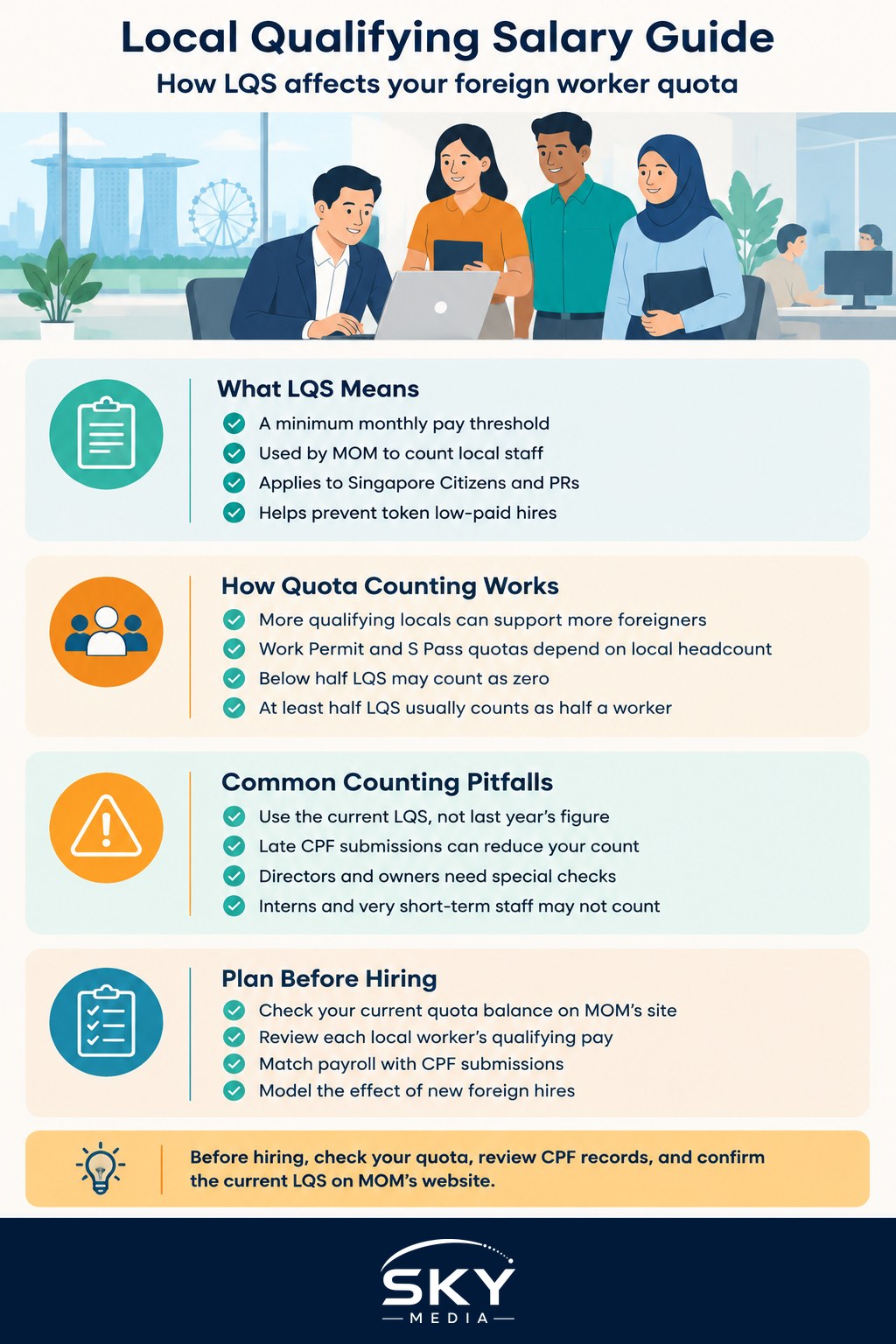
What the Local Qualifying Salary Is and Why It Exists
The LQS is a minimum monthly salary that MOM uses as a threshold. A local employee, meaning a Singapore Citizen or Permanent Resident, must be paid at least this amount to count towards your company’s foreign worker quota.
The policy has two aims. First, it stops companies from inflating their local headcount with token employees on very low pay, purely to unlock more foreign worker quota. Second, it nudges employers towards paying local workers a reasonable wage. MOM reviews the LQS periodically, usually with advance notice, so the figure you used last year may not be the one that applies today.
The LQS has also become part of Singapore’s wider wage policy. MOM has introduced rules under the progressive wage framework that expect firms hiring foreign workers to pay their local employees at least the LQS, so falling short can affect more than your quota count. These rules are separate from the sector-specific Progressive Wage Model wage floors and from the minimum qualifying salaries for S Pass and Employment Pass applicants. Check MOM’s site for how each one applies to your business.
How Foreign Worker Quotas Depend on Your Local Headcount
MOM limits how many Work Permit and S Pass holders a company can employ through a quota, often called the Dependency Ratio Ceiling (DRC) for Work Permits and a sub-ceiling for S Passes. The quota is expressed as a share of your total workforce, and the ratio differs by sector, such as services, manufacturing, construction, process and marine shipyard.
In simple terms, your total workforce is your qualifying local employees plus your foreign employees. The more qualifying locals you have, the more foreign workers you may be able to hire within your sector’s ratio. If some of your local staff do not meet the LQS, they may count as only half a worker or not at all, and your quota drops accordingly.
Employment Pass holders are not subject to these quotas, so the LQS mainly matters for businesses with Work Permit or S Pass staff, for example in food and beverage, retail, cleaning, construction and manufacturing.
How MOM Counts Local Staff Against the LQS
The core counting logic, as MOM has described it, works in bands. The table below summarises it. Check MOM’s site for the current dollar figures and any conditions that have been added.
| Local employee’s monthly pay | How they count for quota | What it means for you |
|---|---|---|
| At or above the full LQS | 1 local worker | Full quota contribution |
| At or above half the LQS, but below the full LQS | 0.5 local worker | Half the quota contribution |
| Below half the LQS | Not counted | No quota contribution at all |
| No CPF contributions recorded for the month | Not counted | Even well-paid staff can drop out |
Some practical points follow from this:
- Part-timers can still count. A part-time local earning at least half the LQS typically counts as half a worker. Two such part-timers can therefore add up to one full local in quota terms.
- CPF is the evidence. MOM generally works out your local headcount from CPF contribution records, not from your own staff list. If CPF contributions for a local employee are missing, late or wrong, that person may not count for that period. Our guide to CPF for employers explains how contributions are calculated and submitted.
- Averaging over months. MOM has typically looked at your local workforce over a recent period rather than a single day. A sudden hiring spree right before a pass application may not immediately show up in your quota.
- Pay means the qualifying wages MOM specifies. What counts towards the LQS, for example whether certain allowances or bonuses are included, is defined by MOM. Do not assume that every payment in a payslip counts.
Common Mistakes That Quietly Reduce Your Quota
Quota shortfalls are often self-inflicted. These are the issues that catch small employers most often:
- Using an outdated LQS figure. When MOM raises the LQS, local staff who sat just above the old threshold can fall into the half-worker band overnight. Review your payroll whenever an increase is announced.
- Late CPF submissions. If contributions are not submitted on time, MOM’s records may show fewer qualifying locals than you actually employ.
- Counting directors and shareholders automatically. Company directors and owners are treated differently depending on how they are paid and whether CPF is contributed. Check MOM’s guidance before counting them.
- Assuming every local counts. Interns, very short-term staff and locals paid below half the LQS may not count at all.
- Ignoring your sector classification. Your sector determines your ratios. If your business activity has changed, make sure your classification still reflects what you actually do.
MOM has also acted against companies that create phantom local employees, meaning people on the payroll who do no real work, just to inflate quota. This is an offence under the Employment of Foreign Manpower Act, with serious penalties for the company and the individuals involved. Only count genuine employees doing real work.
How to Check and Plan Your Quota Before Hiring
Before you apply for a new Work Permit or S Pass, take these steps:
- Check your current quota balance. MOM provides an online quota and levy check through its employer services, which shows how many more Work Permit or S Pass holders you can hire. You will need your CorpPass access.
- Review local salaries against the current LQS. List each local employee’s qualifying monthly pay and mark which band they fall into.
- Confirm CPF records are clean. Reconcile your payroll with CPF submissions so that every qualifying local appears correctly.
- Model the effect of new hires. If you plan to bring in a new foreign worker, work out whether you have enough qualifying locals to support the ratio, and remember that levies also apply. Your levy rate can depend on how close you are to the quota ceiling.
- Plan for LQS increases. When MOM announces a future increase, budget for raising local pay where needed, rather than losing quota once the new figure takes effect.
If you are building your team from scratch, our guide on hiring employees in Singapore covers the wider steps, and the Employment Act for employers explains your obligations to staff once they join.
Where to Get Authoritative Answers
The LQS and quota framework involve several moving parts: sector ratios, levy tiers, qualifying wages and CPF-based counting. All are set by MOM and can change with Budget announcements or policy reviews. For definitive answers:
- Read the “Work Permit for foreign worker” and “S Pass” sections on the MOM website, which explain the quota and levy rules for each sector.
- Use MOM’s online quota and levy check rather than estimating by hand.
- Check the CPF Board site for contribution rules and deadlines.
- For complex cases, such as group companies or restructured businesses, consider speaking to a qualified HR consultant or contacting MOM directly.
Getting the local qualifying salary right is one of the simplest ways to protect your ability to hire. Pay your local staff at or above the threshold, keep CPF records accurate, and recheck your numbers whenever MOM updates its figures.
Official sources: Ministry of Manpower (MOM)
Further reading: How Employers Should Respond to a TADM Salary Claim