
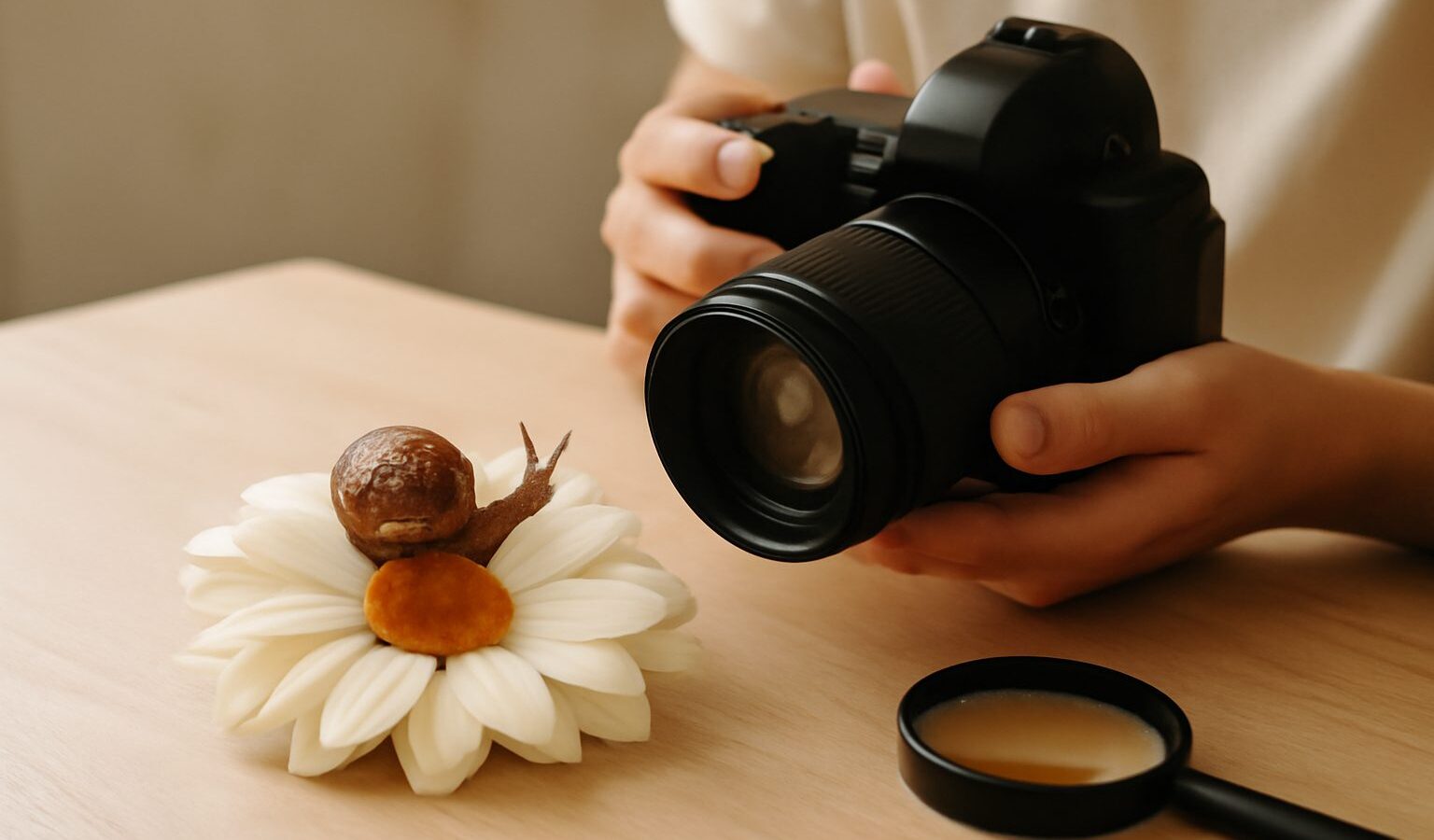
There is a whole world living below our usual eye level: the dew on a leaf after a morning shower, the pattern on a beetle’s back, the crystals of sugar on a kaya toast. Macro photography is the art of getting close enough to reveal that hidden detail, filling the frame with something most people walk right past. It looks technical, but the core ideas are simple, and Singapore’s gardens, parks and even your kitchen table give you endless subjects. This beginner guide shows you what to shoot, how to get sharp, and how to make the tiny look spectacular.
Macro simply means photographing small subjects at high magnification, so they appear life size or larger in your image. You do not need exotic kit to start; you need patience, good light and a steady hand.
What Macro Photography Actually Is
True macro means reproducing a subject at roughly life size on your sensor, but for a beginner the spirit matters more than the strict definition. If you are getting close and revealing detail the naked eye misses, you are doing macro in the way that counts.
You can begin with several approaches, and it is worth understanding the trade-offs before spending money:
- A dedicated macro lens gives the best quality and lets you focus very close, but it is an investment.
- Clip-on macro lenses for phones are cheap, fun and surprisingly capable for flowers and food.
- Extension tubes sit between your camera body and an existing lens to let it focus closer, at a low cost.
- Close-up filters screw onto the front of a lens like a magnifying glass, the most budget-friendly option of all.
Gear and prices change quickly, so check current options and reviews before buying. The good news is that most modern phones have a decent close-up or dedicated macro mode, so you can learn the skills today with what is already in your pocket.
Master Focus and Depth of Field
The single biggest surprise in macro is how little of the scene stays sharp. The closer you get, the shallower your depth of field becomes, until only a sliver of the subject is in focus while the rest melts away. This is both the beauty and the challenge of macro.
Two things help you control it:
- Use a smaller aperture, meaning a larger f-number such as f/8 or f/11, to keep more of the subject sharp. Go too far and images can soften, so experiment to find your lens’s sweet spot.
- Focus manually where you can. Autofocus hunts badly this close, so many macro shooters switch to manual focus, set the magnification they want, then gently rock the camera back and forth until the key detail snaps sharp.
Aim your focus at the most important part of the subject. For an insect, that is almost always the eyes; for a flower, the stamen or the nearest petal edge. When a single frame cannot hold enough in focus, advanced shooters use focus stacking, taking several photos focused at different distances and blending them later, but that is a technique to grow into rather than a starting point.
Light the Tiny World
Because you are working so close, your own camera and hands can cast shadows over the subject, and small movements of light make a big difference. Soft, even light flatters most macro subjects.
Natural light is the easiest place to start. An overcast Singapore sky acts like a giant softbox, wrapping subjects in gentle light with no harsh shadows, which is perfect for flowers and leaves. Bright direct midday sun creates hard shadows and blown-out highlights, so shoot in open shade or early in the day. A simple white card or even a piece of paper held opposite the light bounces a little fill back into the shadows, and a translucent sheet can soften a harsh beam.
For food macro at home, place your subject near a window with the light coming from the side to bring out texture, whether that is the glisten of chilli crab sauce or the flake of a curry puff. Side light reveals surface and depth far better than flat front light.
Steady Your Shot and Stay Sharp
At high magnification, the smallest wobble turns a crisp image into mush, because camera shake is magnified just as much as your subject. Keeping everything still is often the difference between a keeper and a blur.
| Challenge | Quick fix | When to use it |
|---|---|---|
| Camera shake | Use a tripod or brace on a firm surface | Static subjects like flowers and objects |
| Shallow focus | Close the aperture and refocus carefully | Any close-up needing more sharpness |
| Subject movement | Raise shutter speed and wait for a lull | Insects and outdoor shots in a breeze |
| Dim light | Add light or raise ISO a little | Indoor food and shaded subjects |
A few more habits help. Use a two-second timer or a remote so pressing the button does not jog the camera. Shoot at a faster shutter speed when handholding, and take several frames of the same subject, since one is usually sharper than the rest. Outdoors, our afternoon breeze is the enemy of flower shots, so wait for a still moment or gently shield the subject.
Find Subjects Around Singapore
You are surrounded by macro subjects once you start looking. The Botanic Gardens and HortPark are full of flowers, leaf veins and water droplets, especially just after rain. Neighbourhood parks and even the plants along an HDB corridor hide spiders, ants and beetles if you look patiently. Your kitchen offers spices, coffee beans, the bubbles in a teh tarik and the texture of local kueh.
When photographing living creatures, move slowly and keep your distance until you have your settings ready, then approach gently. Do not trap, chill or harm insects for a photo, and never damage plants to get a cleaner shot. Leave the scene as you found it. The reward of macro is learning to notice, and the more you slow down and observe, the more this tiny, overlooked world opens up to your lens.
Explore more
Keep building your close-up skills with our guide to using natural light in photography, which pairs perfectly with macro work. To arrange your tiny subjects more powerfully in the frame, read the rule of thirds and composition basics. For a different kind of patience and quick reflexes, try how to photograph pets and kids.