

New motherhood can be surprisingly lonely. Your old friends may be at work or not yet parents, your days revolve around feeds and naps, and if you have recently moved here, you might not know anyone in your block at all. Knowing how to make mum friends in Singapore is less about luck and more about putting yourself in the right places, regularly, and being willing to make the first small move.
This guide covers where new mums tend to meet, how to turn a friendly chat at a playgroup into an actual friendship, and how to keep those connections going when everyone’s schedule is unpredictable. It focuses on friendship rather than formal support groups, and works whether you are a first-time mum, a new arrival, or a mum returning to work.
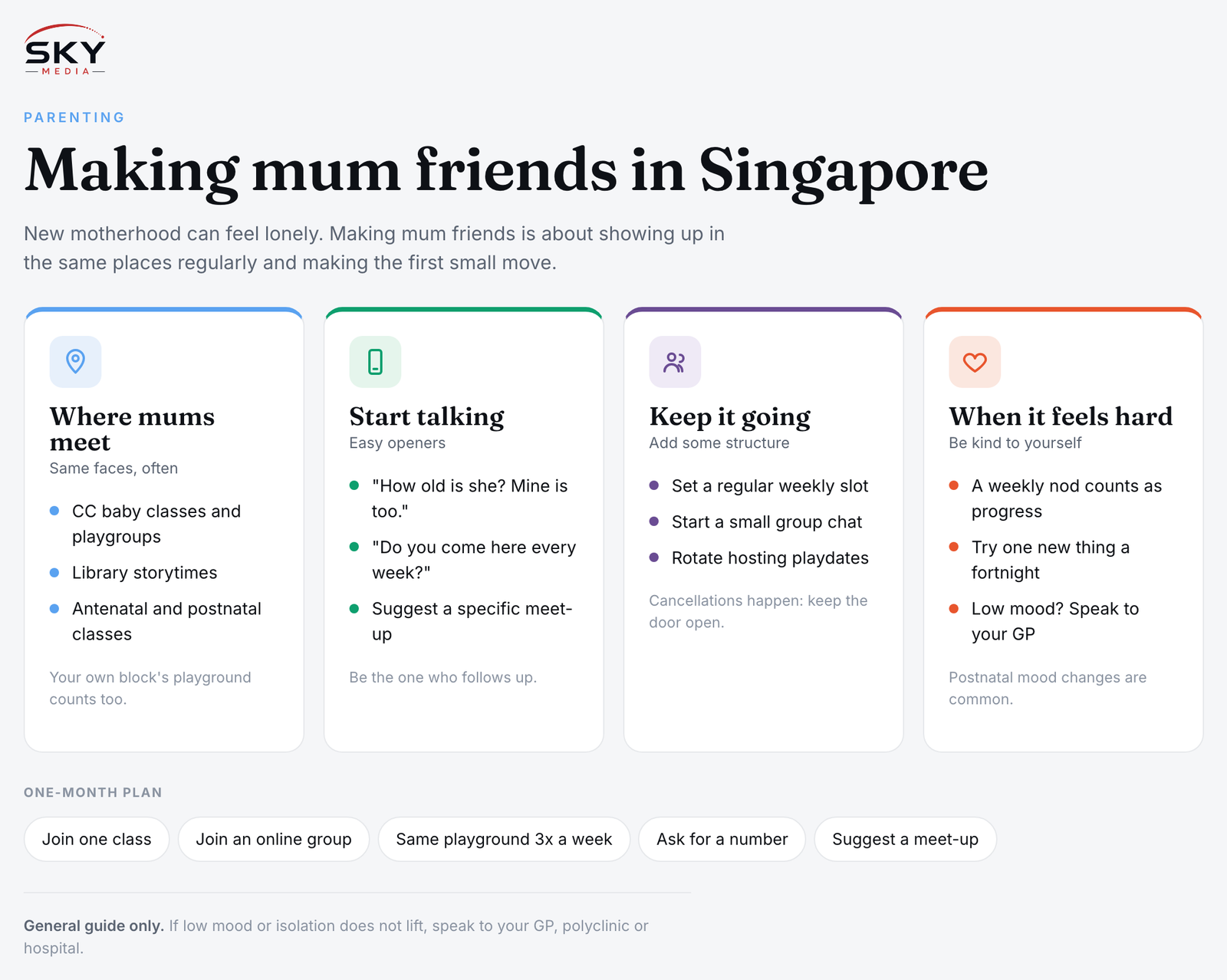
Why Mum Friends Matter (and Why It Feels Awkward)
Friends who have babies around the same age as yours understand things others may not: the 3am wake-ups, the weaning dilemmas, the guilt about screen time. A mum friend can be someone to walk with at the park, swap tips with, or simply message when the day has been long.
It often feels awkward because adult friendships rarely form by accident. School and work used to do the work of putting you next to the same people every day. With a baby, you have to recreate that repetition yourself. The good news is that many other mums feel exactly the same way and are quietly hoping someone will say hello first. For broader ideas on building adult friendships, see how to make friends as an adult.
Where New Mums Meet in Singapore
The best places share one feature: you see the same faces more than once.
| Where | What to expect | Good for |
|---|---|---|
| Community centre (CC) classes | Baby massage, music and movement, or toddler play sessions run through your local CC; booked via the People’s Association channels | Meeting mums who live nearby |
| Playgroups and drop-in play sessions | Regular sessions at libraries, churches, temples, community spaces or private play centres | Toddlers and repeat contact with the same families |
| Library storytimes | Free or low-cost sessions for babies and young children at public libraries; check the National Library Board for schedules | Low-pressure, quiet mums and bookish kids |
| Antenatal and postnatal classes | Classes run by hospitals and private providers before and after birth | Mums with babies of the exact same age |
| Online groups and apps | Neighbourhood and estate chat groups, mum communities on social platforms, and friend-finding apps | Finding people nearby before meeting in person |
| Parks and playgrounds | Regular weekday mornings or late afternoons when it is cooler | Casual chats that can grow over time |
A few more places worth trying:
– Your own block or estate. Void decks, estate playgrounds and condo pools are full of parents and helpers at predictable times. Becoming a familiar face here is often the easiest route to a local friend.
– Interest-based classes. Pram walking groups, postnatal fitness classes and mum-and-baby swimming give you a shared activity to talk about.
– Faith and cultural communities. Many religious and cultural groups run family activities and parent fellowship sessions.
– Your child’s first school. Infant care, preschool and kindergarten bring daily drop-offs and parent chat groups, which can turn into lasting friendships.
If you are a newcomer, check community groups linked to your home country or language as well as local ones. Mixing both gives you people who understand where you came from and people who know how things work here. Our guide on making friends in Singapore as a newcomer has more ideas beyond parenting circles.
How to Start the Conversation
Most mum friendships begin with something small. Babies are an easy opener because every parent likes talking about theirs.
Simple openers that work:
– “How old is she? Mine is about the same.”
– “Do you come to this session every week?”
– “Have you tried the other playground at the next block? Is it shaded?”
– “Any tips for getting him to nap outside? Mine refuses.”
Then look for a natural next step. If you have chatted a couple of times, it is completely normal to say, “Shall we swap numbers? I’m usually here on Tuesdays.” Suggest something specific and easy, such as a walk after class or coffee at the nearby hawker centre, rather than a vague “we should meet up sometime”.
Some gentle tips:
– Be the one who follows up. Send a short message after you meet. Most people are pleased to be asked.
– Keep the first meet-ups short. An hour at a playground or mall play area is manageable with a baby and takes the pressure off.
– Share a little honesty. Admitting that you are tired, or that the first months are harder than you expected, often makes the conversation real faster than polite small talk.
– Do not take silence personally. Mums are busy and messages get buried. Try again once before moving on.
Keeping Mum Friendships Going
Friendships with young children need a bit of structure, because spontaneity is hard when nap times rule your day.
- Set a regular slot. A standing weekly walk or a fortnightly playdate is easier to keep than arranging each meeting from scratch.
- Start a small group chat. Three or four mums who met at the same class can share plans, outgrown clothes and recommendations.
- Rotate hosting. Short playdates at each other’s homes are relaxed and air-conditioned on hot afternoons. Agree on simple rules about snacks and screens.
- Keep it flexible. Cancellations happen when babies fall ill. A friendly “no worries, next week?” keeps the door open.
- Include partners sometimes. Weekend family meet-ups can widen the circle and give everyone a break.
As children grow and start making their own friends, these relationships often shift. Our guide to helping your child make friends covers that next stage.
When It Feels Hard
Some mums find it harder to connect, whether because of postnatal exhaustion, a language barrier, shyness, or a baby who needs extra care. That is normal, and it does not mean you are doing anything wrong.
- Lower the bar. A friendly nod each week at the same class counts as progress.
- Try one new thing a fortnight. Steady, small steps beat forcing yourself into many events at once.
- Look after yourself first. If low mood, anxiety or isolation feels heavy or does not lift, speak to your GP, polyclinic or the hospital where you delivered. Postnatal mood changes are common and support is available.
A Simple Plan to Get Started
If you want to make mum friends in Singapore but are not sure where to begin, try this over the next month:
- Sign up for one recurring class near home, such as a CC baby session or library storytime.
- Join one local online parents’ group for your estate or area.
- Visit the same playground at the same time three times a week.
- Ask one mum for her number, and suggest one specific meet-up.
Friendship takes repetition and a little courage, but almost every mum you meet is looking for the same thing. Saying hello first might be the start of a friendship that lasts well beyond the baby years.
Frequently Asked Questions
How can I make mum friends if I work full-time? Use the times you are already out and about: weekend classes, playgrounds near home, library storytimes, and your child’s infant care or preschool pick-ups. A local online parents’ group can keep you in touch between meetings. Suggest short, specific plans, such as a Saturday walk.
Are online mum groups safe to join? Most are fine, but treat them like any public group. Avoid posting your home address, your child’s full name or school, and be careful about who you meet alone. Meet new contacts first in a public place such as a playground or hawker centre.
What if my new mum friends have different parenting styles? That is common and rarely ends a friendship. Many mums choose to avoid arguing about feeding, sleep or screen time and focus on what you enjoy together. If a comment feels judgemental, a polite change of subject works, and you can see that friend in smaller doses.
Is it too early to join baby classes when my baby is very young? It depends on the class and your baby, so check the age range with the provider and ask your doctor if you are unsure, particularly after a difficult birth. Many antenatal and postnatal classes are designed for newborns and are a good way to meet mums with babies the same age.