
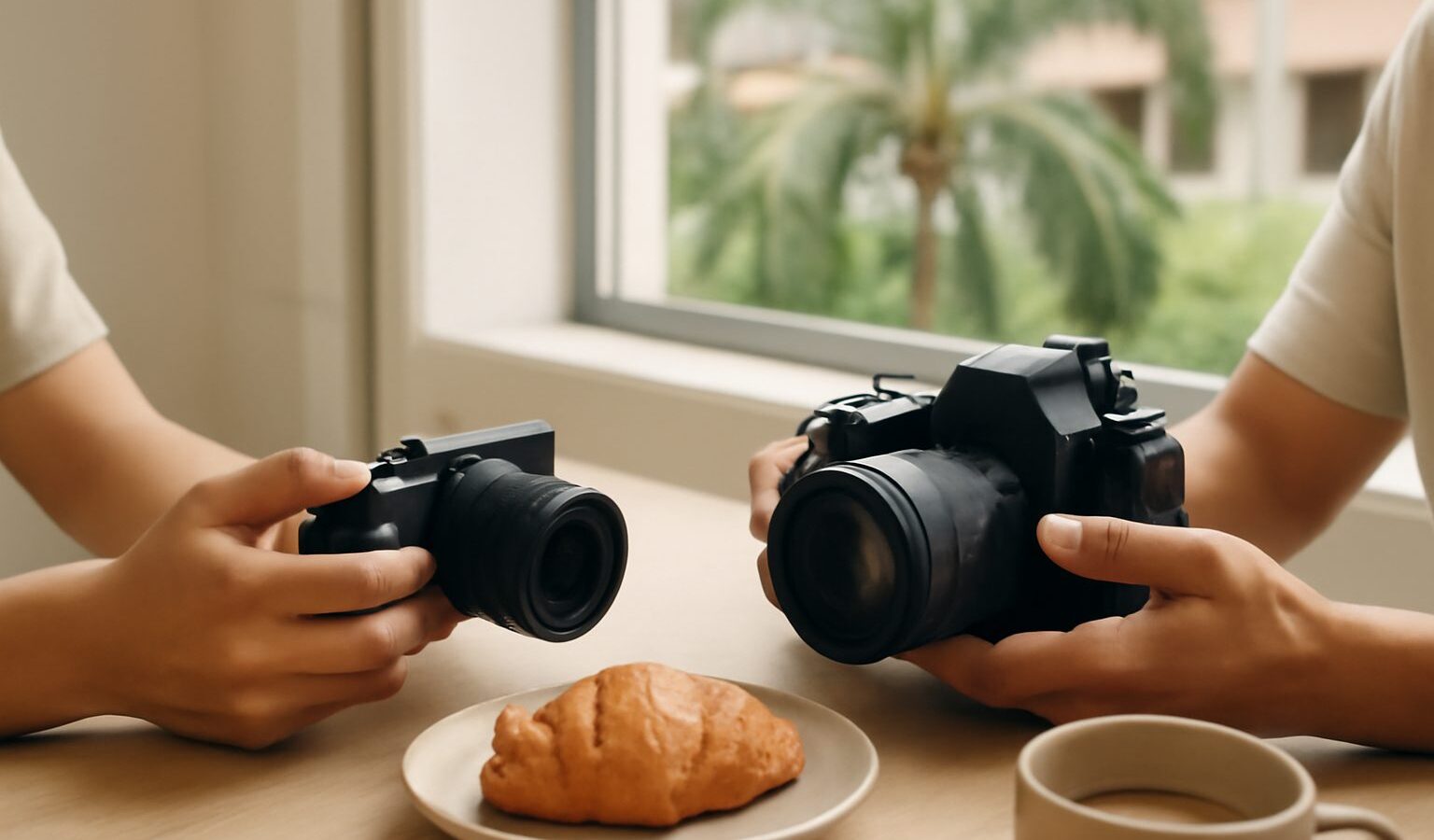
If you are shopping for your first proper camera, the mirrorless vs DSLR question comes up almost immediately, and it can feel weightier than it really is. Both are excellent tools that let you change lenses and take full control of your images. The honest answer is that either can serve a beginner beautifully. What matters is understanding the practical differences so you buy the one that fits how you shoot.
This guide compares the two in plain language, grounded in everyday Singapore use, from walks along the Marina Bay waterfront to family shots in an HDB flat. We will keep gear talk generic, because specific models, specs and prices change fast. Once you know which type suits you, check current options and prices before you commit.
What Actually Differs
The core difference is simple. A DSLR uses a mirror and a prism to bounce light up into an optical viewfinder, so you see the scene directly through the lens with your eye. A mirrorless camera removes that mirror. Light hits the sensor directly, and you compose using either the rear screen or a small electronic screen inside the viewfinder that shows a live preview.
That one design choice ripples out into size, handling and shooting experience. It does not make one type better overall. It makes them feel different, and it changes which is easier to live with day to day.
Image quality between comparable cameras is broadly similar. A modern mirrorless and a modern DSLR at the same level will both produce lovely photos. So do not agonise over sharpness or resolution when deciding. Focus instead on the practical factors below.
Size, Handling and Everyday Carry
Because mirrorless bodies have no mirror box, they are usually smaller and lighter, though not always by a lot once you add a decent lens. If you plan to carry your camera all day around Chinatown or on the MRT, that saved weight and bulk genuinely matters. A lighter kit is one you actually bring along, and the best camera is the one you have with you.
DSLRs tend to be chunkier, which some people dislike and others love. A larger body with a deep grip can feel more secure in bigger hands, and the heft can steady your shots. If comfort in the hand matters most to you, hold both types in a shop before deciding.
- Choose smaller and lighter if travel, street photography or all-day carry is your priority.
- Choose a bigger grip if you find small cameras fiddly or you shoot with larger lenses often.
Autofocus, Viewfinder and the Shooting Experience
This is where the two feel most different in practice.
An optical viewfinder on a DSLR shows the real scene with zero lag and no battery drain from the finder itself. Some photographers simply prefer that natural, direct view. The trade-off is that what you see is not exactly what the sensor will capture, so you judge exposure only after taking the shot or by checking the screen.
An electronic viewfinder on a mirrorless camera previews your actual exposure, colour and depth of field before you press the shutter. For a beginner learning how settings affect an image, this live feedback is a real teaching aid. You can see a photo getting brighter or darker as you adjust, which shortens the learning curve. The trade-offs are a slight lag in some situations and more battery use.
Autofocus has swung towards mirrorless in recent years. Because a mirrorless camera focuses using the main sensor, it often excels at tracking eyes and faces across the whole frame, which helps with portraits and lively kids. Many DSLRs focus superbly through the viewfinder too, but can be weaker when using the rear screen. If you expect to shoot a lot of video or use the screen to compose, mirrorless usually feels more modern here.
Lenses, Battery and Long-Term Cost
A camera body is only the start. The lenses you buy over the years often cost more than the body and shape your results far more.
DSLRs have been around longer, so there is a huge pool of lenses, including affordable used ones. If a friend or family member already owns DSLR lenses you could inherit or borrow, that tips the scales. Mirrorless systems are newer, with rapidly growing native lens ranges, and you can often adapt older lenses with an adapter, though autofocus may be slower when you do.
Battery life is a common mirrorless weak point. Powering the sensor and electronic viewfinder all the time drains batteries faster, so plan to carry spares. DSLRs, resting on an optical viewfinder, tend to last far longer per charge, which is handy on a full day out with no chance to recharge.
On price, both types span budget to professional. Entry-level cameras of either kind are capable and affordable. New development and the latest features increasingly land on mirrorless first, while DSLR bargains, especially used, can stretch a tight budget further.
Mirrorless vs DSLR at a Glance
Here is a quick side-by-side to summarise the trade-offs. Treat it as a starting point, then check current models and prices before buying.
| Factor | Mirrorless | DSLR |
|---|---|---|
| Size and weight | Usually smaller and lighter | Usually larger, deeper grip |
| Viewfinder | Electronic, previews exposure live | Optical, direct and lag-free |
| Autofocus on screen and video | Generally stronger | Often weaker on rear screen |
| Battery life | Shorter, carry spares | Longer per charge |
| Lens availability | Growing fast, adapters possible | Very large, many cheap used options |
| Where new tech lands | First | Slower to update |
So Which Should You Buy
For most beginners buying new today, a mirrorless camera is the more future-proof choice. It is lighter to carry around Singapore, its live viewfinder helps you learn, its autofocus suits video and portraits, and manufacturers are focusing their newest features there. Just budget for a spare battery or two.
A DSLR still makes strong sense in a few cases: if you can inherit or buy DSLR lenses cheaply, if you love a big optical viewfinder and a chunky grip, or if you want the most camera for the least money on the used market. There is nothing outdated about taking wonderful photos with one.
Whichever way the mirrorless vs DSLR decision goes, hold both in your hands first if you can, buy within your budget, and remember that lenses, light and practice will improve your photos far more than the body you start with.
Explore more
Not sure where to begin at all? Start with choosing your first camera in Singapore, then plan your kit with our guide to essential camera accessories for beginners. When you are ready to think about glass, understanding camera lenses, prime vs zoom is the natural next read.